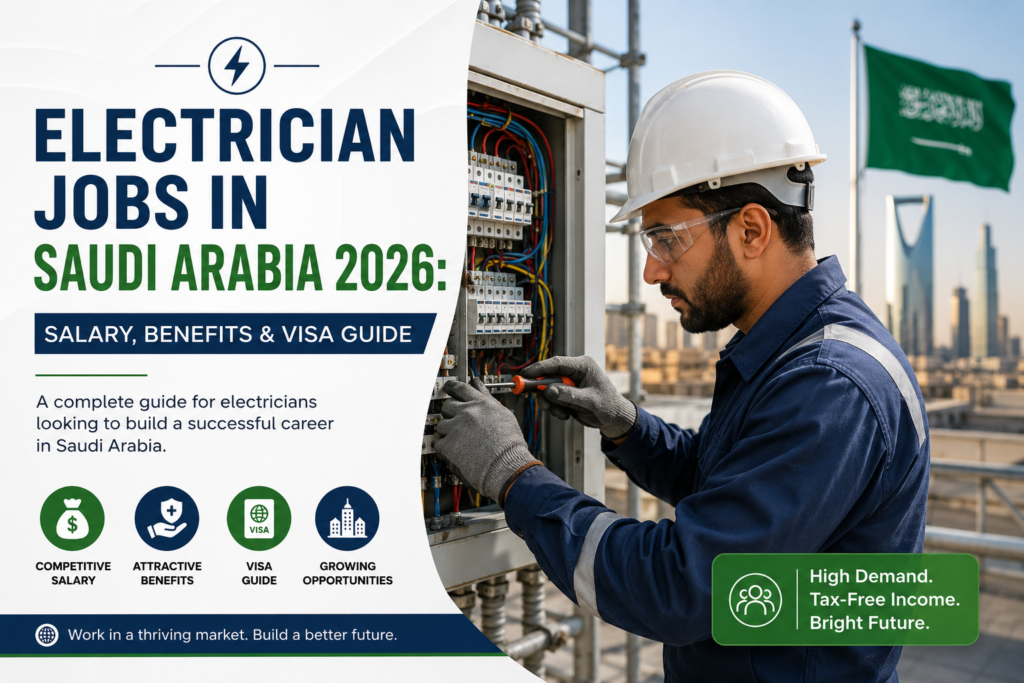

Whether you are a licensed electrician from India, the Philippines, Egypt, Pakistan, or anywhere else in the world, Saudi Arabia offers a package that is hard to match — tax-free salaries, free accommodation, and a direct pathway to stable long-term employment. This guide walks you through everything you need to know before you apply: salary benchmarks, job types, visa requirements, top employers, and where to find verified openings.
Why Electrician Jobs in Saudi Arabia Are in Demand in 2026

The scale of construction and industrial activity underway across Saudi Arabia in 2026 is genuinely unprecedented. The government’s Vision 2030 reform agenda has triggered a wave of spending that touches almost every sector — and all of it needs electrical infrastructure.
Several major drivers are pushing demand for skilled electricians higher than ever before:
- Vision 2030 mega-projects: NEOM, the Red Sea Project, Qiddiya, and ROSHN are collectively among the largest construction programmes ever undertaken. Each requires massive electrical installation and maintenance workforces.
- Renewable energy expansion: Saudi Arabia has committed to generating 50% of its electricity from renewables by 2030. Enormous solar and wind farms are under active construction, creating strong demand for solar electricians and high-voltage specialists.
- Industrial growth: SABIC’s petrochemical plants, Saudi Aramco’s upstream and downstream operations, and dozens of new manufacturing zones all rely on industrial electricians for ongoing operations.
- Smart city infrastructure: Projects like NEOM’s THE LINE require advanced smart building electrical systems, driving demand for electricians with IoT, automation, and BMS experience.
- Hospitality and real estate boom: Thousands of new hotels, residential complexes, and commercial towers are under construction across Riyadh, Jeddah, and the Eastern Province.
“Saudi Arabia’s construction sector is on a multi-decade growth trajectory. Electricians who position themselves now can benefit from a decade of consistent demand.”
Types of Electrician Jobs in Saudi Arabia
See also: Dubai Electrician Jobs in UAE 2026 Dubai & Abu Dhabi Hiring Now
Electrician Jobs in Holland: Requirements, Salary, Visa Sponsorship & Relocation Guide 2026
The Saudi market is not one-size-fits-all for electricians. Different projects demand different specialisations, and understanding which category fits your background is the first step to finding the right role.
Industrial Electrician Jobs in Saudi Arabia
Industrial electricians work in oil refineries, petrochemical plants, desalination facilities, and manufacturing complexes. These roles typically involve installing and maintaining high-power electrical systems, motor control centres, switchgear, and industrial automation equipment. Saudi Aramco, SABIC, and Ma’aden are among the biggest employers in this category. Experience with PLCs and SCADA systems gives candidates a significant advantage.
Construction Electrician Jobs in Saudi Arabia
This is the highest-volume category by far in 2026, driven by the mega-project pipeline. Construction electricians install wiring, conduit, panels, and lighting systems in new residential, commercial, and infrastructure projects. Roles are available at every level — from junior wiremen to senior electrical foremen. Most large contracting companies are actively hiring in Riyadh, Jeddah, and the Eastern Province.
Maintenance Electrician Jobs in Saudi Arabia
Maintenance electricians keep existing facilities running safely and efficiently. They are employed in hospitals, hotels, shopping malls, government buildings, and industrial plants. These positions are often residential (on-site accommodation provided) and tend to offer stable, long-term contracts. Strong troubleshooting skills and familiarity with preventive maintenance systems are key for this role type.
High Voltage Electrician Jobs in Saudi Arabia
High voltage specialists work on transmission lines, substations, and power distribution infrastructure managed primarily by the Saudi Electricity Company (SEC) and its contractors. These roles command above-average pay and require specific certifications in HV switching and safety procedures. The expansion of the national grid to support new cities and renewable energy sources is creating sustained demand here.
Solar and Renewable Energy Electrician Jobs in Saudi Arabia
This is the fastest-growing niche in the Saudi electrician market. Projects like the 1.5 GW Al-Shuaibah solar plant and the Neom Green Hydrogen project are part of a portfolio of renewable developments that need electricians skilled in PV system installation, DC wiring, inverter management, and grid connection. Candidates with formal solar PV certifications — such as NABCEP or equivalent — are in particularly high demand.
Electrician Jobs in Saudi Arabia Salary Structure 2026
Salaries for electricians in Saudi Arabia vary by experience, specialisation, and employer type. The figures below represent market-wide estimates drawn from multiple compensation data sources as of early 2026. All salaries are tax-free under Saudi labour law.
| Role Level | Monthly (SAR) | Annual (SAR) | Notes |
|---|---|---|---|
| Entry-Level Electrician (0–3 yrs) | 2,500 – 4,500 | 30,000 – 54,000 | Often includes accommodation & transport package |
| Mid-Level Electrician (3–7 yrs) | 4,500 – 8,000 | 54,000 – 96,000 | Broader responsibility; eligible for overtime |
| Senior Electrician (7+ yrs) | 8,000 – 14,000 | 96,000 – 168,000 | Supervisory tasks; higher bonus potential |
| Industrial Electrician | 7,000 – 13,000 | 84,000 – 156,000 | Oil & gas, petrochemical, manufacturing |
| Electrical Supervisor / Foreman | 10,000 – 18,000 | 120,000 – 216,000 | Team leadership; often annual air ticket included |
Overtime is a meaningful component of total earnings for many electricians in Saudi Arabia. The Saudi Labour Law specifies overtime pay at a minimum of 150% of the regular hourly rate for hours worked beyond the standard 48-hour week, and 200% for work on public holidays. In project-intensive environments, electricians regularly earn an additional 15–25% above their basic salary from overtime alone.
Benefits Offered to Electricians in Saudi Arabia
The compensation package for expatriate electricians in Saudi Arabia typically goes well beyond the base salary. Most formal employment contracts — especially with large companies and government-linked contractors — include a comprehensive set of additional benefits.
- Tax-free salary: Saudi Arabia does not levy personal income tax on employees, meaning your entire gross salary is your take-home pay. This is one of the most significant financial advantages of working in the Kingdom.
- Free accommodation: The majority of blue-collar and technical roles include employer-provided housing, either on-site (especially for industrial and project work) or an allowance to cover rental costs in the city.
- Transportation: Many employers provide company buses or a monthly transport allowance, particularly for site-based roles. This removes a significant day-to-day expense for expatriate workers.
- Medical insurance: Saudi law requires all employers to provide health coverage for expatriate employees. Coverage quality varies by employer, but most large contractors offer comprehensive inpatient and outpatient plans.
- Annual paid leave: Under Saudi Labour Law, employees are entitled to a minimum of 21 days of paid annual leave (rising to 30 days after five years of service).
- Annual flight ticket: Most expatriate employment contracts include one return flight ticket to the employee’s home country per year, either as a direct provision or a reimbursement.
- End-of-service benefits: Employees who complete at least two years of service are entitled to an end-of-service gratuity — equivalent to half a month’s salary per year for the first five years, and one month’s salary per year thereafter. This can represent a substantial lump sum for long-serving workers.
- Overtime pay: As noted above, overtime is legally protected at 1.5x the regular rate, and employers in high-activity project environments often build overtime into the expected earnings structure.
Saudi Arabia Work Visa Requirements for Electricians
Securing a work visa for Saudi Arabia requires your employer to initiate the process from within the Kingdom. As an applicant, your role is primarily to gather the required documents and pass the necessary health checks. Here is a step-by-step overview.
Required Documents
- Valid passport (minimum 6 months’ validity beyond your expected stay)
- Signed employment contract from a Saudi-registered company
- Educational and trade qualification certificates (attested)
- Experience letters and reference documents
- Valid police clearance certificate from your home country
- Recent passport-size photographs (white background)
- Completed visa application form
Medical Examination Requirements
All expatriate workers must pass a medical fitness examination at an approved centre before their visa is issued. The examination includes tests for tuberculosis, HIV, Hepatitis B and C, and other communicable diseases. Most countries have government-approved medical centres that conduct these tests specifically for Gulf employment purposes. You should schedule this as early as possible, as processing times vary.
Employment Contract Verification
Your employment contract should be verified and attested through official channels. Saudi Arabia participates in the Musaned system for domestic workers and has formal requirements for contract attestation through Saudi embassies or through MOFA (the Ministry of Foreign Affairs). Your recruiter or employer should guide you through this step — but ensure you read and understand all contract terms before signing.
Work Permit Process
Once you arrive in Saudi Arabia, your employer applies for your Iqama (residency permit) on your behalf. The Iqama serves as your national identification for the duration of your stay and must be renewed annually. Your employer typically covers the cost of Iqama issuance and renewal under standard contract terms, though you should confirm this before accepting any offer. The entire process — from job offer to Iqama issuance — typically takes between four and eight weeks.
Qualifications and Skills Needed for Electrician Jobs in Saudi Arabia
Saudi employers set clear minimum standards for electricians, particularly for industrial and high-voltage roles. Here is what most companies will look for:
Trade Certifications
City & Guilds, NPTC, NVQ, TESDA electrical certifications, or national equivalents are widely recognised in the Saudi market.
Electrical Safety Training
OSHA 10/30, NEBOSH, or equivalent safety certificates are expected for industrial and construction site roles.
Experience
Most roles require a minimum of 2–5 years of relevant hands-on experience. Senior and supervisory roles require 7+ years.
Technical Skills
Blueprint reading, conduit installation, panel wiring, PLC/SCADA familiarity, and fault diagnosis are core competencies.
Solar / HV Specialisation
NABCEP (solar), HV switching certificates, or IEC 60364 knowledge adds significant value for specialist roles.
English Proficiency
Basic to intermediate English is required for most technical roles, as site documentation and safety briefings are typically in English.
How to Apply for Electrician Jobs in Saudi Arabia
The best strategy is to use multiple verified platforms simultaneously and to tailor your CV for each application. Use a clean, skills-forward format that highlights your certifications, years of experience, and key projects. Below are the most reliable job search platforms for electrician roles in Saudi Arabia.
LinkedIn Jobs
Bayt.com
Naukri Gulf
GulfTalent
Indeed
SaudiJobs.sa
When applying, always include a cover letter that explicitly mentions the role title and the specific certifications you hold. Recruiters scanning large volumes of applications will prioritise candidates whose documents are immediately clear and complete.
Top Saudi Arabian Companies Hiring Electricians
These are the organisations most consistently seeking qualified electricians in Saudi Arabia in 2026. Some hire directly; others recruit through approved manpower agencies.
Saudi Aramco
SABIC
Saudi Electricity Company (SEC)
NESMA & Partners
Alfanar Group
Saudi Binladin Group
Common Interview Questions for Electrician Jobs in Saudi Arabia
Preparing for technical and behavioural questions before your interview significantly improves your chances. Here are the questions that come up most often — along with notes on what a strong answer looks like.
Walk me through your experience with electrical installation and panel wiring.
How do you troubleshoot a tripping circuit breaker?
What safety procedures do you follow before working on live or high-voltage equipment?
Can you read and interpret electrical schematics and single-line diagrams?
Have you worked in an industrial or oil and gas environment before?
Tips to Increase Your Chances of Getting Electrician Jobs in Saudi Arabia
Actionable Advice for International Applicants
- Get your certificates attested early. Document attestation (home country, then Saudi embassy) can take several weeks. Start this process before you even begin applying, so it does not delay a job offer.
- Create a skills-first CV. Lead with your certifications, voltage levels you are qualified to work with, and any specialist experience (solar, HV, industrial). Keep your CV to two pages maximum.
- Add a photo. Unlike in Europe or North America, including a professional passport-style photo on a Gulf job application is standard and expected.
- Register on multiple platforms simultaneously. Do not rely on a single job board. Active candidates on Bayt, LinkedIn, and Naukri Gulf at the same time significantly increase their exposure to recruiters.
- Follow Saudi Aramco, SABIC, and SEC on LinkedIn. Major companies often post jobs directly on their pages days before listings reach third-party boards.
- Be prepared for a video or phone interview first. Many Saudi recruiters conduct initial screenings remotely. Have your documents, certificates, and a quiet space ready before any interview is confirmed.
- Be clear about your salary expectations. Research market rates before you engage with recruiters. Knowing the salary range for your level gives you negotiating power and prevents you from being lowballed.
- Verify the recruiter before paying any fees. Legitimate Saudi employers and authorised recruitment agencies do not charge job seekers placement fees. If anyone asks you to pay to secure a job, walk away.
Conclusion: Your Path to Electrician Jobs in Saudi Arabia
Electrician jobs in Saudi Arabia represent a genuine opportunity for skilled workers who are willing to take the step of working overseas. In 2026, the combination of Vision 2030-driven construction activity, industrial expansion, and a rapidly growing renewable energy sector means demand for qualified electricians is running at historically high levels.
Salaries are competitive and tax-free — ranging from around SAR 2,500 per month for entry-level roles to SAR 18,000 or more for electrical supervisors and specialists. Add accommodation, transport, medical insurance, annual flights, and end-of-service gratuity, and the total compensation package is among the most attractive available in the global trade sector.
The visa and permit process is straightforward once you have a confirmed employer. Gather your attested documents, pass your medical fitness examination, and your employer handles the rest. From offer to Iqama, the process typically takes four to eight weeks.
The best time to start is right now. Update your CV, get your certifications in order, and begin searching on: Bayt.com, LinkedIn Jobs, and Naukri Gulf today.