
Mechanic Jobs in Germany 2026: Why Germany Needs You
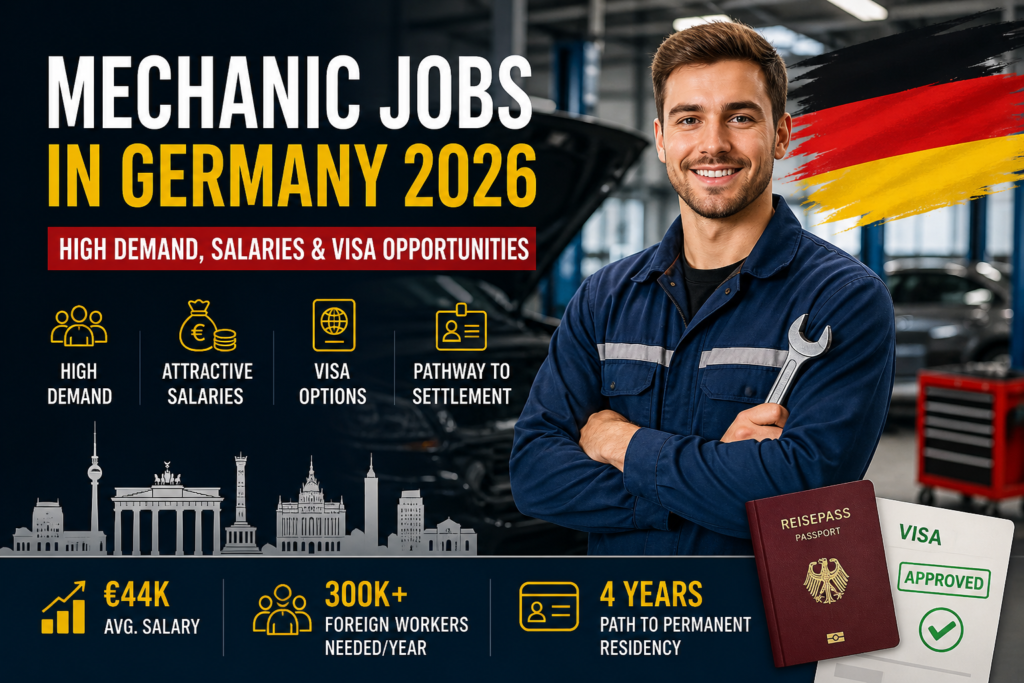
“Germany estimates it needs around 300,000 skilled foreign workers every year just to maintain current staffing levels.”
Why Mechanic Jobs in Germany 2026 Are in High Demand

Germany’s skilled labor shortage — known locally as Fachkräftemangel — is driven by three powerful forces. Understanding them helps you appreciate why mechanic jobs in Germany are so accessible to foreigners right now.
1. An Aging Workforce
Germany’s baby boomers are retiring in record numbers. More people are leaving the workforce than entering it. This creates a growing gap in skilled trades, including automotive and mechanical roles, that domestic workers simply cannot fill fast enough.
2. Rapid Technological Change
Germany’s world-famous automotive sector — home to Mercedes-Benz, BMW, Volkswagen, Porsche, and Audi — is rapidly shifting toward electric vehicles (EVs) and hybrid technology. As a result, demand for technically skilled mechanics who understand modern diagnostics is surging.
3. Industrial Growth
Manufacturing and industrial production continue to expand in Germany. Factories, logistics networks, and energy infrastructure all need qualified mechanical technicians to keep operations running smoothly. In addition, construction projects across the country require maintenance engineers in large numbers.
Key Statistics
Germany needs 300,000+ foreign professionals per year to offset retirements
163 occupations are officially listed as shortage fields by Germany’s Federal Employment Agency
Over 260,000 positions remain unfilled in the top shortage sectors alone
Germany’s DIHK report shows 83% of companies expect negative impacts from labor shortages in the coming years
Types of Mechanic Jobs in Germany 2026
Germany’s job market for mechanics is diverse. Therefore, you should identify which category matches your training and experience. Here are the main roles available to international applicants.
Mechanic Jobs in Germany: Automotive Technician (Kfz-Mechatroniker)
This is the most in-demand mechanic role in Germany. Automotive technicians service and repair cars, trucks, and increasingly, electric vehicles. Germany’s premium car manufacturers and thousands of independent garages actively recruit for this position.
Mechanic Jobs in Germany: Diesel Mechanic Roles
Diesel mechanics work on heavy-duty vehicles, freight trucks, agricultural equipment, and buses. Germany’s logistics sector — one of the busiest in Europe — relies heavily on these specialists. Consequently, diesel mechanics enjoy excellent job security.
Mechanic Jobs in Germany: Industrial Technician Roles
Industrial technicians maintain and repair machinery in manufacturing plants, production lines, and industrial facilities. These roles are found across Germany’s Mittelstand — the network of mid-sized companies that form the backbone of the economy.
Mechanic Jobs in Germany: Maintenance Engineer Positions
Maintenance engineers oversee the upkeep of large-scale machinery, HVAC systems, and infrastructure equipment. These roles often come with higher salaries and greater responsibility, particularly in energy and logistics companies.
Top Employers Hiring Mechanics Jobs in Germany
- Mercedes-Benz, BMW, Volkswagen Group, Audi, Porsche
- Deutsche Bahn (rail maintenance)
- BASF, Siemens, Bosch (industrial maintenance)
- Independent garages and dealerships (thousands of positions)
- Municipal and government vehicle maintenance departments
Mechanic Jobs in Germany 2026: Salary Guide
One of the strongest reasons to pursue mechanic jobs in Germany in 2026 is the competitive pay. Salaries vary based on your experience level, specialization, and location. However, even entry-level mechanics earn a livable wage with room to grow.
Mechanic Jobs in Germany: Salary Factors That Affect Pay
Location matters significantly. Cities with major automotive headquarters — such as Stuttgart (Mercedes-Benz, Porsche), Munich (BMW), and Wolfsburg (Volkswagen) — typically offer higher wages. Hamburg also ranks among the best-paying cities for automotive technicians.
Specialization pays more. Mechanics with EV and hybrid vehicle expertise, or those who work on heavy industrial machinery, tend to earn at the higher end of the scale.
Trade unions can boost your pay. In regions with strong union representation, collective bargaining agreements often secure better wages and benefits for mechanics.
Salary Insight
- Public sector mechanics earn approximately 8% more than private sector counterparts on average
- The top 25% of German mechanics earn over €24,280 net annually
- Germany’s national minimum wage is approximately €12.50/hour in 2026
- Benefits often include health insurance, pension contributions, and paid leave
Requirements for Mechanic Jobs in Germany 2026
Germany has clear — but manageable — standards for foreign mechanics. Meeting these requirements before you apply will save you significant time and frustration.
Educational Qualifications
Germany values its dual-education vocational system. Therefore, the most important thing you need is a recognized vocational qualification in a mechanical or automotive trade. This typically means a 2–3 year apprenticeship or trade school certificate from your home country.
Certification Recognition
Your foreign qualification must be formally recognized in Germany. The main authority for this is the Central Office for Foreign Education (ZAB) or the relevant Chamber of Commerce (IHK). This process can take 2–6 months, so start it early. In addition, many employers will guide you through recognition if you have a confirmed job offer.
German Language Level
Most employers prefer at least A2–B1 German proficiency for workshop roles. B2 level will give you a much stronger application. However, some international companies accept English for initial roles. Learning German is essential for long-term integration and career growth.
Work Experience
Germany’s Skilled Worker Visa requires at least 2 years of relevant professional experience. This experience must match the job you are applying for. Therefore, document your work history carefully with reference letters and employment certificates.
- Vocational certificate or trade school diploma in mechanics/automotive
- Minimum 2 years of professional experience in the field
- German language proficiency (A2 minimum; B1–B2 preferred)
- Valid passport and clean background record
- Qualification recognition from ZAB or IHK
- A confirmed job offer from a German employer (for most visa types)
Visa Options for Mechanic Jobs in Germany 2026
As a foreign mechanic, you have several legitimate pathways to enter Germany legally. Each visa type suits a different situation. Therefore, choose the one that best fits your qualifications and circumstances.
Most Common
Skilled Worker Visa (§18a AufenthG)
For mechanics with a recognized vocational qualification and a job offer. Valid for up to 4 years. This is the primary route for most international mechanics.
Higher Earners
EU Blue Card
Requires a salary of at least €45,934/year for shortage occupations in 2026. Offers a fast track to permanent residency in as little as 21–27 months.
No Job Yet?
Job Seeker Visa (Chancenkarte)
The Opportunity Card allows you to enter Germany for up to 12 months to search for a job in person. You need to meet a points-based eligibility criteria.
Transitional
Recognition Partnership Visa
Allows you to enter Germany while your qualification is still being assessed. You can begin working in a related role during the recognition process.
Basic Application Steps
- Secure a job offer from a German employer (or apply for a Job Seeker Visa first)
- Get your vocational qualifications recognized by ZAB or IHK
- Gather documents: passport, qualification certificates, employment contract, proof of accommodation
- Apply for your visa at the German embassy in your home country
- Register your address and convert to a residence permit within 90 days of arrival
Important Note
Processing times for German visas currently range from 6 weeks to 6 months depending on your country. Start your application as early as possible, and track your qualification recognition status regularly.
How to Apply for Mechanic Jobs in Germany 2026
Finding and securing automotive technician jobs in Germany as a foreigner requires a smart, targeted strategy. Here is exactly what to do.
Use the Right Job Portals
Germany has several major job platforms where mechanics can find openings. The most effective ones include:
Top Job Portals for Mechanics
Official Government Portal:
https://www.make-it-in-germany.com/en/working-in-germany/professions-in-demand/mechatronics
Federal Job Board:
https://jobboerse.arbeitsagentur.de
Indeed Germany
https://de.indeed.com/jobs?q=kfz+mechatroniker
StepStone Germany
https://www.stepstone.de/jobs/kfz-mechatroniker
LinkedIn Jobs
https://www.linkedin.com/jobs/mechanic-jobs-germany
EURES Portal
https://ec.europa.eu/eures/portal/jv-se/home
Format Your CV the German Way
German employers expect a Lebenslauf — a structured, chronological CV. Unlike many Western formats, the German CV typically includes a professional photo, your date of birth, and sometimes your nationality. Keep the design clean, clear, and formal. A one-page summary is rarely enough; two to three pages is standard.
Furthermore, include a formal cover letter (Anschreiben) that directly addresses why you want to work for that specific company. Generic letters get ignored.
Tips to Stand Out as a Foreign Applicant
- Start the qualification recognition process before applying — it shows employers you are serious
- Learn basic German — even A2/B1 proficiency significantly improves your chances
- Mention any experience with EVs, hybrids, or modern diagnostic tools prominently
- Contact German embassies or cultural institutes for free application resources
- Target smaller cities and towns — competition is lower and employers are more eager to hire
Challenges of Mechanic Jobs in Germany 2026 for Foreign Workers
It is important to be realistic. Working in Germany as a foreign mechanic comes with genuine challenges. However, every one of them is manageable with the right preparation.
Language Barrier
German is the primary working language in most workshops and factories. Workshop instructions, safety rules, and customer interactions are almost always in German. Therefore, investing time in language learning before you arrive is one of the best decisions you can make. Apps like Duolingo, Babble, and Goethe-Institut courses are excellent starting points.
Qualification Recognition Delays
The credential recognition process can be slow and confusing. In some cases, assessors may request additional training or bridging courses before fully recognizing your qualification. Plan for this process to take 3–6 months in the best case.
Cultural and Workplace Differences
German workplace culture values punctuality, precision, and direct communication. Arriving late, cutting corners, or being vague in reporting will quickly damage your professional reputation. Adapting to this culture takes time — however, most foreigners find it fair and respectful once they adjust.
Pro Tip
Connect with expat mechanic communities on Facebook groups and Reddit (r/Germany, r/arbeitsvisum) before you move. Real-world experiences from people who have already done it will prepare you far better than any guide.
Benefits of Mechanic Jobs in Germany 2026
Despite the challenges, the rewards of landing mechanic jobs in Germany are genuinely compelling. Here is what you gain.
Why Germany Is Worth It
- Competitive salary: Even entry-level mechanics earn €28K–€36K per year — far above average wages in most developing countries
- Job security: Shortage occupations like mechanics face virtually no unemployment risk in the current market
- Career progression: Germany’s apprenticeship system and continuing education programs give you a clear path to senior roles and certifications
- Social benefits: Health insurance, unemployment protection, pension contributions, and generous paid leave (typically 20–30 days/year) are standard
- Family reunification: Spouses and children can join you in Germany, and your spouse has full working rights regardless of profession
- Permanent residency: After just 4 years on a Skilled Worker Visa — or 21–27 months on an EU Blue Card — you can apply for permanent residence
- European mobility: A German residence permit opens doors across the European Union
Next Steps for Mechanic Jobs in Germany 2026
Germany is not simply looking for workers — it is actively competing to attract skilled mechanics from around the world. The demand is real, the salaries are fair, and the visa pathways are clearer than ever before.
If you have the qualifications, the drive, and the willingness to learn German, then 2026 may be your best window yet to build a lasting career in Europe’s most powerful economy.
Start today: get your credentials assessed, open your language app, and visit make-it-in-germany.com to explore current mechanic job listings. The opportunity will not wait.