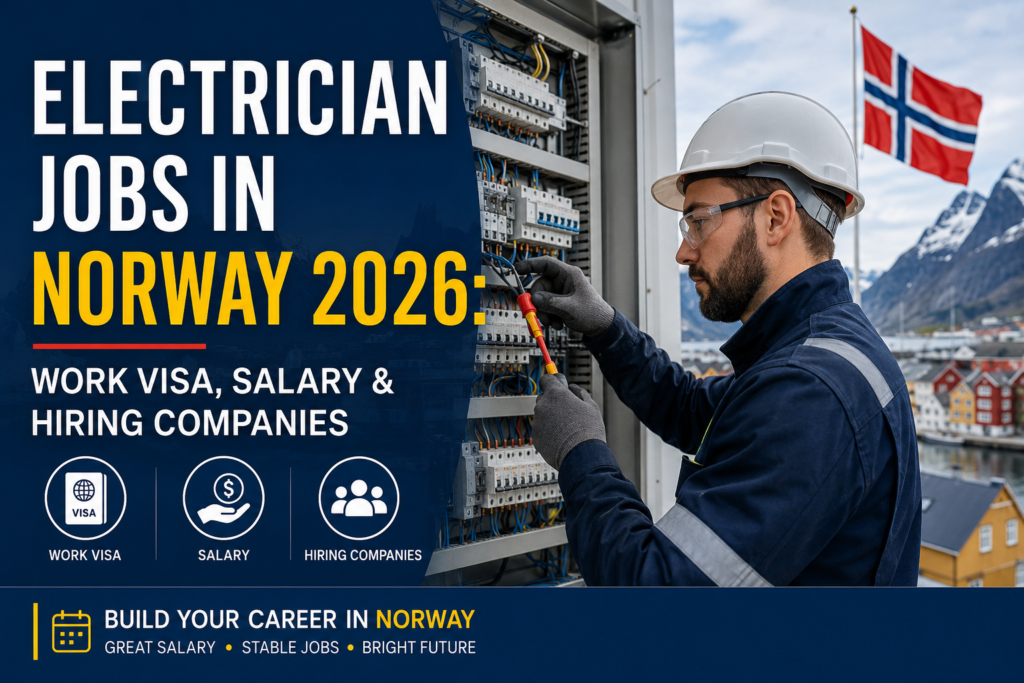

For skilled electricians willing to make the move, Norway offers something rare: a country where your trade is genuinely valued, compensated generously, and supported by some of the strongest worker protections in the world. Annual salaries routinely clear NOK 600,000 (roughly €52,000), paid parental leave is generous, and universal healthcare comes as standard.
This guide covers everything you need to know — from work visa requirements and qualification recognition to salary benchmarks, top hiring companies, and where to send your CV today.
Norway Electrician Jobs in 2026: Market Overview

The demand for electricians in Norway has never been stronger. The country’s construction industry is in the middle of a sustained boom, driven by residential development, commercial infrastructure upgrades, and a massive push into offshore wind and green energy. At the same time, Norway’s existing workforce is aging, leaving a significant skills gap that domestic training alone cannot fill.
According to recent labor market data, skilled tradespeople — including electricians, plumbers, welders, and carpenters — represent the single largest category of shortage occupations, with an estimated 16,850 unfilled roles. Norway’s employment minister has publicly called for more flexible immigration policy to support foreign workers integrating into these sectors.
Key Industries Hiring Foreign Electricians
Construction & Infrastructure
Residential builds, commercial fit-outs, road and rail electrification across Oslo, Bergen, Stavanger, and Tromsø.
Offshore Oil & Gas
Platform maintenance and installation work in the North Sea, offering premium wages and rotation schedules.
Renewable Energy
Onshore and offshore wind farms, hydropower upgrades, and solar installations driven by Norway’s green transition.
Industrial Maintenance
Factories, processing plants, and maritime facilities requiring certified electricians for ongoing preventive maintenance.
Norway’s position as a leader in renewable energy means demand for high-voltage electricians and automation specialists is growing particularly fast. Knowledge of Norwegian electrical standards (NEK 400) is a genuine advantage, though many employers provide on-the-job training for international hires.
Norway Electrician Work Visa Requirements
Se also: Electrician Jobs in Holland: Requirements, Salary, Visa Sponsorship & Relocation Guide 2026
Electrician Jobs in Saudi Arabia 2026: Salary, Benefits & Visa Guide
Understanding the visa pathway is critical before you start applying. The route you take depends primarily on your nationality. EU and EEA citizens enjoy freedom of movement and can begin working in Norway without a residence permit, though they still need professional authorization to practice independently. Non-EEA nationals must secure a Skilled Worker Residence Permit through UDI (the Norwegian Directorate of Immigration) before starting work.
Skilled Worker Visa: Eligibility for Electricians
To qualify for the Skilled Worker Residence Permit as an electrician, you generally need to meet the following criteria set by UDI:
- A confirmed, full-time job offer from a registered Norwegian employer (at least 80% contract).
- Pay and working conditions equal to or better than Norwegian industry standards.
- A formal vocational qualification of at least three years at upper-secondary level — equivalent to a Norwegian fagbrev (trade certificate).
- In rare cases, equivalent qualifications through extensive, documented professional experience may be accepted, though UDI sets a very high bar for this.
Important: You are generally not permitted to begin working — including remote work — until your residence permit has been granted. However, UDI does offer a confirmation of early employment start in certain cases once the application has been submitted with a Norwegian employer.
Required Qualifications and Certifications
Electricians in Norway operate under a regulated profession system. This means foreign qualifications must be formally recognized before you can work independently. There are two parallel approval processes for non-EEA nationals:
- DSB Authorization: The Norwegian Directorate for Civil Protection (DSB) must approve your electrical qualifications before you can legally carry out electrical work. This applies to all foreign-educated electricians, regardless of nationality.
- NOKUT Recognition: For those from outside the EU/EEA, the Norwegian Agency for Quality Assurance in Education (NOKUT) may need to assess whether your vocational training is equivalent to a Norwegian fagbrev.
- NEK 400 Knowledge: Familiarity with Norway’s national electrical installation standard (NEK 400) is strongly recommended and increasingly expected by employers.
- FSE Safety Training: For working on or near live electrical systems, FSE (Forskrift om sikkerhet ved arbeid i og drift av elektriske anlegg) safety certification is typically required.
Documents Needed for the Application
- Valid passport (minimum 12 months remaining validity)
- Signed employment contract from your Norwegian employer
- Certified copies of your trade certificates and academic transcripts
- DSB approval letter (or proof of application in progress)
- NOKUT qualification recognition (for non-EEA nationals)
- Application fee: approximately NOK 6,300–8,000 (around €580–740)
Applications are submitted through UDI’s online portal. Processing times vary, but skilled worker applications for shortage occupations often benefit from expedited handling. The practical approach recommended by immigration specialists is to begin applying for jobs and starting DSB recognition simultaneously, as the job offer is required for the visa but DSB approval takes time.
Norway Electrician Salary Expectations in 2026
Compensation is one of the most compelling reasons to pursue a Norway electrician career. Wages are governed by collective sector agreements rather than a national minimum wage, and these agreements set strong floors that employers are legally required to meet.
Average Monthly Salary
| Salary Metric | Annual (NOK) | Monthly (NOK) | Approx. Monthly (€) |
|---|---|---|---|
| Average | 620,553 | ~51,700 | ~€4,750 |
| 25th Percentile | 441,834 | ~36,800 | ~€3,380 |
| 75th Percentile | 749,628 | ~62,500 | ~€5,740 |
| DSB-Certified Electrician (hourly) | — | ~265 NOK/hr | ~€24/hr |
| Without DSB Certificate (hourly) | — | ~220 NOK/hr | ~€20/hr |
These figures confirm that a certified Norway electrician earns comfortably above the national average across most salary surveys. The DSB certificate alone can increase your hourly rate by approximately 20%, making it a worthwhile investment before arrival.
Salary by Experience Level
| Experience Level | Annual Salary Range (NOK) | Approx. Monthly (€) |
|---|---|---|
| Entry-Level (0–2 years) | 450,000 – 530,000 | €3,450 – €4,050 |
| Mid-Level (3–6 years) | 550,000 – 650,000 | €4,200 – €4,980 |
| Senior / Specialist (7+ years) | 650,000 – 750,000 | €4,980 – €5,740 |
| Offshore / High-Voltage Specialist | 700,000 – 900,000+ | €5,360 – €6,890+ |
Overtime and Additional Benefits
Beyond base salary, most electricians in Norway receive a generous package of benefits. Overtime is typically compensated at 40–100% above standard rates depending on the hour and day. Offshore and remote Northern Norway postings often include accommodation and meals as part of the package, significantly increasing the effective take-home value of the role.
Worth knowing: Certified workers in Norway consistently earn 20–40% more than those without recognized qualifications. Offshore platform roles and positions in Northern Norway or remote areas command the highest wages, partly compensating for harsher working conditions and distance from urban centers.
Top Companies Hiring Norway Electrician Professionals
A wide range of employers are actively seeking qualified electricians — from major construction contractors to energy giants and specialist staffing agencies. Here is a breakdown by sector.
Construction Companies
NCC Norway
One of Scandinavia’s largest construction groups, with major infrastructure and residential projects across Norway requiring certified electricians at all levels.
AF Gruppen
Norwegian contractor covering civil engineering, building, and offshore. Regularly hires foreign skilled tradespeople including electricians for large-scale projects.
Skanska Norge
Part of the global Skanska group, active in Norway’s construction sector with ongoing demand for qualified electrical professionals on commercial and public builds.
Veidekke
A leading Norwegian contractor known for its collaborative model. Hires electricians for construction, renovation, and infrastructure contracts nationwide.
Energy and Renewable Sector Employers
Equinor
Norway’s state energy major, operating oil, gas, and increasingly large offshore wind projects. Hires high-voltage electricians and electrical engineers at competitive rates.
Statkraft
Europe’s largest producer of renewable energy, with hydropower, wind, and solar assets requiring skilled electrical maintenance professionals across Norway.
RWE Renewables Norway
Growing its offshore wind footprint in Norwegian waters. Actively hiring turbine electricians and offshore specialist electricians for upcoming projects.
SPIE Global Services Energy
An international energy services company with active recruitment for offshore specialist electricians and turbine supervisors for Norwegian projects.
Industrial, Offshore, and Staffing Companies
Adecco Norway
One of Norway’s largest staffing agencies, with a dedicated trades division regularly placing electricians on short-term and permanent contracts across all sectors.
Manpower Norway
Specialist in skilled trades recruitment, matching foreign electricians to roles in construction, industrial maintenance, and offshore environments.
Randstad Norway
Global recruiter with a strong Norwegian presence, placing tradespeople in permanent and temporary roles with some of Norway’s biggest employers.
Lys Bemanning AS
A Norway-based electrical specialist staffing agency placing certified electricians on projects such as those in Narvik and other Northern Norway locations.
How to Apply for Norway Electrician Jobs
Securing a Norway electrician role from abroad requires a structured approach. The process typically takes three to six months from initial application to arrival, so starting early is essential — especially if you need DSB recognition and NOKUT qualification assessment.
Best Job Portals for Electrician Jobs in Norway
- nav.no — NAV (Official Norwegian Labor Authority)
- finn.no/job — FINN Jobs (Norway’s largest job board)
- eures.europa.eu — EURES European Jobs Network
- adecco.no — Adecco Norway (Staffing & Trades)
- manpower.no — Manpower Norway (Skilled Trades)
- randstad.no — Randstad Norway (Permanent & Contract)
CV and Application Tips for Foreign Electricians
Norwegian employers appreciate directness and clarity. Your CV should be clean, no longer than two pages, and focused on measurable outcomes — projects completed, systems maintained, team size managed. Listing your certifications prominently (DSB, fagbrev equivalent, FSE, NEK 400 familiarity) will immediately set you apart from other applicants.
If you are applying through staffing agencies, register with multiple firms simultaneously. Adecco, Manpower, and Randstad all have specialist trades divisions and maintain active talent pools that employers access directly when roles arise — sometimes before the position is publicly advertised.
Interview Preparation
Norwegian workplace culture values pragmatism, equality, and honest communication. Interviews tend to be more conversational than formal, but be prepared to discuss specific technical scenarios — electrical fault diagnosis, safety compliance, and project experience are commonly covered. Even a basic grasp of Norwegian phrases is well received and signals genuine commitment to integration.
Benefits of Working as a Norway Electrician
The financial rewards of working as a Norway electrician are significant, but the broader employment package is equally compelling. Norway consistently ranks among the top countries in the world for quality of life, and workers in regulated trades benefit fully from these national standards.
- Universal Healthcare— Access to Norway’s public health system from day one of employment, covering GP visits, specialist care, and hospital treatment.
- Generous Pension— Employers are required to contribute to a mandatory occupational pension scheme, with contributions typically between 2–7% of salary.
- Paid Annual Leave— A statutory minimum of 25 days paid leave per year (four weeks and one day), with many collective agreements providing more.
- Paid Parental Leave— One of the world’s most generous parental leave systems, with up to 49 weeks at full pay shared between parents.
- Work-Life Balance— The standard working week is 37.5 hours. Overtime is strictly regulated and well-compensated.
- Job Security— Strong labor laws and active union representation make arbitrary dismissal rare in the trades sector.
- Career Progression— Electricians can advance to foreman, site supervisor, project manager, or electrical engineer roles with additional training — often funded by employers.
- Path to Permanent Residency— After three years on a Skilled Worker Permit, non-EEA workers can apply for permanent residency in Norway.
Frequently Asked Questions
Can foreigners work as electricians in Norway?
Yes — both EU/EEA and non-EEA citizens can work as electricians in Norway. EU and EEA nationals benefit from freedom of movement and need no work permit, but all foreign-educated electricians must obtain DSB (Directorate for Civil Protection) professional authorization before carrying out electrical work independently. Non-EEA nationals additionally need a Skilled Worker Residence Permit from UDI, which requires a confirmed job offer from a registered Norwegian employer before the application can be submitted.
What is the average electrician salary in Norway in 2026?
The average annual salary for a Norway electrician in 2026 is approximately NOK 620,553 (around €4,750 per month). The typical range runs from NOK 441,834 at the 25th percentile to NOK 749,628 at the 75th percentile. DSB-certified electricians working on hourly contracts typically earn around 265 NOK per hour before tax. Offshore and high-voltage specialists can push well above NOK 800,000 annually.
Do electricians need a work visa for Norway?
EU and EEA citizens do not require a work visa or permit to work in Norway, though they must register with local authorities after three months. Non-EEA nationals must apply for a Skilled Worker Residence Permit through UDI. The permit requires a valid job offer, proof of recognized qualifications, and a salary meeting Norwegian industry standards. Application fees range from NOK 6,300 to NOK 8,000. You generally cannot begin working until the permit is granted, though early start confirmations are possible in some cases.
Which companies hire foreign electricians in Norway?
Leading employers include major construction contractors such as NCC Norway, AF Gruppen, Skanska Norge, and Veidekke; energy companies like Equinor and Statkraft; and specialist staffing agencies including Adecco Norway, Manpower Norway, and Randstad Norway. Offshore and renewable energy firms such as SPIE Global Services Energy and RWE Renewables are also actively recruiting electricians with relevant certifications.
Where can I apply for electrician jobs in Norway?
The most reliable job portals for electrician jobs in Norway are NAV (nav.no) — the official Norwegian labor authority; FINN Jobs (finn.no/job) — Norway’s largest job board; and EURES (eures.europa.eu) — the EU’s cross-border employment network. For staffing-agency placements, register directly with Adecco Norway (adecco.no), Manpower Norway (manpower.no), and Randstad Norway (randstad.no). All links above are verified HTTPS sources.