
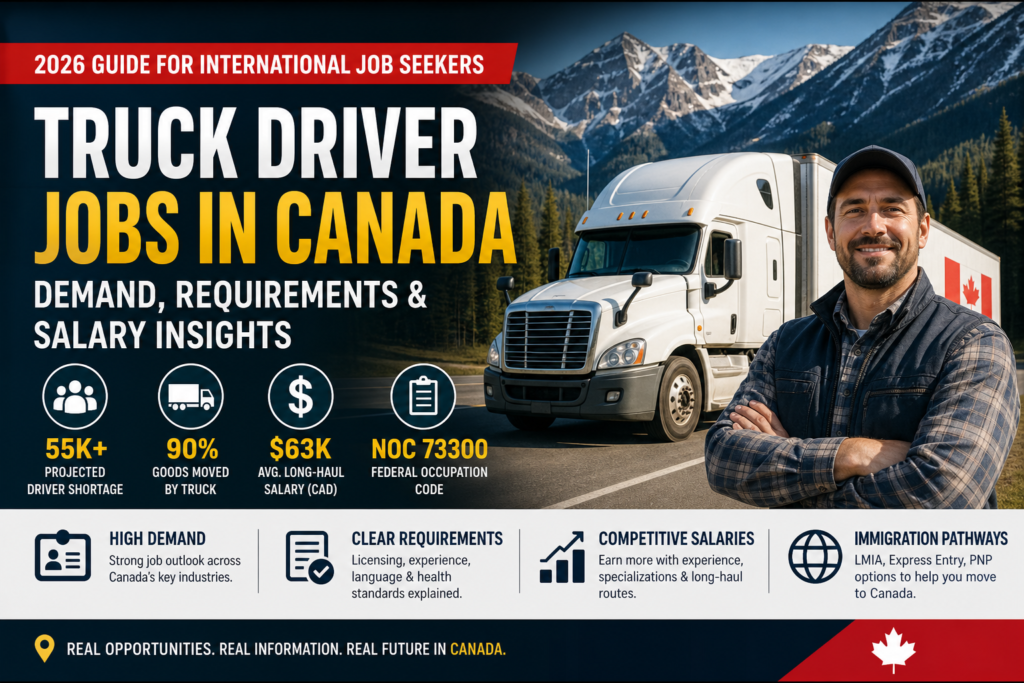

Truck driver jobs in Canada remain one of the most in-demand opportunities for international job seekers in 2026, driven by a long-standing labour shortage and the country’s heavy reliance on road transport across industries.
A practical, no-hype guide to one of Canada’s most persistently in-demand trades — covering what the industry actually looks like, what it takes to get hired, and what you can realistically earn.
If you’ve been researching truck driver jobs in Canada 2026, you’re looking at one of the most consistently understaffed sectors in the country’s labour market. The demand is real — but so are the requirements. This guide cuts through the noise and gives you an honest picture of the opportunity.
Canada’s trucking industry doesn’t make headlines the way tech or healthcare does. Yet it powers nearly every other sector of the economy. Grocery stores, auto manufacturers, construction sites, oil fields — all of them depend on a reliable network of commercial drivers to function. And right now, that network has a serious gap in it.
For international job seekers with the right experience and preparation, that gap represents a genuine opening. But as with any career move to a new country, success depends on understanding the landscape before you commit. Let’s walk through what 2026 actually looks like for truck drivers in Canada.
73300 Federal occupation code
Demand for Truck Driver Jobs in Canada (2026)
Canada has been grappling with a truck driver shortage for well over a decade, and the problem is getting worse — not better. Projections from the Canadian Trucking Alliance and the Conference Board of Canada place the shortfall between 25,000 and 55,000 drivers in the near term, with the gap widening toward 2035 as the current workforce retires in large numbers.
The average Canadian trucker is over 50 years old. With a significant portion of the workforce nearing retirement and fewer young Canadians pursuing commercial driving as a career, the industry cannot replace departing drivers fast enough to meet demand. That structural dynamic is what makes this a durable opportunity rather than a short-term blip.
“The acute shortage of truck drivers in Canada is felt beyond the trucking industry. Trucking is the lifeline for critical industries like forestry, auto manufacturing, and retail.”
— Kristelle Audet, Principal Economist, Conference Board of Canada
Which Industries Rely Most on Truck Drivers?
The demand for Canada trucking jobs cuts across virtually every productive sector of the economy:
Key Sectors Driving Demand
- Retail & E-Commerce — Online shopping growth has sharply increased last-mile and regional delivery needs
- Agriculture & Food Distribution — Perishable goods require reliable refrigerated transport across vast distances
- Construction & Infrastructure — Materials, heavy equipment, and dump hauling tied to Canada’s ongoing infrastructure push
- Oil & Gas (Alberta, BC) — Oilfield service trucks, tankers, and equipment transport
- Forestry & Mining — Remote-route specialists needed in British Columbia, Ontario, and northern regions
- Manufacturing & Auto — Just-in-time supply chains depend entirely on driver reliability
Where Is Demand Highest by Province?
Not all regions of Canada face the same intensity of need. Alberta, British Columbia, Manitoba, and Saskatchewan are among the provinces reporting the most acute shortages, particularly for long-haul and oilfield-related routes. Ontario and Quebec have significant demand in urban logistics and regional delivery, though these roles also attract the most domestic competition. Atlantic Canada (New Brunswick, Nova Scotia, PEI, Newfoundland) is increasingly using provincial immigration pilots to attract foreign drivers — and the competition for those spots is generally lower.
Requirements for Truck Driver Jobs in Canada
Please Read also:
CONSTRUCTION JOBS IN SPAIN FOR NIGERIANS & AFRICANS — 2026 COMPLETE GUIDE
Licensing: Class 1 / Class A Commercial Driver’s License
The foundational requirement for most professional truck driving roles — especially long-haul and tractor-trailer work — is a Class 1 (also called Class A in some provinces) commercial driver’s licence (CDL). This is Canada’s equivalent of a full commercial vehicle licence and is non-negotiable for employers operating large combination vehicles.
Licensing Breakdown by Vehicle Type
- Class 1 / A — Tractor-trailers, semi-trucks, and large combination vehicles (most in-demand)
- Class 3 / D — Straight trucks, dump trucks, and some delivery vehicles
- Air Brake Endorsement (Z) — Required for vehicles with air brake systems; most long-haul trucks qualify
- WHMIS / TDG Certificates — Needed for drivers transporting dangerous or hazardous goods
Canada also has a mandatory Entry-Level Training (MELT) requirement, introduced federally, which combines classroom instruction and behind-the-wheel training. Training programs typically run 4–8 weeks and cost between CAD $7,000 and $10,000. Many employers offer training subsidies or signing bonuses that offset part of this cost. Government programs in some provinces also provide grants for newcomers.
Work Experience Expectations
Most Canadian employers — particularly for long-haul routes — prefer candidates with at least 1–2 years of verifiable commercial driving experience. If you drove trucks in your home country, that experience generally counts, but you’ll need to document it clearly. A clean driving record is essential; violations, DUIs, or serious at-fault accidents can disqualify candidates even before the licensing conversation begins.
Language Proficiency
English (or French in Quebec) proficiency is a practical necessity. Drivers need to communicate with dispatchers, read road signs, fill out customs documentation for cross-border loads, and interact with receiving staff. Immigration programs typically require a Canadian Language Benchmark (CLB) score of 4–5 at minimum — roughly basic conversational fluency.
Health and Background Checks
A valid medical examination confirming fitness to drive is required. This typically covers vision, hearing, cardiovascular health, and the absence of medical conditions that could impair judgment or reaction time. Background checks vary by employer but are standard for companies operating cross-border Canada–US routes, where US Customs clearance adds another layer of vetting.
Salary for Truck Driver Jobs in Canada (2026)
Norway Job Opportunities 2026 for Africans: Quiet Recruitment and How to Apply
One of the most common questions about this career path — and one where wildly different numbers circulate online — is salary. Here’s a grounded look at what the truck driver salary in Canada actually looks like across experience levels and roles.
| Experience / Role | Annual Salary (CAD) |
|---|---|
| Entry-Level / Local Delivery | $45,000 – $55,000 |
| Regional Driver (1–3 yrs exp.) | $55,000 – $68,000 |
| Long-Haul / Tractor-Trailer (experienced) | $63,000 – $85,000 |
| Specialized (hazmat, reefer, oversized) | $75,000 – $95,000+ |
| Owner-Operator (self-employed) | $80,000 – $120,000 (gross) |
A few important caveats: many long-haul drivers are paid per kilometer rather than a fixed salary, which means income can fluctuate based on routes, delays, and seasonal demand. Waiting time at loading docks, which can eat several hours per trip, is often uncompensated — a source of frustration for many drivers and a known pain point in the industry.
Factors That Affect Your Earnings
Province matters significantly. Alberta and British Columbia tend to offer the highest wages, partly reflecting higher living costs and remote-route premiums. Specialization pays — drivers certified to carry hazardous materials, refrigerated loads (reefer), or oversized equipment can command premiums of 15–30% over standard rates. Owner-operators who own their trucks can earn more gross revenue, but must factor in fuel, maintenance, insurance, and downtime — net income varies considerably.
Immigration Pathways for Truck Driver Jobs in Canada
For international candidates, understanding how to legally access Canada work visa trucking jobs is critical. The good news: Canada has deliberately opened immigration pathways for this occupation.
Temporary Foreign Worker Program (TFWP) via LMIA
The most common entry route for foreign drivers. An employer who cannot find a local candidate can apply for a Labour Market Impact Assessment (LMIA). If approved, you can obtain a work permit tied to that employer. Provinces like Manitoba, Saskatchewan, Alberta, and BC report frequent LMIA approvals for transport truck drivers (NOC 73300).
Express Entry – Federal Skilled Worker (FSW)
Truck driving was added to the Federal Skilled Worker Program as a qualifying occupation. Candidates with sufficient points in the Comprehensive Ranking System (CRS) can receive an Invitation to Apply (ITA) for permanent residency, particularly through targeted category-based draws for trades and transportation workers.
Provincial Nominee Programs (PNPs)
Several provinces operate streams specifically targeting truck drivers. A provincial nomination adds 600 CRS points — effectively guaranteeing a PR invitation. Atlantic Canada’s immigration pilots (AIPP) and streams in Manitoba and Saskatchewan are particularly accessible for experienced drivers with a valid job offer.
Employer-Sponsored Work Permits
Larger carriers such as Day & Ross, Mullen Group, and regional operators actively recruit foreign workers. Some employers will arrange or co-fund the LMIA process and support the permit application. Job Bank Canada (the federal government’s official job board) lists open positions and shows whether LMIA-based hiring is available.
Official Application Portals for Truck Driver Jobs in Canada (2026):
http://www.jobbank.gc.ca/jobsearch/jobsearch?fn21=7511
https://www.jobbank.gc.ca/jobsearch/jobsearch?fn21=73300
https://www.canada.ca/en/immigration-refugees-citizenship/services/work-canada.html
http://www.erbgroup.com/careers/
For most foreign candidates, the realistic path looks like this: secure a job offer → employer obtains LMIA → you apply for a work permit → arrive in Canada → work, build experience, and apply for permanent residency through Express Entry or a PNP. The timeline from job offer to work permit is typically 3–6 months, though processing times vary.
Challenges and Expectations for Truck Driver Jobs in Canada
No honest career guide skips this section. Truck driving in Canada is a solid opportunity — but it isn’t without significant demands. Knowing what you’re actually signing up for is the difference between a successful transition and a costly mistake.
What to Prepare For
Upfront licensing costs are real. Class 1 training typically runs CAD $7,000–$10,000. Some employers subsidize this in exchange for a service commitment (usually 1–2 years). Government grants exist but aren’t guaranteed. Budget for this before you arrive.
Long-haul means time away from family. Cross-provincial or Canada–US routes can mean weeks on the road at a stretch. Local and regional routes offer more home time, but typically pay less. This is one of the biggest reasons younger workers avoid the profession — and one of the biggest reasons the shortage persists.
Per-kilometer pay has gaps. Waiting time, border delays, and loading/unloading periods are often unpaid. Your effective hourly rate can be lower than the headline salary figure suggests. Read contracts carefully and ask specifically about how non-driving time is compensated.
Canadian winters are unforgiving. Driving in heavy snow, ice, and extreme cold is a genuine safety challenge. New drivers, especially those from warmer climates, need to take winter driving conditions seriously. Many carriers provide training, but you’ll need to adapt quickly.
Be cautious of job scams. The volume of “visa sponsorship guaranteed” ads for trucking jobs online has also attracted fraudulent recruiters. Legitimate employers do not charge fees to process your work permit. Use official channels — Job Bank Canada, direct carrier websites — and verify LMIA claims independently.
The Bottom Line
Truck driver jobs in Canada 2026 represent a genuine, well-documented labor market opportunity — not a social media trend. The structural driver shortage is real, the immigration pathways are established, and the salaries are competitive by international standards.
At the same time, this is a demanding profession that requires investment: financial (licensing and training), physical (the realities of long-haul routes), and professional (meeting Canada’s safety and regulatory standards). Success isn’t guaranteed by simply applying — it comes to those who research thoroughly, prepare properly, and enter the process with realistic expectations.
If you have verifiable commercial driving experience, a clean record, and the willingness to navigate the licensing and immigration process, Canada’s trucking industry offers something increasingly rare in today’s job market: a stable, skilled trade with a clear path to permanent residency. That combination is worth taking seriously.
Always verify immigration requirements directly with Canada.ca or a licensed immigration consultant. Policies and processing times change frequently.