
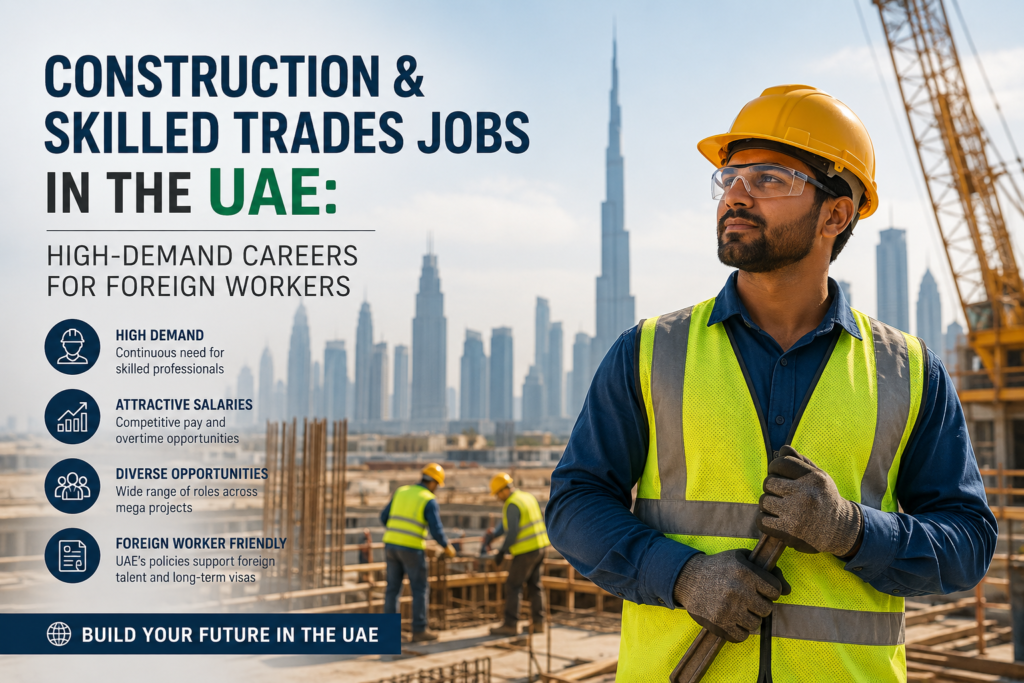

Consequently, the demand for skilled foreign tradespeople — the welders, HVAC technicians, BIM modelers, electricians, and project managers who actually build things — has surged beyond what the domestic workforce can supply. Employers are actively looking abroad, and recruitment pipelines have never been more accessible.
This guide cuts through the noise. Whether you are a seasoned project manager in the Philippines, an HVAC technician in South Asia, or an electrician in Sub-Saharan Africa, you will find clear, honest, and actionable information here — from the roles that pay the most to the exact steps for securing a legal work visa.
The 2026 Demand Landscape for Construction & Skilled Trades Jobs in the UAE

Three forces are driving this hiring surge simultaneously. First, the UAE’s ambitious National Development Agenda has accelerated infrastructure spending across all seven emirates — not just Dubai. Projects in Sharjah, Ras Al Khaimah, and Fujairah are drawing contractors and subcontractors into a workforce competition that has tightened labor supply considerably.
Second, a growing emphasis on green building standards and energy efficiency has created demand for a newer generation of specialists: solar installation technicians, MEP (mechanical, electrical, plumbing) engineers, and BIM modelers capable of working with digital construction methodologies. These roles command significant premiums over general labor.
Third, the construction sector’s rapid pace of project delivery — deadlines tied to tourism goals, expo legacies, and economic diversification targets — means employers cannot afford long hiring cycles. They are drawing from tried-and-tested overseas labor markets in South and Southeast Asia, East Africa, and the Arab world, moving fast to fill skilled roles.
Top 5 High-Demand Roles & 2026 Salary Ranges For Construction & Skilled Trades Jobs in the UAE
Below is a breakdown of the roles where construction & skilled trades jobs are seeing the most active recruitment, along with realistic monthly salary benchmarks for experienced foreign workers in 2026.
Role |
Monthly Salary (AED) |
USD Equivalent |
Demand Level |
|---|---|---|---|
| HVAC Technician | 4,500 – 9,000 | ~$1,225 – $2,450 | Critical |
| Construction Project Manager | 15,000 – 30,000+ | ~$4,080 – $8,170 | High |
| Specialized Welder / Fabricator (6G) | 5,000 – 11,000 | ~$1,360 – $2,995 | Critical |
| BIM Modeler / Structural Drafter | 7,000 – 14,000 | ~$1,905 – $3,810 | High |
| Licensed Electrician (MEP) | 4,500 – 9,500 | ~$1,225 – $2,585 | Critical |
Furthermore, workers holding internationally recognized certifications — such as AWS welding certifications, ASHRAE credentials for HVAC, or Autodesk-certified BIM competencies — consistently earn at the upper end of these ranges. Certification is no longer just a differentiator; in large-contractor accounts, it is increasingly a prerequisite.
Navigating the Legalities: Visas & Regulations for Construction & Skilled Trades Jobs in the UAE
see also: Logistics Jobs in Ireland: High Demand, Real Salaries, and Visa Roadmap
Finance Jobs in Ireland 2026: Salary, In-Demand Roles & Work Visa Pathways
The UAE’s work visa system is employer-led, well-structured, and — in 2026 — increasingly streamlined. Your employer does the heavy administrative lifting, but understanding the process protects you from bad actors and ensures you arrive with the right expectations.
Every foreign worker in the construction sector requires an employer-sponsored employment visa, regulated jointly by the Ministry of Human Resources and Emiratisation (MOHRE) and, in Dubai specifically, the General Directorate of Residency and Foreigners Affairs (GDRFA). In free zones, a parallel process applies through the relevant free zone authority.
Quota Approval from MOHRE
Formal Job Offer & Contract Signing
Entry Permit Issuance
Medical Fitness Screening
Emirates ID & Residence Visa Stamping
Know Your Rights Under UAE Labour Law
On the other hand, once you are legally settled, the benefits compound. A UAE employment visa lets you open local bank accounts, rent property, and sponsor family members for dependent residency — a substantial quality-of-life upgrade over many competing labor markets.
Where to Find Construction & Skilled Trades Jobs in the UAE: Verified Platforms
The single biggest risk for foreign workers is applying through unverified channels — fake recruiters, fraudulent job boards, and social media posts that charge upfront fees. To protect yourself and maximize your chances, stick to platforms with verifiable legitimacy.
The Official Government Portal
Your first stop should always be the UAE Government’s official employment portal, operated directly by MOHRE. Listings here are tied to registered, compliant employers, giving you an immediate layer of protection. You can find it at:
Specifically, this portal is useful for cross-referencing whether a recruiter or employer claiming to list there is actually registered. Use it as a verification tool even if you find your job elsewhere.
Top Regional Construction Recruitment Platforms
Beyond the government portal, two regional platforms dominate for construction & skilled trades jobs in the UAE and broader Gulf market:
GulfTalent
One of the most established specialist platforms for Gulf-region professionals. GulfTalent carries a strong concentration of mid-to-senior construction, engineering, and project management roles, and it vets employer listings more rigorously than most general boards.
Bayt.com
The largest job board in the Middle East by volume. Bayt lists thousands of active UAE construction vacancies at any given time — from site supervisors and MEP technicians to steel fixers and safety officers. Create a detailed profile and set up job alerts for your specific trade.
Tips for a Stronger Application
First, get your credentials attested. Documents need to be notarized in your country of issue, verified by the UAE Embassy in your country, and finally cleared by the UAE Ministry of Foreign Affairs. Incomplete attestation is one of the leading causes of visa application rejection. Second, tailor your CV to highlight GCC experience whenever you have it — UAE employers treat prior Gulf region work as a strong trust signal.
Furthermore, for trade roles such as welding and HVAC, including certification numbers directly in your CV header (AWS, ASHRAE, DEWA-approved) dramatically increases callback rates from screeners who process high volumes of applications daily.
Honest Assessment: The Pros, Cons, and Crucial Realities of Construction & Skilled Trades Jobs in the UAE
No guide worth its salt glosses over the hard parts. The UAE genuinely offers exceptional earning and career-building opportunities for skilled foreign tradespeople — and it also comes with real challenges that can blindside the unprepared. Here is a clear-eyed view of both sides.
Advantages
- Zero income tax on all earnings — your full salary goes to you
- Salary packages often include housing, health insurance, and airfare
- Exposure to world-scale infrastructure projects
- Strong legal employment protections under UAE Labour Law
- Gateway to broader GCC career mobility
- Fast career progression for certified, high-performing tradespeople
- Modern infrastructure: housing, transport, healthcare
Challenges
- Extreme summer heat (May–September can exceed 45°C on outdoor sites)
- Distance from family — loneliness is a genuine occupational hazard
- Visa is employer-tied; job changes require visa transfers
- Cultural and social adjustment for workers from very different backgrounds
- Risk of fraudulent recruiters targeting overseas applicants
- Strict workplace conduct standards under local law
- Mandatory mid-day outdoor work bans during peak summer months
The Heat Reality
The UAE government enforces a mandatory midday outdoor work ban from 15 June to 15 September, prohibiting outdoor construction labor between 12:30 PM and 3:00 PM. While this is a meaningful protection, temperatures outside those hours remain punishing. Consequently, experienced workers treat physical conditioning, proper hydration, and UV-protective clothing as non-negotiable, not optional.
Separation From Family
For many tradespeople, particularly those from South and Southeast Asia, the emotional toll of long-term family separation is the hardest part of UAE employment — not the work itself. To put this into perspective, surveys of Gulf-based migrant workers consistently rank family proximity as their top repatriation trigger. Budget for regular flights home from the start; negotiate it into your employment package if possible.
The Fraud Risk
Fake recruiters are a documented, serious problem for overseas applicants. They typically charge upfront “processing fees,” supply doctored job offers, and disappear once payment clears. As a rule: legitimate UAE employers never ask you to pay to be hired. Verify every recruiter against the MOHRE portal, and cross-check all job offers before paying any third party anything.
Conclusion: Your Next Move for Construction & Skilled Trades Jobs in the UAE Starts Here
Construction & skilled trades jobs in the UAE represent one of the clearest value exchanges available to foreign workers anywhere in the world right now. You bring certified skills and a serious work ethic; the UAE offers tax-free income, world-class project experience, and a legal framework that — when navigated correctly — genuinely protects employees.
In summary, the path forward involves three straightforward steps: get your credentials properly attested, apply only through verified platforms and registered employers, and understand your legal rights before you sign anything. Workers who do all three consistently report smooth transitions and rapid progression.
The building boom will not last forever. Megaproject timelines eventually close, and hiring windows with them. For skilled tradespeople considering this move, 2026 is an exceptionally well-timed entry point.
Ready to Start Your UAE Career Search?
Use the verified platforms below to browse live construction & skilled trades vacancies across the UAE today.