
Navigating a foreign job market, however, can feel genuinely overwhelming — particularly if you’re arriving from South Asia, Southeast Asia, Africa, or Europe and you’re not yet sure how the recruitment landscape here actually works. Because the UAE blends global corporate structures with a uniquely fast-paced Gulf employment culture, the rules aren’t always obvious from the outside.
This guide cuts through the noise. It gives you a clear, honest picture of what roles are available, what employers actually expect, and how to pursue Warehouse & Light Industrial Jobs in the UAE safely and strategically in 2026.
The Current State of Warehouse & Light Industrial Jobs in Dubai and Abu Dhabi
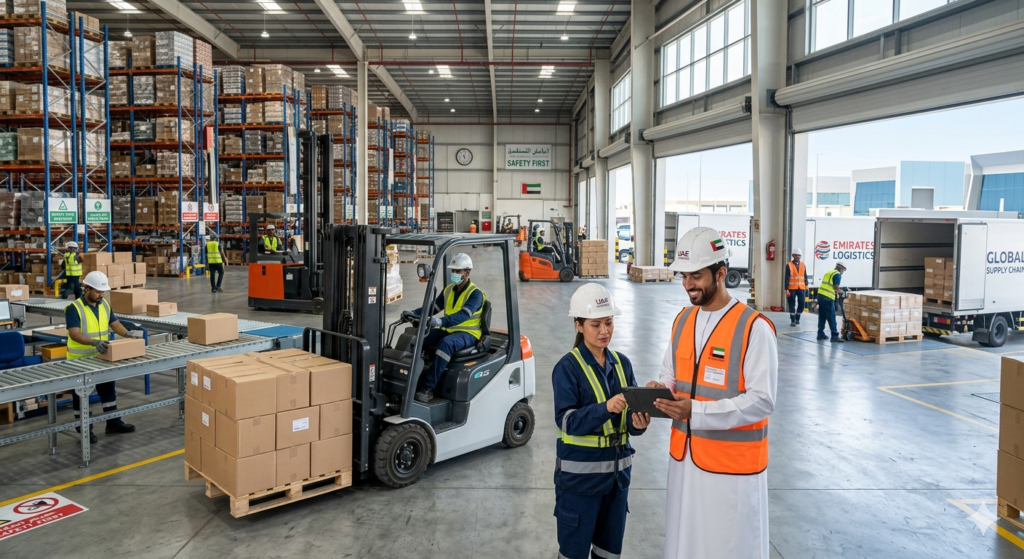
The UAE’s logistics sector has been growing at a pace that consistently surprises analysts. According to industry trackers, the country’s e-commerce market is projected to exceed $9 billion by the end of 2026 — and behind every online order sits a real warehouse, a real team, and a real set of hands moving goods through the chain. That demand translates directly into job openings.
Dubai’s free zones — particularly Jafza (Jebel Ali Free Zone), Dubai South, and Dubai Logistics City — concentrate the largest clusters of warehousing and distribution facilities in the region. Abu Dhabi, meanwhile, pushes its own industrial muscle through KIZAD (Khalifa Industrial Zone Abu Dhabi) and the Musaffah Industrial Area. Both emirates are actively expanding their cold-chain, automotive parts, and fast-moving consumer goods (FMCG) infrastructure, which means the pipeline of roles remains healthy.
Before diving deeper, it’s worth clarifying what “Light Industrial” actually means in practical terms. Broadly speaking, it refers to work that combines physical labour with process-following in a structured indoor environment — think assembly, packaging, quality control, and small-scale manufacturing. It sits above pure heavy manufacturing in terms of safety requirements, but it doesn’t require the same level of technical credentialing that, say, electrical engineering would. For a motivated worker, the learning curve is achievable and the career trajectory is real.
Because global trade lanes continue to pass through the UAE’s ports and airports, demand for Warehouse & Light Industrial Jobs in Dubai and Abu Dhabi shows no signs of softening. In fact, the post-pandemic nearshoring trend has encouraged more multinational brands to build regional distribution hubs in the Emirates rather than relying solely on European centres — a structural shift that directly benefits job seekers in the sector.
Highly Demanded Roles in Warehouse & Light Industrial Jobs
Security & Facility Services Jobs in the UAE: Stable Career Paths for Foreign Workers
Understanding which roles actually appear on job boards — and what they involve day to day — saves you a lot of time during your search. Here’s a breakdown of the positions you’ll encounter most frequently:
Forklift Operators & Material Handlers
Forklift operators move palletised goods through receiving, storage, and dispatch zones. Because UAE warehouses handle high-value cargo, employers prioritise operators with a valid forklift licence and a clean safety record. Material handlers, on the other hand, work without powered equipment — loading, unloading, and staging goods manually or with pallet jacks.
Warehouse Associates, Pickers & Packers
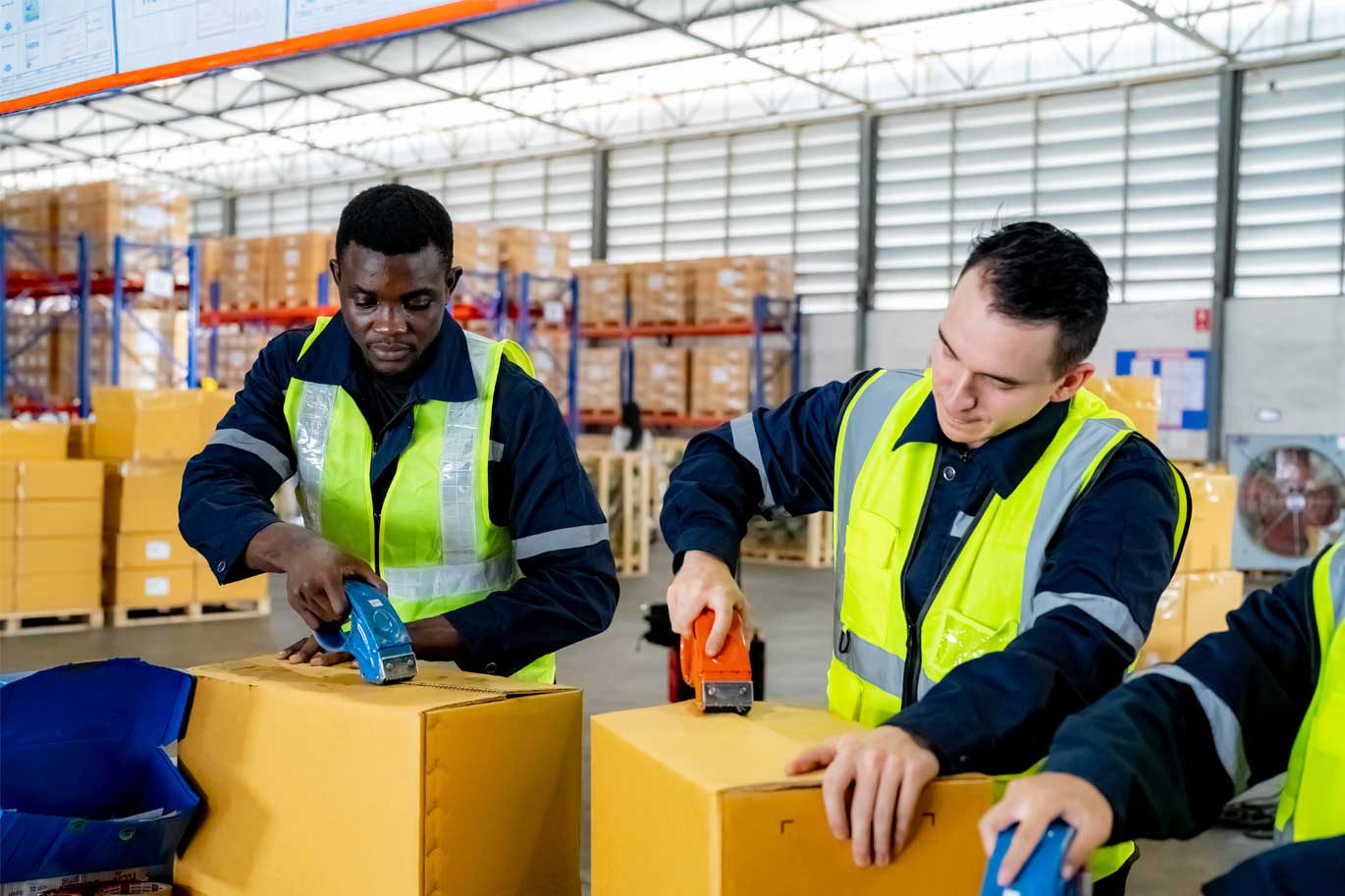
These roles form the backbone of any fulfilment operation. Pickers locate items from storage using handheld scanners or voice-picking systems, while packers prepare orders for dispatch — verifying contents, applying packaging, and meeting quality standards. Speed and accuracy matter in equal measure here.
Inventory Clerks & Storekeepers
Inventory clerks maintain stock accuracy records, process goods-received notes, and reconcile system counts with physical counts. Storekeepers manage the physical organisation of the warehouse floor — slotting products correctly, flagging slow-moving stock, and coordinating with procurement teams. Basic WMS (Warehouse Management System) literacy is increasingly expected for both roles.
Assembly & Light Production Technicians
Assembly technicians work along production or kitting lines — joining components, applying labels, testing functionality, or preparing finished goods for export. In the UAE’s growing electronics accessories and consumer goods sectors specifically, this role is in active demand. Precision, patience, and process discipline define a strong candidate here.
Across all of these roles, employers consistently value workers who show up reliably, communicate clearly with their team, and take safety rules seriously. The technical skills matter, but the human qualities often determine whether someone gets hired and whether they progress.
Essential Qualifications for Warehouse & Light Industrial Jobs
One of the great strengths of this sector is its accessibility. You don’t need a university degree to secure a well-paying role in UAE warehouse and light industrial operations. However, employers do maintain clear expectations — and understanding those expectations helps you position yourself competitively from day one.
Hard Skills & Certifications
- Valid forklift / reach truck licence (counterbalance or reach truck)
- OSHA or equivalent occupational safety awareness training
- WMS familiarity (SAP WM, Oracle WMS, or similar)
- RF scanner operation and basic barcode literacy
- Cold-chain handling knowledge (for food/pharma roles)
- Basic Microsoft Excel or inventory software skills
Soft Skills Employers Actively Seek
- Physical stamina and willingness to work rotating shifts
- Clear verbal communication in a multilingual environment
- Reliability — showing up consistently matters enormously
- Attention to detail, particularly when handling documentation
- Adaptability to new processes and system updates
- Team spirit — warehouses run on collaboration, not solo performance
Because the UAE’s warehouse workforce draws from over 150 nationalities, cultural adaptability is genuinely prized. Specifically, employers appreciate candidates who can navigate a diverse team professionally and maintain composure under pressure during peak periods — Ramadan, year-end inventory counts, and promotional sale seasons tend to push volumes sharply higher.
On the documentation side, employers typically require attested educational certificates, a valid passport with at least six months’ remaining validity, and a medical fitness certificate from an approved UAE health facility. If you’re already in the country, you’ll also need a No Objection Certificate (NOC) from your current sponsor if you plan to transfer employment.
Entry-level candidates without certifications can still pursue Warehouse & Light Industrial Jobs in the UAE by targeting companies that run in-house training programmes — several large 3PL operators, including Aramex, Agility, and DSV, actively onboard motivated candidates and provide safety certifications internally. This route can be genuinely career-changing for someone willing to start at the ground level and demonstrate commitment over time.
Where to Apply for Safely
This is, honestly, one of the most important parts of this guide — because the UAE job market, for all its opportunity, also attracts bad actors who specifically target foreign workers who are unfamiliar with local recruitment norms.
Red flags to watch for: Legitimate UAE employers and registered recruitment agencies will never charge you a placement fee. If someone asks you to pay upfront for visa processing, training, uniforms, or a “deposit” before you’ve signed a verifiable UAE labour contract — walk away immediately. Always verify that any agency you work with holds a valid licence from the UAE Ministry of Human Resources and Emiratisation (MOHRE).
The safest strategy is to apply through established, reputable job platforms that vet their employer listings. However, you should also cross-check any offer you receive by searching the company on the MOHRE’s official portal before accepting. Genuine companies in the UAE free zones and mainland areas have verifiable trade licences, and asking to see one is entirely reasonable.
Beyond online platforms, many major logistics operators accept direct applications through their corporate careers pages. Applying directly removes the intermediary entirely and signals genuine interest in the company specifically — which recruiters notice. Here are the verified portals and application channels you should use when searching for Warehouse & Light Industrial Jobs in the UAE:
- Indeed UAEhttps://ae.indeed.com
- GulfTalenthttps://www.gulftalent.com
- Naukrigulfhttps://www.naukrigulf.com
- Bayt UAEhttps://www.bayt.com/en/uae/
- Aramex Careers Portalhttps://www.aramex.com/ae/en/careers
When you set up job alerts on these platforms, use specific search terms rather than broad ones. Terms like “forklift operator Dubai,” “warehouse associate Jafza,” or “inventory clerk Abu Dhabi” will surface more relevant results than a generic “warehouse jobs UAE” search. Specificity also signals to algorithms — and to recruiters who review your applications — that you understand the roles you’re pursuing.
Actionable Tips to Stand Out for Warehouse & Light Industrial Jobs
Hundreds of candidates apply for the same postings every week — particularly for entry-level and mid-level Warehouse & Light Industrial Jobs in Dubai and Abu Dhabi. However, most of those applications are poorly tailored, rushed, or riddled with gaps that make shortlisting easy to skip. You can separate yourself by doing the fundamentals really well.
Optimize Your CV for ATS Systems
Most large UAE employers use Applicant Tracking Systems to filter CVs before a human sees them. Because of this, include exact role titles from the job description in your CV — if the posting says “Warehouse Associate,” use that exact phrase, not “Goods Handler.” Mirror their language thoughtfully throughout, and avoid tables, text boxes, or graphics that confuse parsing software.
Lead With Quantified Achievements
Instead of writing “responsible for picking orders,” write “picked and packed up to 400 orders per shift with 99.8% accuracy across an 18-month tenure.” Numbers tell recruiters exactly what you can deliver — and in a competitive market, specificity builds credibility far faster than vague job descriptions.
Highlight Shift Flexibility Explicitly
UAE warehouses operate across morning, afternoon, and night shifts — particularly in FMCG, e-commerce, and pharmaceutical logistics. As a result, candidates who explicitly state their availability for rotating shifts, overtime periods, and weekend work during peak seasons move up shortlists noticeably faster than those who don’t address it at all.
Get Your Documents Attested Early
UAE employers often need attested copies of your educational and professional certificates before they can process a visa application. Accordingly, arrange attestation through your home country’s relevant ministry and the UAE embassy before you start applying — delays in attestation are one of the most common reasons job offers fall through at the final stage.
Build a LinkedIn Profile That Matches Your CV
A surprising number of UAE recruiters search LinkedIn proactively rather than waiting for applications. Because of this, ensure your LinkedIn profile reflects your CV accurately, uses industry keywords (forklift, WMS, GRN, cycle count, dispatch), and includes a professional photo. Inconsistencies between your CV and LinkedIn profile raise doubt — so keep them aligned.
Follow Up Professionally After Applying
If you apply directly through a company’s careers portal and don’t hear back within 10 days, it’s entirely acceptable to follow up once — politely and briefly — via LinkedIn or email. A short note reaffirming your interest and availability signals initiative without being pushy. Many candidates who land roles credit a well-timed, respectful follow-up as the reason they got called in.
Final Thoughts on Securing Your Next Logistics Role
The UAE’s supply chain runs because of people — real, skilled, dedicated workers who show up every shift and keep the goods moving. Behind every product that reaches a customer’s door, there’s a picker, a packer, a forklift operator, or an inventory clerk whose work made it happen. That’s you. Your skills aren’t just useful in this economy — they’re essential to it.
The market for Warehouse & Light Industrial Jobs in the UAE is competitive, yes — but it’s also genuinely accessible to motivated, prepared candidates who pursue it the right way. Use the verified portals above. Apply with a tailored, ATS-ready CV. Be honest about your experience and flexible about your availability. And above all, protect yourself by verifying every offer before you commit.
The Emirates has built something extraordinary — and it needs people like you to keep building it.