
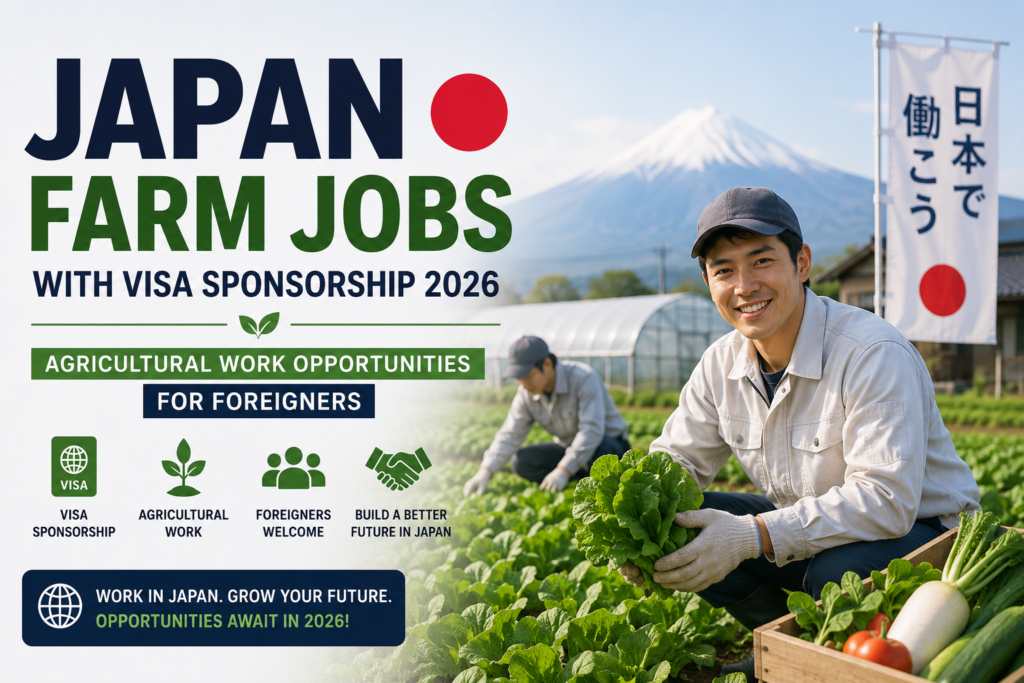

Japan farm jobs have become one of the most accessible and legally supported pathways for foreign workers seeking employment in Japan — and in 2026, demand has never been stronger. Japan’s agricultural workforce is aging rapidly, with the average farmer now well into their sixties. Meanwhile, domestic youth show limited interest in farm work, leaving thousands of positions unfilled across rice paddies, vegetable farms, orchards, and livestock facilities every season.
Japan’s Ministry of Agriculture, Forestry and Fisheries (MAFF) has repeatedly flagged agriculture as a critical labor-shortage sector. To address this, the Japanese government has formalized two structured visa pathways specifically designed to bring overseas workers into the fields legally and with full labor protections. These aren’t grey-market arrangements or short-term workarounds — they’re official residence statuses backed by Japanese law.
If you’re a foreign national considering agricultural employment in Japan, this guide will walk you through everything you need to know: who qualifies, which visa applies to your situation, what the work actually looks like, how much you can expect to earn, and exactly how to apply. Let’s cut through the noise and give you what you actually need.
Eligibility Requirements for Foreign Agricultural Workers

Before diving into the visa specifics, it’s worth understanding what Japan generally requires of any foreign worker entering the agricultural sector. The exact criteria vary depending on which visa route you pursue, but some baseline requirements are consistent across both pathways.
General Eligibility Criteria For Japan Farm Jobs
- Age: Most programs accept applicants between 18 and 40 years old, though this varies by program and sending country agreement.
- Health: You must pass a medical examination confirming you’re fit for physical labor. Conditions such as communicable diseases or significant mobility limitations will typically disqualify applicants.
- Criminal record: No serious criminal history. Background checks are conducted as part of the application process.
- Relevant experience or willingness to train: Prior agricultural experience helps but is not always mandatory — especially under the TITP, which treats Japan itself as the training environment.
- Japanese language ability: Required under the SSW visa (basic level); TITP applicants must also demonstrate minimal communicative ability.
- Sponsorship by a registered employer or sending organization: You cannot self-apply; a licensed Japanese employer or registered sending organization must sponsor your placement.
Important Note on Nationality
Japan’s TITP operates through bilateral agreements between Japan and specific sending countries. As of 2026, eligible countries include Vietnam, Indonesia, the Philippines, Thailand, Myanmar, Cambodia, China, and several others. The SSW visa does not carry the same nationality restrictions, though receiving countries may differ in the administrative channels available to them.
Visa Sponsorship Pathways for Japan Farm Jobs
See also: Morocco Farm Work Jobs in 2026: Agricultural Employment Opportunities for Foreigners
USA Farm Work Visa Sponsorship Jobs 2026: Agricultural Jobs for Foreigners Explained
This is the section most guides get wrong — or gloss over entirely. There are two legally distinct visa mechanisms for Japan farm jobs with visa sponsorship, and understanding the difference matters enormously when planning your application.
Visa Type 1 & 2
Specified Skilled Worker Visa
(Tokutei Ginou / 特定技能)
- Open to foreigners who pass a Japanese-language test and a sector-specific skills evaluation
- Agriculture is a designated SSW sector
- SSW Type 1: up to 5 years total, no family accompaniment
- SSW Type 2 (agriculture): longer-term residence, family accompaniment permitted
- Employer must be a registered “Specific Skilled Worker Accepting Organization”
- Worker is hired directly — no sending organization intermediary required
- Salary must meet or exceed domestic minimum wage levels
Technical Intern Training Program
(TITP / 技能実習)
- Designed to transfer Japanese agricultural skills to workers from developing countries
- Duration: 3 years (extendable to 5 for workers who pass a skills test)
- Applicants are recruited through a registered sending organization in their home country
- Accommodation, meals, and basic Japanese language training typically provided
- Administered by a Supervising Organization in Japan
- Movement between employers is heavily restricted
- Subject to oversight by the Organization for Technical Intern Training (OTIT)
Which Visa Pathway Is Right for You As A Japan Farm Jobs Applicant
The honest answer depends on your background and long-term goals. If you have prior agricultural experience, can pass a basic Japanese proficiency test (JLPT N4 level or equivalent skills evaluation), and want more employment flexibility, the SSW visa is the stronger long-term option. The SSW Type 2 designation in agriculture is one of the few pathways that can eventually lead to permanent residence without needing to change status.
If you’re a first-time Japan-bound worker from a TITP-eligible country and you’re applying through a legitimate sending organization, the TITP may be your practical entry point. Be cautious, however: the TITP has faced significant criticism for worker exploitation in some cases. Always verify that your sending organization is officially registered with OTIT and that your supervising organization in Japan holds a valid license. Japan has been strengthening enforcement significantly since 2023, but due diligence on your part remains essential.
TITP Reform Update (2024–2026)
Japan passed legislation in 2024 to restructure the TITP into a revised framework called the “육成就労” (Ikusei Shuro / Skilled Development Employment) system, improving worker rights and mobility. As of 2026, both the legacy TITP and the transitional new framework operate in parallel. Check with OTIT or your sending organization for the most current designation applicable to your application.
Official Government Resources
- Ministry of Agriculture, Forestry and Fisheries (MAFF) — Japan’s lead agency for agricultural labor policy
- Ministry of Foreign Affairs of Japan (MOFA) — Visa information, bilateral agreements, consular contacts
- Organization for Technical Intern Training (OTIT) — TITP supervising organization registry and worker support
- Immigration Services Agency of Japan — SSW visa procedures and registered employer lists
Types of Japan Farm Jobs Available for Foreign Workers
Japan’s agricultural landscape is more varied than many outsiders expect. The country produces a remarkable diversity of crops and livestock across its prefectures — from Hokkaido’s vast dairy farms and potato fields in the north, to the vegetable greenhouses of Ibaraki and Chiba near Tokyo, to the subtropical fruit farms of Okinawa in the south. Japan farm jobs span a wide range of roles, and the SSW visa for agriculture currently covers the following designated activities:
Crop Cultivation (耕種農業)
- Rice farming: Japan’s staple crop, grown primarily in Niigata, Akita, Yamagata, and Hokkaido. Work includes transplanting seedlings, irrigation management, and harvesting.
- Vegetable cultivation: Year-round work across greenhouses and open fields. Common crops include cabbage, lettuce, onions, tomatoes, and sweet potatoes.
- Fruit growing: Apples (Aomori), grapes (Yamanashi), peaches (Okayama), and strawberries (Tochigi) are major sectors. Work involves pruning, pollination, picking, and packing.
- Floriculture: Cut flower and potted plant production in greenhouse environments, requiring careful handling and climate management.
Livestock Farming (畜産農業)
- Dairy farming: Especially prevalent in Hokkaido, involving milking, feeding, and animal welfare tasks on large-scale farms.
- Beef cattle raising: Including famous Wagyu beef operations, which require skilled feeding and care routines.
- Pig and poultry farming: Large-scale operations concentrated in several rural prefectures, requiring workers comfortable with indoor industrial environments.
Seasonal Nature of Some Roles
Many crop-related jobs are highly seasonal. Apple picking in Aomori, for example, peaks in September–November. Strawberry cultivation runs November through May. If your visa allows it, some workers develop multi-crop seasonal schedules, moving between farms in different prefectures. Confirm with your employer in advance whether the role is year-round or seasonal before signing any agreement.
Salary Expectations and Working Conditions
Let’s be direct: Japan farm jobs are not high-income positions by Japanese standards. But for workers coming from countries with lower wage floors, the combination of a stable yen salary plus employer-provided housing can represent a significant financial opportunity. Here’s a realistic breakdown.
Role / Sector |
Monthly Gross (¥) |
Approx. USD |
Notes |
|---|---|---|---|
| General crop worker (entry) | ¥150,000–¥170,000 | ~$1,000–$1,130 | TITP baseline rate |
| Vegetable / greenhouse worker | ¥160,000–¥190,000 | ~$1,065–$1,265 | Year-round role |
| Fruit farm worker (seasonal) | ¥165,000–¥200,000 | ~$1,100–$1,330 | Peak-season overtime common |
| Dairy / livestock worker | ¥180,000–¥220,000 | ~$1,200–$1,465 | Early morning shifts typical |
| SSW Type 2 / experienced worker | ¥200,000–¥260,000 | ~$1,330–$1,730 | Includes supervisory roles |
Exchange rate reference: ¥150 ≈ USD 1.00 (approximate 2026 rate). Actual earnings depend on region, employer, overtime hours, and deductions for housing/meals.
What’s Typically Included in Compensation Packages
- Employer-provided housing: Extremely common in agricultural placements. Quality varies — some farms offer private rooms, others shared dormitory-style accommodation. Always ask for specifics before accepting.
- Meals or cooking facilities: Some employers provide meals; others give access to a shared kitchen. Confirm this early.
- Social insurance: Legal employers are required to enroll workers in Japan’s health insurance and pension system (厚生年金). Foreign workers can reclaim pension contributions upon leaving Japan.
- Transportation subsidies: Increasingly common, particularly for farms in rural areas not served by public transit.
Working Hours and Days Off
Standard working hours in Japan are 8 hours per day, 40 hours per week under the Labor Standards Act. In practice, agricultural work during peak seasons often involves overtime. Under the SSW visa framework, overtime is compensated at a minimum of 125% of the base hourly rate. Under TITP, labor law protections are equivalent to those of Japanese nationals — though enforcement historically has been inconsistent. OTIT maintains a consultation hotline for intern trainees facing labor issues.
Step-by-Step Application Process for Japan Farm Jobs
The application process differs depending on which visa pathway you’re using, but the general sequence is similar. Here is a realistic step-by-step breakdown.
Determine your visa pathway
Prepare your documents
Pass the required tests (SSW pathway)
Secure employer sponsorship
Apply for your Certificate of Eligibility (COE)
Apply for your visa at a Japanese consulate
Depart for Japan and complete entry procedures
Benefits and Challenges of Taking Farm Jobs in Japan
No career guide worth its salt glosses over the difficulties. Japan agricultural work is genuinely rewarding in many ways — and genuinely demanding in others. Here’s an honest assessment.
Benefits
- Legal protection: Both visa pathways come with full application of Japan’s Labor Standards Act, meaning overtime pay, rest days, and workplace safety standards are legally guaranteed.
- Pathway to longer-term status: The SSW Type 2 agriculture visa is one of the few routes that can lead toward long-term residence in Japan without needing to convert to a different status category.
- Accommodation included: Housing costs in rural Japan are extremely high relative to local salaries — having accommodation provided can represent savings equivalent to ¥40,000–¥80,000 per month.
- Cultural and language immersion: Living and working in rural Japan offers a depth of cultural experience that urban tourism never provides. Many workers report that their Japanese improves dramatically within six months.
- Reliable demand: Japan’s agricultural labor shortage is structural, not cyclical. Job availability is consistent and unlikely to diminish in the near term.
Challenges
- Rural isolation: Most farm jobs are in remote rural areas with limited English infrastructure, few international communities, and minimal entertainment options. This is a significant adjustment for many workers.
- Physical intensity: Agricultural work is hard on the body. Long hours during harvest seasons, outdoor work in variable weather, and repetitive physical tasks are the norm — not the exception.
- Language barrier: While the SSW test sets a basic language bar, day-to-day farm communication in Japanese can still be challenging, particularly when instructions are technical or delivered quickly.
- TITP restrictions on mobility: If you’re on the TITP, switching employers is extremely difficult without the supervising organization’s cooperation. Workers who face abusive employers have historically had limited options — though the 2024 reform legislation is designed to address this.
- Income limitations: Agricultural wages are not high by Japanese urban standards. If your goal is to save aggressively, you will need to be disciplined with spending in a country where food, transport, and daily goods are not cheap.
Frequently Asked Questions
Can foreigners get farm jobs in Japan with visa sponsorship?
What is the SSW visa for agriculture in Japan?
How much do foreign farm workers earn in Japan?
Which countries can apply for Japan farm jobs under TITP?
Do I need to speak Japanese to work on a Japanese farm?
Is it safe to apply through private recruitment agencies?
Final Guidance: Taking the Next Step
Japan farm jobs represent a genuine, legally supported opportunity for foreign workers in 2026. The country’s agricultural labor shortage is not going away — and the Japanese government has invested real legislative effort in making overseas recruitment work. Whether you enter through the SSW visa or the TITP, you’ll have access to labor protections, employer-provided housing, and a structured pathway to live and work in one of the world’s most culturally distinctive societies.
The path requires preparation: passing language and skills tests if you’re pursuing the SSW route, verifying the registration of sending organizations if you’re applying through TITP, and being realistic about the physical demands and rural lifestyle that agricultural work in Japan entails.
Start by exploring the official resources. The Ministry of Agriculture, Forestry and Fisheries and the Ministry of Foreign Affairs are your most reliable sources of current information — not third-party recruitment websites. The OTIT portal allows you to verify the legitimacy of any TITP supervising organization before you commit.
Do the groundwork, choose the right pathway for your situation, and approach the process methodically. Japan’s fields are waiting for workers who are serious about the opportunity.