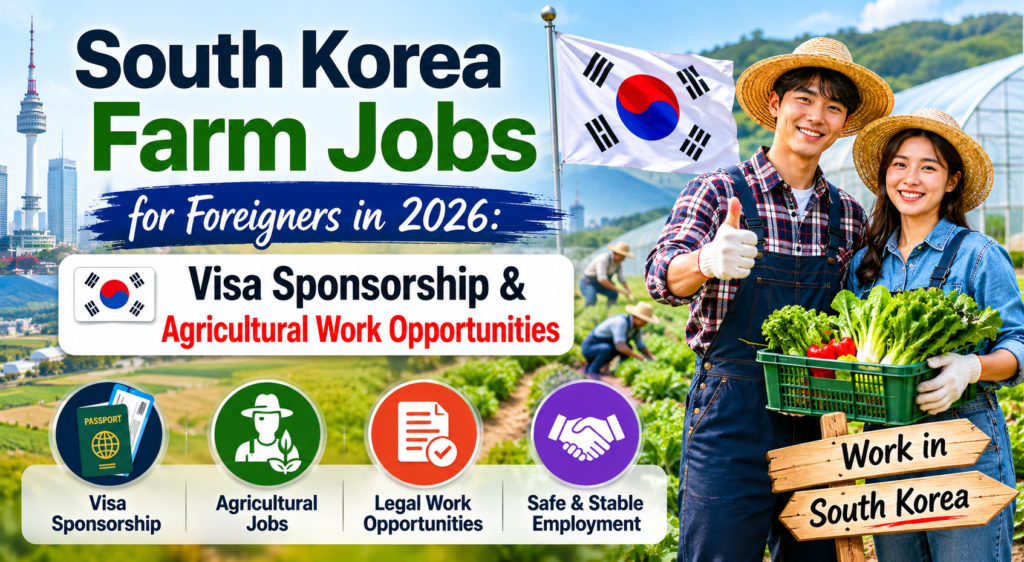

But here’s what this guide won’t do: pretend the path is smooth or simple. African applicants face compounded obstacles — from a limited number of countries with active government agreements to a flood of predatory agents who charge significant fees for “guaranteed placement” that doesn’t exist. Scams targeting African job seekers hoping to work in South Korea are widespread, and the financial damage they cause is lasting.
The 2026 Agricultural Work Landscape in South Korea
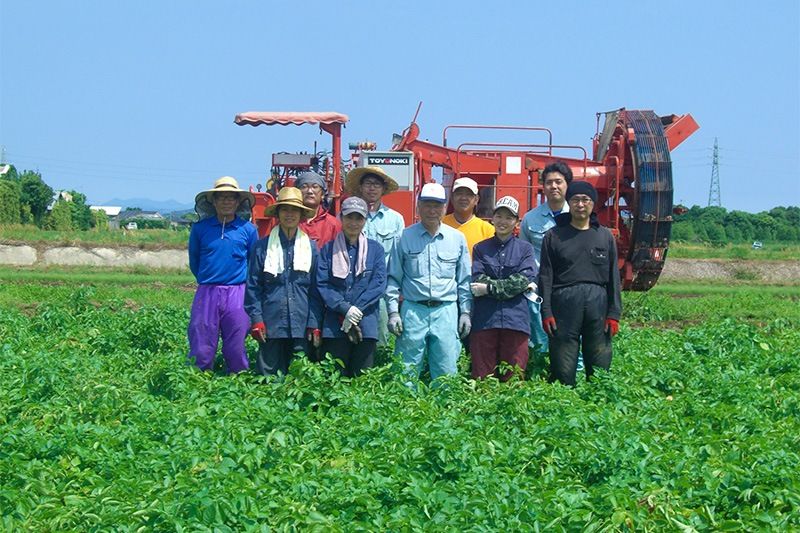
South Korea’s rural workforce challenge is structural, not temporary. Young, educated Koreans tend to move to major cities and pursue white-collar careers. Farm work — physically demanding, often seasonal, and located far from urban centers — is increasingly difficult to staff locally. This has pushed the government to open agricultural and fisheries sectors to international workers in a deliberate, government-managed way.
The Ministry of Employment and Labor (MOEL) manages the foreign labor intake through its Employment Permit System (EPS), a bilateral framework built on Memoranda of Understanding (MOU) with selected countries. Recent policy discussions and recruitment reports suggest continued expansion of non-professional foreign labor intake to address these persistent gaps — though exact annual quotas are reviewed by government cycle and can shift year to year.
For agricultural work specifically, both the E-8 Seasonal Worker Visa and the E-9 Non-Professional Employment Visa provide legal entry points. Each has very different structures, timelines, and eligibility gates — and understanding the difference before you apply is critical.
Context Note
South Korea held its first-ever Korea-Africa Summit in 2024, which included trade and investment frameworks with multiple African nations. This is a sign of growing bilateral engagement — but as of 2026, it has not yet directly expanded EPS MOU coverage to African countries. Applicants should verify current eligibility through official channels.
Understanding E-8 and E-9 Visas for South Korea Farm Jobs for Foreigners
See also: Warehouse Jobs in Saudi Arabia for Foreign Workers: Logistics & Industrial Careers in 2026
Urgently Hiring: Top Security Guards in Saudi Arabia — Jobs for Foreign Workers in 2026
Two visa types govern most agricultural work for foreigners in South Korea. They look similar on the surface but work very differently in practice. Here’s what you need to understand about each one before making any decisions.
Short-Term Seasonal
E-8 Visa
Government-to-government MOU pathway. Seasonal, typically 5–8 months. Administered through local authority agreements between Korean districts and foreign governments.
Long-Term Work Permit
E-9 Visa
Employment Permit System (EPS) pathway. Up to nearly 5 years. Requires passing the EPS-TOPIK Korean language test and being selected from an official talent pool.
The E-8 Seasonal Worker Visa for South Korea Farm Jobs
The E-8 visa is specifically designed for seasonal agricultural and fisheries work. It typically allows stays of five to eight months, depending on the employer’s needs and the terms of the relevant agreement. What makes this visa unique is its administrative structure: it flows through agreements between Korean local governments and foreign local governments, not through the national EPS framework.
In practice, this means a Korean municipality signs an MOU with a corresponding authority in a sending country. That foreign authority then recommends eligible residents to the Korean side, who allocate workers to farms. The process is managed by governments on both ends — which is precisely what makes it legitimate, but also what makes eligibility very location-specific.
Important for African Applicants
The E-8 pathway depends entirely on whether a specific MOU exists between a Korean local government and a government body in your country. Currently, most active E-8 agreements are with countries in Asia. If you’re from an African country, your first step should be contacting your national labor ministry to ask whether any such agreement is in place — not paying a recruiter to find out for you.
The E-9 Non-Professional Visa for South Korea Farm Jobs
The E-9 is South Korea’s main managed labor visa for non-professional workers, and it covers agricultural work alongside manufacturing, construction, and fisheries. It’s administered entirely through the Employment Permit System, a program the Korean government designed specifically to eliminate corrupt private recruitment.
To access the E-9 system, a worker must register through their country’s designated EPS registration body, pass the EPS-TOPIK Korean language proficiency test, and be placed into the EPS talent pool. Employers then select from that pool based on test scores, preferences, and sector needs. The full cycle from registration to arrival in Korea typically spans several months.
As of 2026, the EPS operates through MOUs with 16 countries — all currently in Asia and the Pacific. African countries are not yet part of this MOU structure. This is a hard eligibility barrier that no agent or recruiter can bypass.
Feature |
E-8 Seasonal Visa |
E-9 Non-Professional (EPS) |
|---|---|---|
| Typical Duration | 5–8 months | Up to ~4 years 10 months (extendable) |
| Sector Coverage | Agriculture & Fisheries only | Agriculture, Manufacturing, Construction, Fisheries, Services |
| Administered By | Local government MOU agreements | National EPS system (MOEL) |
| Language Test Required | Not typically required | Yes — EPS-TOPIK |
| African Country Access | Verify per country MOU | Not currently active |
| Employer Housing | Generally provided | Generally required by law |
| Wage Protection | Korean minimum wage applies | Korean minimum wage enforced via EPS |
| Legitimate Entry Point | Yes — if MOU exists | Yes — through official EPS process |
Who Can Actually Apply For South Korea Farm Jobs
This is the section most guides skip past — or dress up in vague language. Let’s be direct with you.
The E-9 EPS pathway, which is the most structured and widely available route to farm work in Korea, currently covers 16 countries. Based on publicly available information as of early 2026, those countries are concentrated in East, Central, and South Asia — including countries like Vietnam, the Philippines, Indonesia, Nepal, Cambodia, and others. No African country currently holds an active EPS MOU that opens access to E-9 visa registration.
The E-8 pathway is more decentralized — individual Korean municipalities can sign their own agreements with foreign local authorities. It’s theoretically possible for an African country’s regional government to have such an agreement in place, but this is rare, and you would need to confirm it through official government channels in your own country, not through a third-party recruiter.
What This Means in Practice for South Korea Farm Jobs Applicants
If someone is offering you a “South Korea farm job placement” and your country doesn’t have an active MOU with the Korean government, they are not offering you a legal pathway. They are taking your money. This applies regardless of how professional their website looks, how official their documents appear, or how many “testimonials” they show you.
That said, the situation is not static. South Korea’s deepening engagement with Africa — evidenced by the 2024 Korea-Africa Summit — suggests potential for expanded labor agreements in the future. The most productive thing you can do is monitor your national labor ministry’s official announcements, and engage with reputable platforms that will update their listings as agreements develop.
Wages, Housing, and What to Realistically Expect
One of the genuine advantages of South Korea’s EPS-managed labor system is that workers are covered by the same minimum wage protections as Korean nationals. Wages are not a matter of negotiation with individual farm owners — they are legally enforced floors.
Based on available data from early 2026, the minimum monthly wage for EPS-category workers is reported at approximately KRW 2,060,740 — roughly equivalent to USD 1,500–1,550 depending on exchange rates at the time of payment. This figure is updated annually, so verify the current amount through the official EPS portal when you apply.
Benefit |
Legal Requirement |
Notes |
|---|---|---|
| Base Salary | At or above Korean minimum wage | Updated annually by government |
| Overtime Pay | Paid separately from base wage | Particularly common during harvest seasons |
| Accommodation | Employers generally required to provide housing or allowance | Varies by farm and region — confirm before signing contract |
| Industrial Accident Insurance | Enrollment required from employers | Covers work-related injuries |
| Health Insurance | Applicable under EPS framework | Confirm specifics in your employment contract |
Living conditions vary between farms and regions — agricultural work in Korea can be physically demanding, and rural accommodation tends to be basic rather than comfortable. Workers who have gone through the EPS system legally report reasonable living standards, but this is not a luxury work environment. Approach it for what it is: structured labor migration with fair wages and legal protections.
Before You Sign Any Contract
Request a full employment contract specifying wages in Korean Won (KRW), working hours, accommodation details, and deductions. If a recruiter or employer refuses to provide a written contract before you pay anything, walk away. Legitimate employers under the EPS system are required to provide this documentation.
Scam Prevention: The Section That Could Save You Everything
Fraudulent recruitment targeting Africans who want to work in South Korea is a significant and documented problem. The tactics are sophisticated, the emotional appeal is real, and the financial damage to victims can set families back years. This section is not here to discourage you — it’s here to protect you.
How These Scams Typically Work
Most scams operate through social platforms — particularly WhatsApp groups, Facebook pages, and Instagram accounts that present as “Korean recruitment agencies” or “official overseas employment consultants.” They often feature convincing branding, photos of apparent Korean farms, and “testimonials” from supposed successful candidates.
The pitch is usually some version of: “Pay a placement fee of [amount] and we will secure your South Korea farm visa.” Sometimes the fee is framed as a processing fee, visa fee, insurance, or “registration” — but the mechanism is the same. You pay; the documentation never arrives, or arrives as a convincing fake; and the recruiter disappears or demands more money.
Red Flags — Stop Immediately If You Encounter These
- Any recruiter asking for large upfront fees before you have a signed contract from a named Korean employer
- Offers found in WhatsApp groups, Telegram channels, or Facebook posts — not official government portals
- “Guaranteed visa” language of any kind. Visas are issued by governments, not agents.
- Requests to wire money internationally before any official documentation
- Recruiters who claim to “have connections” at the Korean embassy
- Urgency tactics: “Only 5 slots left, pay today”
Legitimate recruitment under the EPS system is entirely government-coordinated. There are no private agents who can open EPS eligibility for you — it is managed country-to-country. If your country doesn’t have an MOU, no agent can change that. Full stop.
For alternative cultural exchange pathways — like WWOOF — there are nominal membership fees that are small and fully transparent. This is categorically different from recruiters charging substantial sums for supposed farm job placements.
Safe and Legitimate Paths to South Korea Farm Jobs for Foreigners
Given the current eligibility landscape for African applicants, here are the pathways that are genuinely worth exploring — in order of their accessibility for most African nationals.
1. WWOOF Korea — Cultural Exchange Through Farm Work
WWOOF Korea (World Wide Opportunities on Organic Farms) is a cultural exchange program connecting volunteers with organic farms in South Korea. Volunteers typically receive accommodation and meals in exchange for farm work — it’s not paid employment, but it is a legitimate, legal, and deeply immersive way to experience Korean agricultural life.
WWOOF is not a work visa pathway, and it won’t replace a salary. But for applicants who want to build experience, improve their Korean language skills, and establish credible connections in Korean agriculture, it’s a real starting point. The program operates through a transparent membership system, and it’s used by people from across Africa who have accessed it on tourist or exchange visas.
2. Jobploy and Official Job Listing Platforms
Jobploy is one of the more structured foreign recruitment platforms operating in Korea’s labor market. While many listings target workers from countries already within the EPS system, monitoring such platforms gives you a real-time view of what employers are actively seeking and what sectors are hiring. It also positions you to act quickly if your country’s eligibility status changes.
3. The Official EPS Portal — Your Primary Reference
Regardless of your current eligibility, the official EPS South Korea portal is the single most reliable source of truth on which countries have active agreements, what the current requirements are, and when registration periods open. Bookmark it. Check it regularly. Don’t rely on second-hand information from WhatsApp groups or Facebook pages.
4. Hi Korea — Visa and Immigration Information
For official visa information, immigration requirements, and status updates on work permit categories, the Hi Korea portal is the Korean Immigration Service’s official English-language resource. If you have questions about visa categories, document requirements, or policy changes, this is where to look — not forums, not social media, not third-party YouTube channels.
5. Your Own National Labor Ministry
This is the most underused resource. Many African labor ministries maintain active correspondence with Korean counterparts and are the first to know when new bilateral labor agreements are negotiated. Contacting your country’s Ministry of Labor or Ministry of Employment directly — asking whether any MOU with South Korea exists or is in development — is free, official, and far more reliable than any online recruiter.
Step-by-Step Application Path for South Korea Farm Jobs for Foreigners
If your country does have an active EPS agreement, or you are positioned to apply through a verified E-8 MOU, here is the general path the application follows. Note that specific steps may vary depending on your country’s arrangements.
Confirm Your Country’s EPS Eligibility
Register Through Your Country’s Official EPS Sending Agency
Sit the EPS-TOPIK Korean Language Test
Complete a Medical Examination
Enter the EPS Talent Pool and Wait for Employer Matching
Receive and Review Your Employment Contract
Apply for the E-9 Visa at the Korean Embassy in Your Country
Arrive, Register, and Begin Work
Pre-Application Checklist for African Applicants
Before doing anything else — before speaking to any recruiter, before paying any fee, before sending any document — work through this checklist.
Reality Check for Applicants Of South Korea Farm Jobs
You deserve honest expectations, not a motivational speech. Here’s what the landscape actually looks like for most African applicants in 2026.
- Direct EPS access is currently unavailable for most African nationals. This is a policy reality, not a reflection of your skills or work ethic. The EPS MOU list is limited to 16 countries, none of which are in Africa.
- The E-8 pathway requires verification country by country and is not a widely available route for most African applicants at this time. Check — don’t assume.
- Anyone charging large fees for South Korea farm placement is almost certainly running a scam. The EPS system was designed to eliminate exactly this kind of exploitation. If someone can “get you in,” they are lying.
- WWOOF Korea is real, legitimate, and accessible — but it’s a cultural exchange program, not an employment pathway. It doesn’t provide a salary or a work visa.
- The policy landscape can change. The Korea-Africa Summit in 2024 marked a genuine shift in engagement between South Korea and African governments. New labor MOUs are possible in the coming years. Staying connected to official channels means you’ll be ready when that happens.
- Learning Korean is the single best investment you can make right now. EPS-TOPIK scores determine selection priority. Strong Korean language skills also open other legal pathways and employment opportunities in Korea beyond agriculture.
The opportunity is real in the long view. The current gates are narrow. That’s the honest picture — and you deserve to plan based on it.
Start With the Right Sources
Every legitimate step starts with official platforms. Bookmark these now before searching anywhere else.