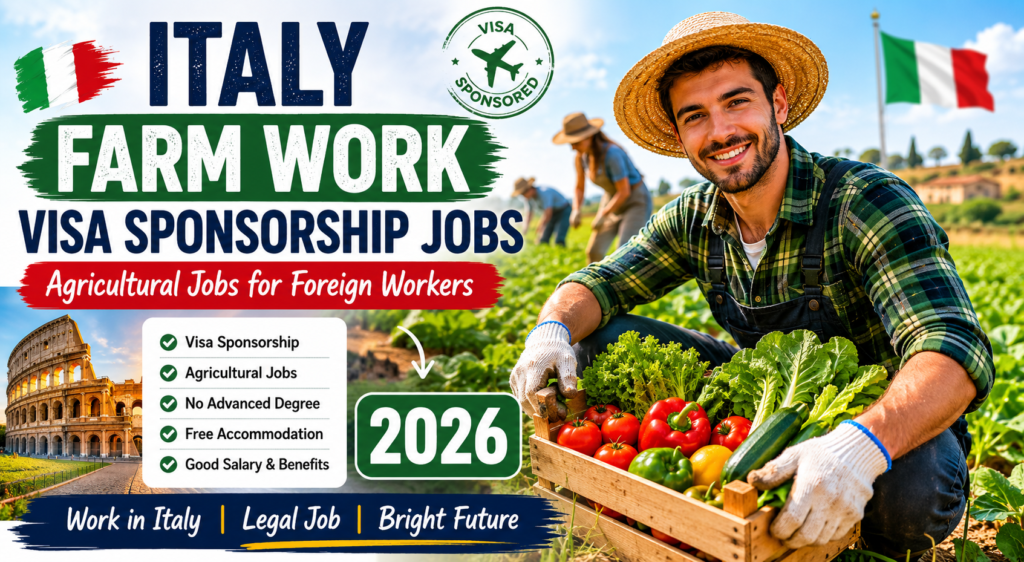

What Is Italy Farm Work Visa Sponsorship?
Italy’s agricultural landscape is one of the most productive in Europe. From the sun-scorched olive groves of Puglia to the iconic vineyards cascading across Tuscany and the apple orchards of Trentino-Alto Adige, the country’s farms stretch across almost every climate zone imaginable. The problem? An ageing domestic workforce and persistent internal migration to Italian cities have left the agricultural sector chronically short of labor.
The result is a genuine and sustained demand for international farmhands, harvesters, and agricultural technicians — workers who are willing to roll up their sleeves in exchange for a legal European work experience, a respectable salary, and a real foothold on Italian soil.
Why Italy’s Labor Shortage Matters for You
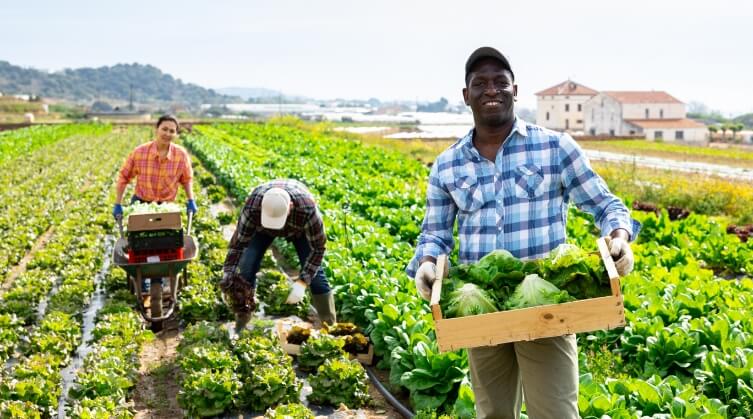
Italian farms need you more than you might realize. The country’s agricultural sector contributes over €30 billion annually to the national economy, yet domestic labor supply falls short of demand every single harvest season. That structural gap is precisely why the Italian government expanded its quota system to historically high levels in 2026.
The Decreto Flussi 2026–2028 Explained
If you want to understand Italy farm work visa sponsorship, you need to understand the Decreto Flussi — Italy’s annual “Flow Decree” that acts as the country’s official immigration shopping list. Published by the Council of Ministers, the decree specifies exactly how many non-EU workers can enter Italy for each category of employment during a given period.
The 2026–2028 Decreto Flussi is the most generous in Italy’s recent immigration history. Under it, Italy has authorised a total of 497,550 work permits over three years, with 164,850 available in 2026 alone. Of those, 88,000 seasonal permits were ring-fenced for agriculture and tourism combined, with approximately 40,075 of those slots designated specifically for seasonal agricultural roles.
How the Quota System Works
Italian employers who want to hire non-EU workers must apply through the Sportello Unico per l’Immigrazione (the Single Immigration Desk) on officially announced “click-days.” On these dates, applications are queued chronologically — first come, first served. The employer submits a request for a Nulla Osta (clearance document), which is the formal basis of your visa sponsorship.
Once the Nulla Osta is approved, it is sent to the Italian embassy or consulate in your home country. You then apply for a D-type seasonal work visa, travel to Italy, and convert your visa into a permesso di soggiorno per lavoro stagionale (seasonal work residence permit).
Decree Highlights for 2026
- Total 2026 non-EU work permits: 164,850
- Seasonal permits (agriculture + tourism): 88,000
- Agriculture-specific seasonal slots: ~40,075
- Multi-year seasonal permits (returning workers): 5,000
- Non-seasonal agriculture included under subordinate work quota
- Countries with bilateral agreements receive priority quota access
Seasonal vs. Non-Seasonal Italy Farm Work
The distinction matters enormously for your planning. Seasonal farm work in Italy typically runs from April to November, covering planting, cultivation, and harvest periods. Contracts are fixed-term, usually three to nine months, and employers are required to provide basic accommodation in many cases.
Non-seasonal agricultural work — including roles on livestock farms, in agricultural cooperatives, or in food processing attached to farms — falls under the broader subordinate work quota. These contracts can be permanent or long-term, and workers who complete a seasonal stint successfully have a stronger pathway toward this more stable category in subsequent years.
Types of Italy Farm Work Agricultural Jobs Available
See also: Portugal Farm Work Jobs With Visa Sponsorship in 2026: Apply as a Foreign Worker
Spain Farm Jobs for Foreigners: Seasonal Agricultural Work With Visa Sponsorship 2026
Italy’s agricultural sector is remarkably diverse, meaning Italy farm work opportunities span a wide spectrum of skill levels, physical demands, and regional characters. Here is a breakdown of the most in-demand roles for foreign workers in 2026.
Seasonal Harvest & Field Roles
These are the most widely available positions for first-time applicants with no prior Italian experience. They require physical fitness and a willingness to work outdoors in variable conditions.
- Fruit and Vegetable Pickers — harvesting tomatoes, citrus, apples, berries, and melons across central and southern Italy
- Grape Harvest Workers (Vendemmia) — Italy’s famous wine harvest in Tuscany, Veneto, Piedmont, and Sicily, typically running from August to October
- Olive Grove Workers — harvesting olives for extra virgin olive oil production in Puglia, Calabria, and Lazio
- Greenhouse Cultivators — planting, pruning, and harvesting crops in protected horticultural facilities, with year-round demand in Almería-style operations in Sicily and Sardinia
- General Farm Labourers — soil preparation, irrigation, fertilising, weeding, and general property maintenance
Technical & Supervisory Agricultural Roles
For workers with vocational training or prior experience, higher-value positions are available that come with better pay and longer contracts.
- Tractor & Agricultural Machinery Operators — operating and maintaining ploughs, harvesters, sprayers, and irrigation systems
- Livestock Farm Hands & Supervisors — dairy cattle, sheep, and poultry management in Lombardy, Emilia-Romagna, and Sardinia
- Agricultural Cooperative Workers — sorting, grading, packing, and cold-chain logistics for export-grade produce
- Agritourism Support Staff — combining farm duties with guest hospitality on Italy’s growing agriturismo estates
- Irrigation & Precision Agriculture Technicians — operating drip systems and digital farm management tools
“Italy’s agricultural sector isn’t just about picking tomatoes. It’s a €30 billion industry that needs everyone from greenhouse technicians to livestock supervisors — and in 2026, it needs them from abroad.”
Eligibility Requirements for Italy Farm Work Visa Sponsorship
Understanding eligibility is the first filter you should apply before investing time and resources in your application. The good news is that Italy’s agricultural visa sponsorship programme is deliberately designed to be accessible, particularly for workers from countries that have bilateral labour agreements with Italy.
Core Eligibility Criteria
- You must be a citizen of a non-EU/EEA country (EU and EEA nationals do not require a work permit and may apply directly to employers)
- You must be at least 18 years of age
- You must have a valid passport with at least six months of validity beyond your intended work period
- You must have no criminal record in your home country or in Italy
- You must be in good physical health and able to undertake the physical demands of agricultural work
- You must have a legitimate job offer from a registered Italian employer who is willing to submit your Nulla Osta application on your behalf
- You must apply from your home country — you cannot convert a tourist visa into a work permit once already in Italy
Preferred Nationalities & Bilateral Agreements
The Italian government gives priority access within specific quota bands to nationals of countries that have active migration cooperation agreements. Historically, these have included nations across North and Sub-Saharan Africa, South and Southeast Asia, and Latin America. Check with your government’s overseas employment authority or the Italian embassy in your country for the current list applicable to the 2026–2028 period.
Language Requirements
Italian is not a strict requirement for most entry-level farm roles. Employers in agriculture are accustomed to multilingual workforces, and basic communication on-site is usually manageable with minimal Italian. That said, learning 50–100 agricultural Italian terms before you arrive will dramatically improve your day-to-day experience and your relationship with your employer.
Pro Tip: Returning Workers Get Priority
The 2026 Decreto Flussi introduced a special allocation of 5,000 multi-year seasonal permits for non-EU workers who have previously entered Italy for seasonal work at least once in the past five years. If you have worked in Italy before, make sure your employer requests this specific permit type — it simplifies the process considerably.
Salary Expectations & Benefits for Italy Farm Work
One of the most common questions international job seekers ask is simple: Is Italy farm work actually worth it financially? The honest answer is yes — particularly when accommodation, meals, and the broader European work experience are factored in alongside the cash wage.
Monthly Salary Table by Role (2026 Estimates)
Role |
Monthly Gross (EUR) |
Experience Required |
Demand Level |
|---|---|---|---|
| Fruit / Vegetable Picker | €1,187 – €1,500 | None | Very High |
| Grape Harvest Worker (Vendemmia) | €1,300 – €1,600 | None – Low | Very High |
| Olive Grove / General Farm Labourer | €1,200 – €1,550 | None | High |
| Greenhouse Cultivator | €1,350 – €1,700 | Low – Medium | High |
| Tractor / Machinery Operator | €1,600 – €2,000 | Medium | Medium |
| Livestock Farm Supervisor | €1,700 – €2,200 | Medium – High | Medium |
| Agricultural Cooperative Packer | €1,400 – €1,800 | Low | High |
| Agritourism Farm Assistant | €1,300 – €1,700 | Low – Medium | Medium |
Note: Salary ranges are indicative estimates based on Paylab.com, SalaryExpert, and CCNL agricultural collective bargaining data for 2025–2026. Actual pay depends on region, employer, and contract type. Italy operates under sector-specific collective agreements (CCNL) rather than a national minimum wage.
Additional Benefits Foreign Workers Typically Receive
- Accommodation — many rural employers provide shared on-site housing as part of the package, significantly reducing your cost of living
- Meals or meal allowances — particularly on agritourism estates and larger cooperatives
- INPS social security contributions — your employer pays into Italy’s national pension and healthcare system on your behalf
- 13th-month salary (Tredicesima) — a mandatory additional month’s pay, typically disbursed in December
- Overtime pay — generally at a higher rate, particularly during peak harvest weeks (8–10 hour days, 6 days per week)
- Pathway to renewals — a successful seasonal stint opens the door to multi-year permits and, eventually, longer-term residency options
Step-by-Step Application Process for Italy Farm Work
The Italy farm work visa sponsorship process has several distinct stages, and understanding the sequence is critical. Missing one step — or getting the order wrong — can cost you an entire season. Follow this process carefully.
Find a Registered Italian Agricultural Employer
Use only verified platforms (listed in Section 8 below). The employer must be legally registered in Italy and willing to file the Nulla Osta on your behalf through the official click-day system. A job offer letter at this stage is informal but essential for your records.
Employer Submits Nulla Osta on Click-Day
On the officially announced Decreto Flussi click-day, your employer logs into the Portale Immigrazione (portaleimmigrazione.it) and submits your quota application usingModel C–Stag (Agriculture)for seasonal roles. Applications are processed in strict chronological order — early submission is critical.
Nulla Osta Approved & Forwarded to Embassy
Once the Ministry of the Interior approves the application (typically within 20–60 days), the Nulla Osta is sent directly to the Italian embassy or consulate in your home country. You will receive a notification from your employer or the embassy.
Apply for Your Type D Seasonal Work Visa
Armed with the Nulla Osta, your job offer letter, and all supporting documents, you submit your visa application at the Italian embassy or consulate in your home country. The visa processing time typically ranges from 10–30 working days.
Travel to Italy & Begin Work
Once your D visa is stamped in your passport, you are authorised to travel to Italy and commence work. Arrive on or before the date specified in your visa — overstaying or under-staying before your role begins can complicate permit conversion.
Apply for Your Residence Permit (Permesso di Soggiorno)
Within8 days of arrival, you must submit a kit form (available from Italian post offices — Poste Italiane) to apply for your permesso di soggiorno per lavoro stagionale. This is the document that legally authorises your stay and work in Italy for the duration of your contract.
Critical Timing Reminder
The 8-day window for submitting your permesso di soggiorno application is non-negotiable under Italian law. Missing it can result in your permit being invalidated. Submit the kit form at any licensed post office (Poste Italiane) on or before day 8 of your arrival — not day 9, not the following week.
Required Documents for Italy Farm Work Visa Applications
Preparing your documents correctly and completely is the single most effective way to avoid delays. Italian immigration authorities process thousands of applications during each click-day cycle — incomplete files go to the back of the queue.
Documents You Must Provide
- Valid passport — with at least 6 months of validity beyond your intended stay; include clear copies of the photo page and all previous visa stamps
- Signed job offer letter — on your employer’s official letterhead, specifying role, contract duration, salary, and accommodation arrangements
- Nulla Osta document — the official clearance certificate issued by the Ministry of the Interior (provided by your employer)
- Completed visa application form — the standard Italian Type D (National) visa application form, available from the Italian embassy website in your country
- Recent passport-sized photographs — typically 2 photos meeting Italian biometric standards
- Medical clearance certificate — confirming you are physically fit for agricultural work
- Police clearance certificate — issued by your national police authority, confirming no criminal record; must be recently dated (usually within 3–6 months)
- Proof of agricultural training or experience (if applicable) — vocational certificates, previous employment letters, or reference letters from past farm employers
- Proof of accommodation in Italy — this may be a letter from your employer confirming housing provision, or documentation of independently arranged accommodation
- Visa application fee receipt — standard Italian national visa fee (check current amounts with your local Italian embassy)
Organization Tip
Prepare two complete sets of every document — one original and one certified copy. Arrange them in the exact order listed above, secured with a binder clip or folder. Italian consular officers process high volumes; a clean, well-organized file signals professionalism and speeds review.
How to Avoid Fake Italy Farm Work Recruitment Offers
It would be negligent to publish a guide on Italy farm work visa sponsorship without a frank discussion of the fraud landscape. Agricultural jobs in Italy — particularly when combined with the promise of visa sponsorship — attract a disproportionately high number of scammers. Many target job seekers in Africa, South Asia, and Latin America, and they are sophisticated enough to produce convincing-looking documents.
Red Flags You Must Never Ignore
- Any upfront fee request — the Decreto Flussi process is entirely employer-funded. Any agent charging you €500 to €5,000 to “guarantee” a permit or quota slot is running a scam, without exception
- Jobs advertised on WhatsApp, Telegram, or Facebook groups without verifiable employer details, a registered company name, and an Italian VAT number (Partita IVA)
- Implausible salary promises — offers of €3,000+ per month for unskilled farm labour are almost certainly fraudulent
- Requests for bank transfers before your visa is issued — legitimate employers do not ask workers to pay for accommodation, tools, or “visa processing” in advance
- Unofficial email domains — be wary of job offers from Gmail, Yahoo, or Hotmail addresses claiming to represent Italian farms or cooperatives
- No written contract before travel — a legitimate employer will provide a signed employment contract and the Nulla Osta before you board any flight
- “Guaranteed visa” claims — no recruiter or employer can guarantee a visa. The Italian embassy makes visa decisions independently
How to Verify a Legitimate Italian Employer
- Check the employer’s Italian company registration on the Registro delle Imprese at registroimprese.it
- Confirm the Partita IVA (Italian VAT number) exists and is active using the EU VIES database at ec.europa.eu/taxation_customs/vies
- Search the employer’s name on Confagricoltura or Coldiretti’s member directories
- Contact the Italian embassy in your country — they will confirm if the Nulla Osta associated with your job offer is genuine
- Never proceed without a written, signed job contract that specifies salary, role, duration, and accommodation terms
Scam Warning
If anyone asks you to pay money before you have received a verified, written job offer and an official Nulla Osta from the Italian Ministry of the Interior, stop all contact immediately. Report the incident to your national police authority and to the Italian embassy. Real Italy farm work visa sponsorship costs the worker nothing.
Frequently Asked Questions About Italy Farm Work
Can I apply for Italy farm work visa sponsorship without prior experience?
How many Italy farm work permits were available under the Decreto Flussi 2026?
What is the average monthly salary for Italy farm work in 2026?
Do Italian farm employers provide accommodation for foreign workers?
Is the Decreto Flussi application process free for workers?
Can Italy farm work visa sponsorship lead to permanent residency?
What Italian regions have the highest demand for farm workers?
Your 2026 Italy Farm Work Journey Starts Today
Thousands of legitimate, visa-sponsored agricultural positions are waiting to be filled across Italy’s farms, vineyards, and olive groves. Use verified platforms, prepare your documents, and apply through official channels — your European work future is closer than you think.