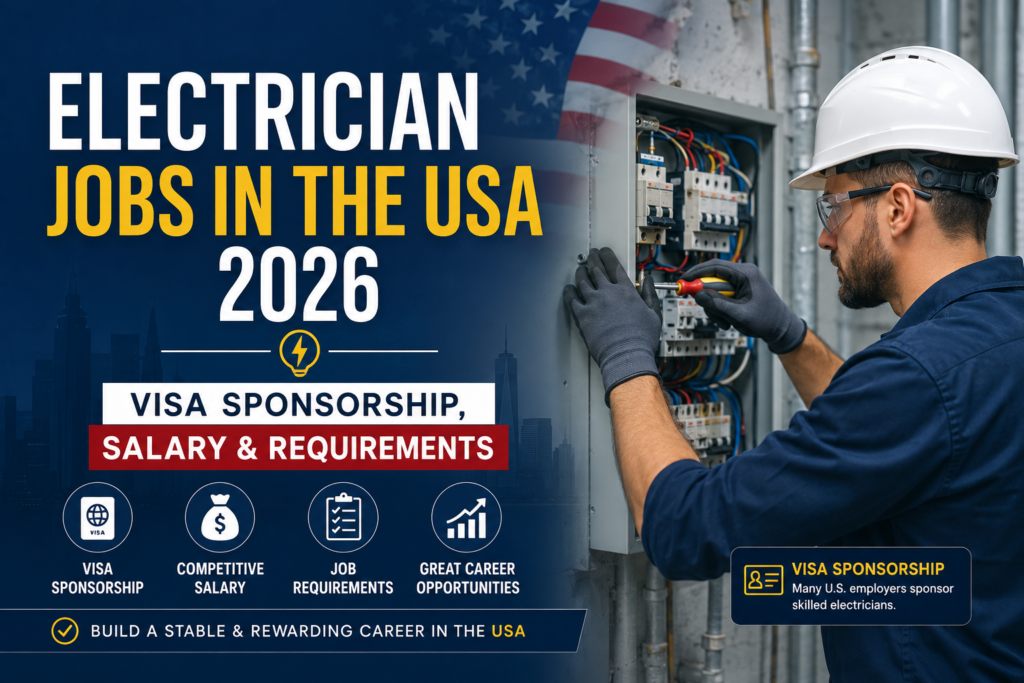

This guide covers everything you need to know: how to find legitimate visa-sponsored electrician jobs in America, what you can realistically earn, what credentials you need, and exactly how to apply. Let’s get into it.
Electrician Jobs in the USA 2026 Overview

The US Bureau of Labor Statistics (BLS) projects that electrician employment will grow by approximately 11 percent between 2022 and 2032 — much faster than the national average for all occupations. That translates to roughly 73,500 new job openings per year, when accounting for both new positions and retirements in the existing workforce.
Several factors are driving this growth simultaneously:
- A massive increase in residential and commercial construction
- National investment in clean energy and solar installation
- Growing demand for EV infrastructure and charging stations
- Smart building technology requiring advanced electrical systems
- An aging domestic workforce nearing retirement
The result is a genuine skills shortage. Employers — from small contractors to Fortune 500 construction firms — are now turning to overseas recruitment to fill roles that cannot be filled locally. For foreign electricians, this is a rare and well-timed window of opportunity.
Electrical jobs in America are not limited to one type of work, either. Roles range from residential wireman and commercial installer to industrial maintenance electrician, solar PV technician, and telecommunications cabling specialist. Whatever your background, there is very likely a role that fits.
Why Electrician Jobs in the USA Are in High Demand
See also: Australia Electrician Jobs 2026: Salary, Visa Sponsorship & How to Apply
To understand why electrician jobs in the USA are so competitive right now, it helps to look at the broader landscape of American infrastructure and energy policy.
The Inflation Reduction Act and the Infrastructure Investment and Jobs Act injected hundreds of billions of dollars into clean energy, grid modernization, and public infrastructure. Those investments don’t build themselves — they require licensed electricians on the ground, running conduit, pulling wire, and commissioning panels at every stage.
At the same time, the domestic pipeline for new electricians has not kept up with demand. Fewer young Americans are entering trade apprenticeships compared to past decades. Vocational education enrollment has declined in many states. This creates a structural mismatch: plenty of funded projects, not enough licensed professionals to execute them.
For international skilled workers, this gap is exactly the opening you need. Companies that previously hired only domestic workers are now actively searching overseas — and they are prepared to navigate the visa sponsorship process to secure the talent they need.
Visa Sponsorship for Electrician Jobs in the USA
USA electrician visa sponsorship is very much a reality — but it requires understanding the specific visa categories involved and knowing which employers actually offer sponsorship. Not every job posting will spell this out, so knowing what to look for is essential.
Companies Offering Visa Sponsorship
Several types of employers regularly sponsor foreign electricians in the United States:
- Large electrical contractors — Companies like EMCOR Group, MYR Group, Rosendin Electric, and IEC Electrical all operate national programs and have HR capacity to manage visa paperwork.
- Construction mega-projects — Data center builds, semiconductor fab construction, and utility-scale solar farms often require hundreds of electricians at once and actively pursue international recruitment.
- Industrial facilities — Petrochemical plants, manufacturing facilities, and refineries in Texas, Louisiana, and the Gulf Coast region regularly hire foreign electricians for maintenance and shutdown work.
- Specialty staffing agencies — Agencies like Tradesmen International and Express Employment Professionals work with visa-eligible candidates and place them with client companies across the country.
When searching job boards, filter for keywords like “visa sponsorship available,” “H-2B visa,” “EB-3 sponsor,” or “sponsorship jobs in USA 2026” to narrow your results to genuine opportunities.
Types of Work Visas Available
There are several work visa pathways available for foreign electricians aiming to work in the United States:
- H-2B Visa (Temporary Non-Agricultural Worker): Used for seasonal or peak-load electrical work. Employers must demonstrate that US workers are unavailable. H-2B is common in construction and maintenance sectors.
- H-1B Visa (Specialty Occupation Worker): Typically requires a bachelor’s degree. Some highly specialized electrical engineering roles or design-build positions may qualify, but most hands-on electrician roles do not fit this category.
- O-1 Visa (Extraordinary Ability): Suitable only for electricians with a demonstrably exceptional record — awards, publications, or leadership roles in international electrical standards bodies.
- TN Visa (Trade NAFTA/USMCA): Available to Canadian and Mexican nationals in specific occupational categories. Electrical engineers may qualify; journeyman electricians typically do not.
EB-3 Visa for Skilled Workers
The EB-3 visa is arguably the most important immigrant visa pathway for foreign electricians targeting the USA. Under the EB-3 skilled worker category, applicants must have at least two years of job-specific training or experience — a threshold most qualified electricians easily meet.
Here is how the EB-3 process works for electricians:
- A US employer agrees to sponsor you for permanent residence.
- The employer files a PERM Labor Certification with the Department of Labor, demonstrating that no qualified US worker is available for the role.
- Once approved, the employer files Form I-140 (Immigrant Petition for Alien Workers) with USCIS.
- You wait for a visa number to become available based on your country of birth and the priority date queue.
- After a visa number is available, you complete immigrant visa processing at a US consulate or adjust status if already in the US.
Processing times vary by country of birth. Nationals from countries like the Philippines, India, and China may face longer waits due to per-country caps, while nationals from most other countries — including African nations, most of Europe, and Latin America — typically face shorter queues. Consulting with a licensed US immigration attorney is strongly advisable before beginning this process.
Electrician Jobs in the USA — Salary Structure
One of the most compelling reasons to pursue electrician jobs in the USA is the competitive compensation. Salaries are well above global averages and tend to increase steadily with experience, specialization, and licensing level.
Entry-Level Electrician Salary
If you are just starting out — or if you are an experienced electrician from abroad whose credentials need to be re-evaluated in the US system — you will likely begin at the apprentice or journeyman level. Entry-level wages in the United States for electricians typically range from $18 to $26 per hour, depending on your location and employer.
Apprentice electricians enrolled in a formal four- or five-year union apprenticeship program start at around 40–50 percent of journeyman wage, with automatic increases tied to progression milestones.
Experienced Electrician Earnings
Once you hold a journeyman’s license and have several years of US experience, your earning potential rises significantly. Journeyman electricians typically earn between $28 and $40 per hour, which translates to roughly $58,000 to $83,000 annually for full-time work. Overtime pay — which is common in the industry — can push annual take-home earnings considerably higher.
Master electricians, who hold the highest level of state licensure and can supervise projects and pull permits, commonly earn $85,000 to $120,000 per year or more in high-demand markets.
Highest Paying States for Electricians
Geography plays a significant role in what you can earn. The following salary table summarizes the top-paying states for electricians in the USA based on the most recent available BLS data:
| State | Mean Annual Wage | Mean Hourly Wage | Status |
|---|---|---|---|
| Illinois | $90,640 | $43.58 | Top Paying |
| New York | $88,420 | $42.51 | Top Paying |
| Alaska | $85,710 | $41.21 | Top Paying |
| Hawaii | $83,940 | $40.36 | Top Paying |
| Oregon | $80,760 | $38.83 | Top Paying |
| California | $79,380 | $38.16 | High Demand |
| New Jersey | $77,480 | $37.25 | High Demand |
| Texas | $60,220 | $28.95 | Large Market |
| Florida | $58,810 | $28.28 | Large Market |
It is worth noting that states with lower average wages — such as Texas and Florida — often have a lower cost of living and fewer regulatory hurdles for out-of-state workers. For international applicants, the total package including housing costs, taxation, and licensing barriers matters as much as the headline salary figure.
Requirements for Electrician Jobs in the USA
Before you can work as an electrician in the United States, you need to understand what the country requires in terms of education, certification, and practical experience. Requirements vary somewhat by state, but the following framework applies broadly across most jurisdictions.
Education Requirements
A high school diploma or equivalent (GED) is the baseline educational requirement for entering an electrician apprenticeship in the USA. Beyond that, formal vocational or technical training is highly valued. If you attended a trade school or technical college in your home country and studied electrical theory, wiring principles, or building systems, that education is a genuine asset — even if it requires evaluation and credential recognition before it is formally accepted by a US licensing board.
Many employers and apprenticeship programs also expect applicants to have a working knowledge of:
- The National Electrical Code (NEC)
- Ohm’s Law and basic electrical theory
- Blueprint and schematic reading
- Conduit bending and wiring methods
- Electrical safety and OSHA standards
Certifications and Licensing
Licensing is mandatory for electricians in the United States, and it is administered at the state level rather than federally. This means the specific requirements differ from state to state. However, there are two universal licensing tiers:
- Journeyman Electrician License: Requires completion of an apprenticeship (typically 8,000 hours of on-the-job training) plus passing a written exam covering the NEC and state code. Some states accept a combination of education and documented work experience in lieu of a formal apprenticeship.
- Master Electrician License: Requires additional experience beyond journeyman status (typically 1–2 more years), plus a more advanced examination. Master electricians can supervise journeymen and obtain permits independently.
If you hold a valid electrical license from your home country, contact the National Electrical Contractors Association (NECA) or your target state’s licensing board about the reciprocity and equivalency process. Some states have streamlined pathways for foreign-trained electricians.
Additional certifications that significantly improve your employability include:
- OSHA 10 or OSHA 30 Construction Safety certification
- NFPA 70E (Arc Flash/Electrical Safety) certification
- Solar PV installation certification (NABCEP)
- Low-voltage and data cabling certifications (BICSI)
Experience Needed
Most employers offering visa-sponsored electrical positions in the USA expect a minimum of 2 to 5 years of verifiable work experience. For EB-3 skilled worker visa applications, at least two years of relevant experience is a hard requirement.
When documenting your experience for visa applications or employer evaluations, you should prepare:
- Signed employment letters on company letterhead confirming dates, job title, and responsibilities
- Copies of any home-country electrical licenses or certifications
- A portfolio of project types you have worked on (residential, commercial, industrial, etc.)
- References from supervisors or clients who can attest to your skill level
How to Apply for Electrician Jobs in the USA
Applying for a foreign electrician job in America requires a more structured approach than a standard domestic job search. Follow these steps to maximize your chances of landing a role with genuine visa sponsorship.
Research Your Target State and Licensing Path
Before applying anywhere, identify one or two target states based on salary potential, cost of living, and licensing reciprocity. Check the state’s electrical licensing board website to understand what documentation you will need to sit for the exam.
Get Your Credentials Evaluated
Use a NACES-approved credential evaluation service (such as World Education Services or Josef Silny & Associates) to have your foreign educational and trade certificates officially recognized in the US system. Many employers and visa attorneys require this step.
Build a US-Format Resume and Cover Letter
American resumes are typically one to two pages and focus on measurable achievements rather than lengthy job descriptions. Highlight your specific electrical skills, certifications, projects, and any safety training. Tailor your cover letter to each employer, mentioning your visa status and timeline upfront — transparency saves everyone time.
Search for Visa-Sponsored Job Listings
Use the platforms listed below to search for electrician roles explicitly offering visa sponsorship. Set up job alerts using search terms like “electrician visa sponsorship”, “electrician H-2B”, or “foreign electrician USA” to be notified of new postings immediately.
Apply and Follow Up Professionally
Submit applications through official company career portals or verified job boards. Follow up by email within 7–10 days if you haven’t heard back. A polite, professional follow-up demonstrates initiative and cultural fit for American workplace norms.
Consult a US Immigration Attorney
Once you receive a job offer that includes visa sponsorship, engage a licensed US immigration attorney or accredited representative immediately. They will guide both you and your employer through the PERM, I-140, or H-2B petition process to ensure the application is completed correctly and filed on time.
Best Websites to Find Electrician Jobs in the USA
Major Job Boards
- Indeed (Electrician Jobs – USA search page)
https://www.indeed.com/q-electrician-l-usa-jobs.html - LinkedIn Jobs (Electrician listings)
https://www.linkedin.com/jobs/electrician-jobs - Glassdoor Jobs (Electrician search page)
https://www.glassdoor.com/Job/electrician-jobs-SRCH_KO0,11.htm - ZipRecruiter (Electrician jobs search)
https://www.ziprecruiter.com/Jobs/Electrician - SimplyHired (Electrician jobs search)
https://www.simplyhired.com/search?q=electrician - CareerBuilder (Electrician jobs search)
https://www.careerbuilder.com/jobs-electrician
Trade-Specific & Union Platforms
- IBEW Official Job Board (International Brotherhood of Electrical Workers)
https://www.ibew.org/jobs-board/ - NECA (National Electrical Contractors Association – main site)
https://www.necanet.org/ - NECA Training & Apprenticeship Info (via NECA system search entry point)
https://www.necanet.org/education-careers/apprenticeship
Bonus (Highly useful electrician-focused job boards)
- SpliceJobs (Trades-only electrician job board)
https://splicejobs.com/ - Tradesppl (Skilled trades job platform)
https://www.tradesppl.com/ - Lineman Jobs (for power line / utility electrical work)
https://lineman-jobs.com/
Tips to Increase Your Chances of Getting Hired
Landing an electrician job in the USA as a foreign applicant is competitive — but it is entirely achievable with the right preparation. These practical tips will set you apart from other international applicants.
- Study the NEC before you apply.The National Electrical Code is the foundation of all US electrical work. Showing even basic familiarity with it in interviews signals that you are serious about transitioning into the US system.
- Get OSHA 10 certified now.This is a short (10-hour) online safety course that costs very little and is a near-universal requirement for US construction sites. Having it before you apply removes a hurdle for employers.
- Target union employers.The IBEW (International Brotherhood of Electrical Workers) is one of the strongest labor unions in the USA. Union apprenticeships offer structured wages, benefits, and training pathways that are particularly well-suited to international workers entering the US system.
- Be transparent about your visa needs.Do not wait until the offer stage to disclose that you need sponsorship. Mentioning it early — and demonstrating that you understand the process — is more likely to reassure a hiring manager than to turn them away.
- Network with the US electrical community.Join LinkedIn groups for US electricians, follow NECA and IBEW on social media, and engage with content from US-based electrical contractors. Being visible in those communities can open doors that job boards cannot.
- Consider a recruitment agency that specializes in trades.Agencies like Tradesmen International, Aerotek, and Catapult Staffing have established relationships with employers who hire foreign workers and understand the sponsorship process.
- Document everything meticulously.Your visa application will rely on documented proof of your skills and experience. Keep organized records of every job, every project, and every credential from day one.
Your Future in American Electrical Work Starts Now
Electrician jobs in the USA in 2026 represent one of the most genuine, accessible pathways to working and living in America for skilled trade professionals. The demand is real. The visa pathways exist. The salaries are competitive. What it takes is preparation, persistence, and the willingness to navigate the process with patience.
Start by identifying your target state, researching the licensing requirements, and reaching out to employers or recruitment agencies that have a history of visa sponsorship. The American electrical industry needs your skills — go show them what you’ve got Search Electrician Jobs Now →