
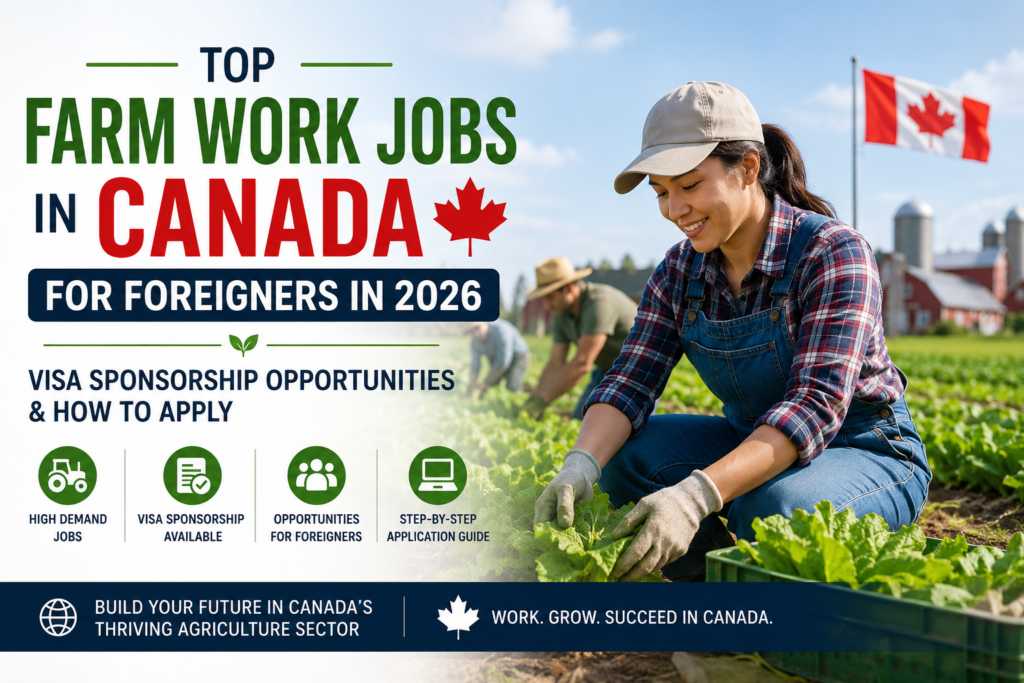

The top farm work jobs in Canada are now more accessible than ever for foreigners — and 2026 is shaping up to be one of the best years yet to make the move. Canada’s agricultural sector is booming, yet chronically understaffed, and that gap is your opportunity.
Whether you’re coming from the Philippines, Jamaica, Mexico, India, Nigeria, or anywhere else in the world, Canada is actively recruiting foreign agricultural workers to fill thousands of roles across its vast farmlands. From British Columbia’s apple orchards to Ontario’s greenhouse operations and Alberta’s cattle ranches, the demand is real, the pay is competitive, and — crucially — visa sponsorship is available.
This guide breaks down everything you need to know: the types of jobs on offer, which provinces are hiring the most, how the visa and LMIA process works, what salaries look like, and exactly how to submit a strong application. Let’s get into it.
Why Canada Needs Foreign Farm Workers in 2026

Canada’s population is aging. The national birth rate has been declining for decades, and rural communities — where most of the farming happens — have been hit hardest by labour shortages. According to the Canadian Agricultural Human Resource Council (CAHRC), the agricultural sector faces a shortage of over 60,000 workers, a gap that domestic labour alone simply cannot fill.
At the same time, Canada is one of the world’s largest food producers and exporters. The country exports billions of dollars in crops, meat, and dairy products every year. To keep that output strong, farms need consistent, reliable, and skilled workers — and more and more of those workers are coming from abroad.
In short: Canada’s farms need you, and the Canadian government has built legal pathways to make your employment possible. This isn’t a grey-area situation. Farm work immigration is actively encouraged at the federal level.
Overview of Top Farm Work Jobs in Canada for Foreigners in 2026
See also: Farm Jobs in Norway for Foreigners: Seasonal Work, Salary & Visa Guide
The agricultural job market in Canada is diverse. It’s not just picking strawberries in a field — though that’s certainly part of it. The sector spans everything from high-tech greenhouse operations to livestock management to farm equipment operation.
Here’s the big picture for 2026:
- Tens of thousands of seasonal and year-round positions are listed annually on Job Bank Canada, the federal government’s official job portal.
- Many employers are registered with federal and provincial seasonal worker programs, meaning they are pre-approved to sponsor foreign workers.
- Wages have increased significantly over the past two years in response to labour shortages.
- Housing and meals are often included as part of the employment package, particularly on larger farms.
Top Farm Work Jobs Available in Canada for Foreign Workers
1. Fruit and Vegetable Picker / Harvester
This is the most common entry point for foreign agricultural workers. Seasonal picking jobs are available across Canada from May through October, with some regions extending work into November.
- Common crops: Apples, strawberries, blueberries, grapes, tomatoes, peppers, cucumbers
- Top provinces: British Columbia, Ontario, Quebec, Nova Scotia
- Typical duration: 4–8 months seasonal
2. Greenhouse and Nursery Worker
Canada has one of the world’s most advanced greenhouse industries, particularly in Ontario and British Columbia. These roles often offer year-round employment — a significant advantage over purely seasonal work.
- Duties: Planting, pruning, harvesting, irrigation management, pest monitoring
- Skill level: Entry to intermediate
- Key benefit: More stable hours and often better pay
3. Livestock and Dairy Farm Worker
Cattle, hog, poultry, and dairy operations need hands-on workers throughout the year. These are among the more physically demanding roles but also among the most consistently available.
- Duties: Feeding, cleaning, milking, health monitoring, equipment maintenance
- Top provinces: Alberta, Saskatchewan, Manitoba, Ontario
- Typical schedule: Early mornings, split shifts
4. General Farm Labourer
A catch-all category covering tasks like weeding, irrigation, soil preparation, crop monitoring, and post-harvest processing. These roles are widely available and ideal for workers with little or no prior experience.
5. Farm Equipment Operator / Tractor Driver
Experienced heavy equipment operators are in high demand. Driving tractors, combine harvesters, and other agricultural machinery requires specific skills — and the pay reflects that.
- Prior certification or experience required
- Higher pay bracket: $18–$28/hour in many provinces
6. Beekeeper / Apiary Worker
A niche but growing sector. Canada is a major honey producer, and beekeeping operations regularly seek seasonal foreign workers, particularly in Alberta and Saskatchewan.
7. Aquaculture / Fish Farm Worker
Not traditional land farming, but classified under agriculture. British Columbia and Atlantic Canada have significant fish farming operations offering foreign worker positions.
8. Farm Supervisor / Team Leader
Experienced foreign workers who have previously worked in Canada under TFWP (Temporary Foreign Worker Program) may qualify for supervisory roles. These carry higher pay and more responsibility.
Top Farm Work Job Salaries in Canada 2026
Salaries vary by province, job type, and employer. Below is a general overview of what foreign farm workers can expect in 2026:
| Job Title | Hourly Wage (CAD) | Annual Estimate (Full Season) |
|---|---|---|
| Fruit/Vegetable Picker | $15.65 – $18.00 | $12,000 – $22,000 |
| Greenhouse Worker | $16.00 – $20.00 | $22,000 – $35,000 |
| Livestock Farm Worker | $16.50 – $22.00 | $28,000 – $42,000 |
| General Farm Labourer | $15.65 – $17.50 | $10,000 – $20,000 |
| Farm Equipment Operator | $18.00 – $28.00 | $35,000 – $55,000 |
| Farm Supervisor | $22.00 – $32.00 | $40,000 – $60,000 |
| Aquaculture Worker | $16.00 – $21.00 | $25,000 – $38,000 |
Note: Canada’s federal minimum wage as of 2026 is $17.30/hour, and most agricultural provinces match or exceed this. Some provinces like British Columbia have their own higher minimums.
Provinces with the Highest Demand for Farm Workers
Not all of Canada’s agricultural demand is concentrated in one region. Here’s a breakdown of the top hiring provinces:
Ontario
The agricultural powerhouse of Canada. Leads in greenhouse vegetable production, tender fruit, and wine grapes. The Niagara region and Leamington area are particularly active.
British Columbia
Famous for its fruit orchards in the Okanagan Valley. Also home to large berry farms and a significant greenhouse sector in the Lower Mainland.
Alberta
Dominated by cattle ranching, grain farming, and vegetable operations. Year-round livestock work is especially available here.
Saskatchewan and Manitoba
Prairie grain farming, livestock, and canola operations. Less visible on international radar but consistently in need of workers.
Quebec
Strawberries, apples, vegetables, and maple operations. Many employers here prefer bilingual workers, though it’s not always a strict requirement.
Nova Scotia and New Brunswick
Blueberry, apple, and potato operations. Strong participation in the Seasonal Agricultural Worker Program (SAWP).
Visa Sponsorship Opportunities for Foreign Farm Workers
This is the section most people are here for — and good news: Canada has well-established legal pathways specifically designed for foreign agricultural workers.
The Seasonal Agricultural Worker Program (SAWP)
The SAWP is Canada’s longest-running agricultural foreign worker program, operating since 1966. It allows workers from participating countries — primarily Mexico, Jamaica, and other Caribbean nations — to work in Canada for up to 8 months per year.
- Eligibility: Must be a national of a SAWP-participating country
- Employer requirement: Must be a pre-approved employer
- Key benefit: Workers return to the same employer year after year, building reliable income
The Temporary Foreign Worker Program (TFWP) — Agricultural Stream
The broader TFWP covers workers from all nationalities. The agricultural stream allows Canadian farms to hire foreign workers after demonstrating they couldn’t find Canadians to fill the roles — which, given the labour shortage, is rarely difficult to prove.
- Visa type: Temporary work permit
- Duration: Up to 2 years, renewable
- Employer requirement: Must obtain LMIA (see below)
The Agri-Food Immigration Pilot (AIP)
One of the most exciting pathways in 2026. The Agri-Food Pilot offers a route to permanent residence for workers in specific agricultural and food processing roles. If your goal isn’t just a seasonal stint but building a life in Canada, this is worth serious attention.
- Eligible occupations: Year-round livestock workers, harvesting labourers, industrial butchers
- Pathway: Leads to permanent residency
- Language requirement: CLB 4 in English or French
The Rural and Northern Immigration Pilot (RNIP)
Several rural Canadian communities actively recruit foreign workers through the RNIP, which includes agricultural roles. Communities in Saskatchewan, Manitoba, and Northern Ontario participate.
What Is an LMIA and Why Does It Matter?
If you’ve been researching Canada farm jobs for more than five minutes, you’ve almost certainly come across the term LMIA. Here’s a plain-English explanation.
LMIA stands for Labour Market Impact Assessment. Before most Canadian employers can hire a foreign worker, they must apply to Employment and Social Development Canada (ESDC) and prove that:
- There is a genuine job vacancy
- Efforts were made to hire a Canadian citizen or permanent resident first
- Hiring a foreign worker will not negatively impact the Canadian labour market
Once approved, the employer receives a positive LMIA, which acts as the official green light to hire you. You then use this document as part of your work permit application.
Key points to know:
- A positive LMIA is employer-specific — it ties you to that particular employer
- Registered SAWP employers often have standing approval and don’t need to apply fresh each cycle
- Some programs, like the RNIP and AIP, are LMIA-exempt
For you as an applicant: When a job posting says “LMIA-approved” or “visa sponsorship available,” that’s a strong signal the employer is ready to hire internationally. Always ask for confirmation before investing heavily in an application.
Eligibility Requirements for Canada Farm Work Jobs
While exact requirements vary by program and employer, here are the general eligibility baselines:
- Age: Typically 18–45 (SAWP has stricter age-related criteria; other programs are more flexible)
- Health: Must pass a medical examination for some visa categories
- Criminal record: Clean criminal background required
- Work experience: Even entry-level roles may ask for 3–6 months of relevant experience
- Language: Basic English or French is helpful; some employers in Quebec prefer French speakers
- Education: Not typically required for most labour roles; equipment operators may need certifications
- Passport: Valid passport required
Step-by-Step Application Process For
Applying for Canada farm work jobs as a foreigner can feel complicated, but the process follows a logical sequence. Here’s how it works:
Step 1: Research and Identify Job Listings
Start with official Canadian job portals. Look specifically for listings that mention “LMIA approved,” “visa sponsorship,” or “foreign workers welcome.”
Where to look:
- Job Bank Canada — The official federal job board
- Indeed Canada – Agricultural Jobs
- Workopolis
- Ag Careers — Agriculture-specific board
- Government of Canada Jobs
Step 2: Prepare Your Application Documents
Before contacting any employer, get your documents in order (see the documents section below).
Step 3: Apply to Employers Directly
Send a tailored cover letter and résumé. Where possible, reference the specific crops, livestock, or equipment mentioned in the job posting. Employers appreciate applicants who’ve done their homework.
Step 4: Receive a Job Offer
If selected, the employer will issue a formal job offer letter. This is a critical document — hold onto it.
Step 5: Employer Obtains LMIA (if required)
Your employer applies for and receives a positive LMIA from ESDC. This can take 2–10 weeks depending on the program and employer history.
Step 6: Apply for Your Work Permit
Using the job offer and LMIA number, apply for a Canadian Temporary Work Permit through IRCC (Immigration, Refugees and Citizenship Canada) at ircc.canada.ca.
Step 7: Medical Exam (if required)
Some applicants require an immigration medical exam through a designated physician. Your permit application instructions will specify if this applies to you.
Step 8: Biometrics
Most applicants outside North America and certain EU countries must provide biometrics (fingerprints and photo) at a Visa Application Centre (VAC).
Step 9: Receive Permit and Travel
Once approved, you’ll receive your work permit. Make sure to carry your job offer letter, LMIA documentation, and all supporting documents when you arrive at the Canadian border.
Step 10: Begin Work
Report to your employer as agreed. Understand your rights — foreign workers in Canada are protected under the same labour laws as Canadians.
Application Requirements For Top Farm Work Jobs in Canada
Having the right paperwork ready saves time and prevents delays. Here’s what you’ll typically need:
- Valid passport (at least 6 months beyond your intended stay)
- Copy of the job offer letter from your employer
- LMIA number (provided by employer)
- Updated CV/résumé tailored to agricultural work
- Cover letter
- Proof of work experience (reference letters, pay stubs, employment contracts)
- Educational certificates (if applicable)
- Police clearance certificate from your home country
- Medical examination report (if required by IRCC)
- Biometric receipt (after completing biometrics appointment)
- Passport-sized photographs meeting IRCC specifications
- Application fee payment receipt
Common Mistakes Applicants Should Avoid
Getting rejected isn’t always about being unqualified — sometimes it comes down to avoidable errors. Here are the mistakes that trip up applicants most often:
1. Applying to employers not approved for LMIA
Always verify the employer’s LMIA status. Don’t assume sponsorship is available unless it’s explicitly stated or confirmed.
2. Submitting a generic CV
A one-size-fits-all résumé reads as low-effort. Tailor each application to the specific farm and role.
3. Misrepresenting experience
Canadian immigration officers and employers verify information. False claims can result in permanent bans.
4. Ignoring language requirements
Even basic English proficiency matters. If your application requires it, get a language assessment done early.
5. Paying recruitment agents upfront
Legitimate Canadian employers do not charge workers recruitment fees. If someone is asking you to pay to get a job, it’s likely a scam.
6. Missing deadlines
Seasonal farming follows the calendar. Employers hiring for May start often post in January and February. Miss the window and you wait another year.
7. Incomplete documentation
IRCC will not process incomplete applications. Missing a single document delays everything. Double-check before submitting.
Tips to Increase Your Chances of Getting Hired
Beyond avoiding mistakes, here’s what actually helps you stand out:
Get a basic food handler or farm safety certificate — these are low-cost and signal commitment
- Learn key agricultural vocabulary in English or French before your interview
- Contact Canadian farms directly via their websites or social media, not just through job boards
- Apply early in the hiring season — January to March for summer positions
- Build a track record — even one successful season makes you far more attractive for the next
- Join farm worker Facebook groups and forums — real workers share legitimate leads
- Use Job Bank’s employer contact feature to send direct expressions of interest
- Be flexible on location — smaller, rural employers often have less competition for applicants
Accommodation and Benefits for Foreign Farm Workers
One of the frequently overlooked advantages of Canadian agricultural employment is the benefits package that often comes with it.
Many farms — particularly those participating in SAWP — are required by law to provide:
- Free or subsidised accommodation (on-farm housing is the norm)
- Transportation to and from worksites
- Access to health insurance through provincial programs after a waiting period (varies by province)
- Return airfare in some SAWP arrangements
- Access to workers’ compensation if injured on the job
Practical notes on housing:
On-farm accommodation varies widely. Some operations provide comfortable dormitory-style housing with kitchen access; others are more basic. Ask detailed questions before accepting an offer, and confirm what’s included in writing.
Seasonal vs Permanent Top Farm Jobs in Canada
Knowing the difference between these two categories matters — especially if your long-term goal is permanent residency.
Seasonal Farm Jobs
- Duration: 4–8 months (spring through fall)
- Programs: SAWP, TFWP Seasonal
- Best for: Workers seeking income without long-term commitment
- Limitation: Must leave Canada when permit expires
- Opportunity: Many employers rehire the same workers annually
Permanent / Year-Round Farm Jobs
- Duration: 12 months, renewable
- Programs: TFWP Year-Round, Agri-Food Immigration Pilot, Provincial Nominee Programs
- Best for: Workers seeking long-term settlement in Canada
- Advantage: Eligible for permanent residency pathways
- Requirement: Usually demands more experience or specific skills (livestock, greenhouse management, equipment operation)
Strategic advice: Start with a seasonal position to gain Canadian experience, then transition to year-round work and use the Agri-Food Pilot or PNP as your pathway to permanent residence.
Frequently Asked Questions About Top Farm Work Jobs in Canada
Q1: Can I get a Canadian farm job without prior experience?
Yes, many entry-level positions like general farm labourer, fruit picker, and greenhouse assistant require no prior experience. Employers provide on-the-job training.
Q2: How long does it take to get a Canadian farm work permit?
Processing times vary by country and visa office. On average, expect 4–16 weeks from application submission. LMIA processing by the employer can add an additional 2–10 weeks before you even apply.
Q3: Can my family come with me on a farm work permit?
Under SAWP, spouses cannot accompany workers. Under TFWP (longer-duration permits), dependants may be eligible to apply for visitor visas or open work permits, depending on the employer’s NOC classification.
Q4: Is there a risk of getting scammed?
Unfortunately, yes — immigration fraud targeting foreign job seekers is a real problem. Never pay a recruiter to get you a job offer. Verify any employer’s legitimacy through Job Bank or the IRCC employer compliance database.
Q5: Can I switch employers once I’m in Canada?
On most TFWP work permits, your permit is employer-specific — meaning you cannot legally switch employers without going through a new permit process. Under some newer IRCC policies, employer-specific restrictions may be eased in cases of abuse or non-compliance by the original employer.
Q6: Do I need a medical exam?
Not always. IRCC will specify during your application whether a medical exam is required. Workers in food handling roles are more likely to require one.
Q7: What is the easiest Canadian province to get farm work in?
Ontario and British Columbia consistently post the highest volume of agricultural job listings. However, competition is also stronger there. Saskatchewan and Manitoba often have less competition for applicants.
Q8: Does farm work in Canada lead to permanent residency?
Yes — through the Agri-Food Immigration Pilot, the Provincial Nominee Program (PNP), or accumulating sufficient Canadian work experience to qualify for Express Entry (Canadian Experience Class). It requires planning and patience, but it’s a genuine pathway.
Conclusion On Top Farm Work Jobs in Canada
Canada’s agriculture sector represents one of the most accessible, well-supported, and legitimate pathways for foreigners seeking employment abroad. The top farm work jobs in Canada — whether in fruit orchards, livestock operations, greenhouses, or grain fields — offer fair wages, legal visa sponsorship, and in many cases, a clear route to permanent residency.
The opportunity is real. The legal framework is in place. What separates those who make it happen from those who don’t is preparation, timing, and the quality of their application.
Start with verified job boards. Target employers with active LMIA approval. Tailor your résumé. Apply early. And if Canada is truly where you want to build your future, consider the Agri-Food Pilot or a Provincial Nominee Program as your long-term strategy.
Good luck — Canada’s farms are waiting.
Apply Now — Verified Job Application Links
| Platform | Description | Link |
|---|---|---|
| Job Bank Canada | Federal job board — search agricultural roles with LMIA status | jobbank.gc.ca |
| Indeed Canada | Wide listing base including farm and seasonal roles | ca.indeed.com |
| Workopolis | Canadian job board with agricultural filter | workopolis.com |
| Ag Careers | Dedicated agricultural job board for Canada | agcareers.com |
| Government of Canada Jobs | Official federal and provincial postings | jobs.gc.ca |