
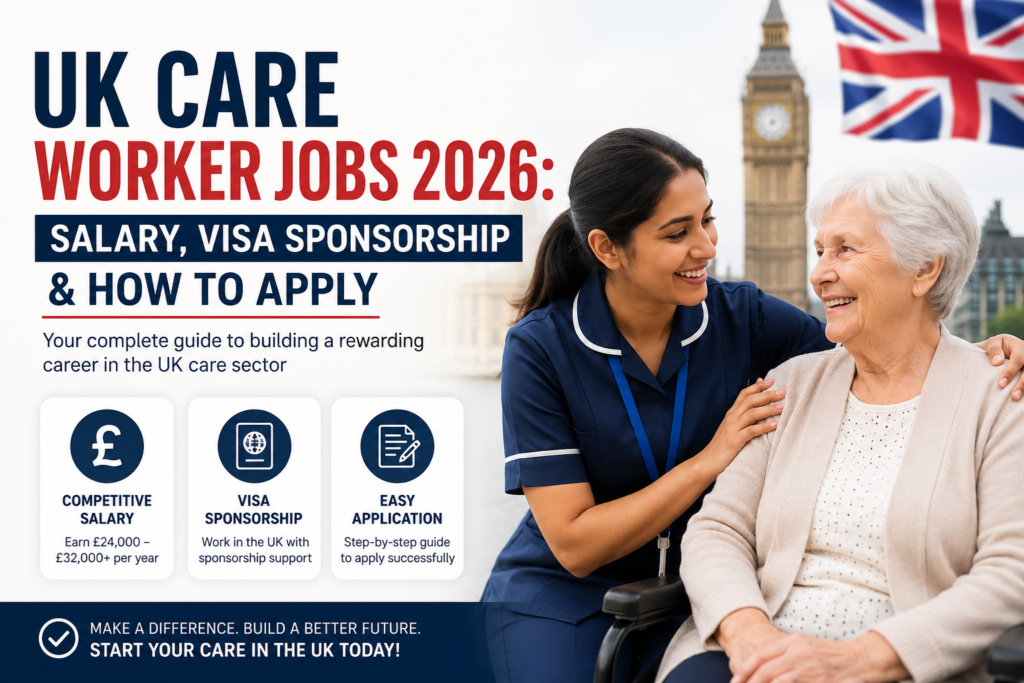

UK care worker jobs remain one of the most accessible and in-demand pathways for international workers looking to build a stable career in Britain. In 2026, the country’s adult social care sector faces a structural workforce crisis that no domestic recruitment drive has been able to fully close. As a result, thousands of care roles across England, Scotland, and Wales are actively seeking qualified international applicants — and many of those roles still come with visa support.
This guide covers everything you need to know: the types of roles available, what you can expect to earn, how the visa process works following significant rule changes in mid-2025, and where to apply through verified, trustworthy sources.
Why UK Care Worker Jobs Are in High Demand in 2026

The demand for UK care worker jobs has not emerged overnight. For years, the adult social care sector has struggled with a combination of rising need, persistent vacancies, and fierce competition for staff from better-paying sectors like retail and hospitality.
An ageing population is the core driver. According to Skills for Care, the UK will need approximately 470,000 new care posts by 2040 to match projected demographic growth. Meanwhile, the sector currently reports around 111,000 unfilled roles, stretching existing teams dangerously thin.
Additionally, the sector employs approximately 1.6 million people across England alone, with the vast majority — around 84% — working in the independent sector. High turnover, particularly among younger workers, further fuels demand. Workers aged under 25 leave at a rate of nearly 44.6% annually, compared to 25% for older staff.
Furthermore, international recruitment has therefore become essential. The UK government recognised this by creating targeted visa pathways for care professionals, and while 2025 brought important rule changes, substantial opportunities remain — particularly for nurses, allied health professionals, and senior care practitioners with verifiable qualifications.
Types of UK Care Worker Jobs Available
see also: Caregiver Jobs in Canada 2026: Salary, Visa Sponsorship & How to Apply
Caregiver Jobs in Germany 2026: High Demand, Salaries & Visa Opportunities
UK care worker jobs span a wide range of settings, from private homes to specialist nursing facilities. Moreover, each role type carries different salary brackets, qualification requirements, and visa eligibility in 2026. Understanding the landscape helps you target the right opportunities.
Residential Care Worker
Works in care homes providing daily personal care, emotional support, and activity coordination for elderly or disabled residents. Most entry-level visa-sponsored positions now require NVQ Level 2 in Health & Social Care as a baseline.
Healthcare Assistant (HCA)
Supports registered nurses and doctors in NHS or private hospital settings. HCA roles remain among the most actively sponsored positions in 2026, particularly for applicants with clinical experience and IELTS scores meeting B1 level.
Home Support Worker
Delivers domiciliary care — visiting clients in their own homes to help with personal hygiene, medication, meals, and companionship. Vacancies are high: around 59,000 home care posts remain unfilled in England as of early 2026.
Nursing Home Care Assistant
Provides hands-on support in nursing homes for residents with complex medical needs. These roles often require experience with dementia care or palliative support, and command higher salaries accordingly.
Community Support Worker
Assists individuals with mental health conditions, physical disabilities, or learning needs to live independently in the community. Some specialist community roles remain eligible for visa sponsorship under the Health and Care Worker route.
Important Note on Visa Eligibility for Standard Care Workers
As of 22 July 2025, standard care worker (SOC 6135) and senior care worker (SOC 6136) roles are no longer open to new overseas applicants. This is a critical change. If you are currently outside the UK, you can no longer apply for entry on these specific codes. However, a transition period extends until July 2028 for those already in the UK to extend or switch routes.
Consequently, international applicants seeking sponsored care roles in 2026 should focus on registered nursing, allied health professions, healthcare assistant roles within NHS-regulated settings, and specialist senior support positions — all of which remain eligible.
Salary for UK Care Worker Jobs in 2026
Pay in this sector has improved in recent years, partly due to National Living Wage increases and partly due to market competition for staff. However, salaries still vary significantly depending on the role, the region, and the employer type.
Entry-Level vs Experienced Worker Pay
| Role Level | Annual Salary Range | Hourly Rate (Approx.) | Notes |
|---|---|---|---|
| Entry-Level Care Worker | £20,963 – £23,500 | ~£11.50 – £12.00 | Residential or domiciliary settings |
| Experienced Care Worker | £23,500 – £30,323 | ~£12.50 – £15.00 | Specialist knowledge (dementia, palliative) |
| Healthcare Assistant (NHS) | £25,760 – £27,476 | ~£13.50 – £14.75 | NHS Band 3; IHS-exempt on H&C visa |
| Registered Nurse (Band 5) | £29,970 – £36,483 | ~£15.60 – £18.00 | NMC registration required |
| Senior / Specialist Support | £28,000 – £35,000 | ~£14.50 – £18.00 | Mental health, learning disability teams |
Regional Pay Differences and Benefits
London typically adds a 10–20% London weighting to base salaries, making it the highest-paying region for UK care worker jobs. Meanwhile, cities like Manchester, Leeds, and Birmingham offer lower base salaries but considerably lower living costs, which can mean greater overall purchasing power.
Beyond the base wage, many employers in the sector provide:
- Paid overtime rates (often time-and-a-quarter or time-and-a-half)
- Free or subsidised uniforms and PPE
- Employer pension contributions (minimum 3% under auto-enrolment)
- Free DBS (criminal background check) processing
- Career development funding toward NVQ Level 3 and beyond
- Paid annual leave of 28 days (including bank holidays)
Visa Sponsorship for UK Care Worker Jobs
Understanding the visa landscape is essential for any international applicant targeting UK care worker jobs. Two main routes are relevant in 2026, and knowing which one applies to your role type can make or break your application.
The Health and Care Worker Visa
The Health and Care Worker visa is a sub-category of the Skilled Worker route, designed specifically for qualified health and social care professionals. It offers significant advantages over the standard route:
- Reduced visa fees compared to the standard Skilled Worker visa
- Exemption from the Immigration Health Surcharge (IHS), currently £1,035 per year — saving over £5,000 on a five-year visa
- Fast-track processing — most applications decided within three weeks
- Visa valid for up to five years, with the possibility of extending and applying for Indefinite Leave to Remain
As of 8 April 2026, visa fees increased by 6.5%, so budgeting accurately before you apply is important.
The Skilled Worker Visa Route
For roles that do not qualify under the Health and Care sub-category, the standard Skilled Worker visa applies. The general salary threshold from April 2026 stands at £41,700 per year, though healthcare-specific roles benefit from a reduced threshold of approximately £25,600–£29,000, depending on the SOC occupation code.
| Visa Route | Min. Salary (2026) | IHS Exempt? | Processing Time | Max Duration |
|---|---|---|---|---|
| Health & Care Worker Visa | £25,600 – £29,000+ | Yes | ~3 weeks | 5 years |
| Skilled Worker Visa (standard) | £41,700 (general) | No | 3–8 weeks | 5 years |
Who can sponsor you? In 2026, only CQC-registered providers in England and NHS bodies hold the authorisation to issue a Certificate of Sponsorship for Health and Care Worker visas. Always verify your employer’s sponsor licence on the official GOV.UK register before proceeding.
Important Scam Warning: Legitimate employers never charge you for a Certificate of Sponsorship. If any recruiter or agent asks for payment to secure a CoS, that is fraud. Report it immediately and walk away. No genuine UK employer operates this way.
Key Documents You Will Need
- Valid passport (at least 6 months remaining validity recommended)
- Certificate of Sponsorship (CoS) reference number from your employer
- Proof of English language proficiency (IELTS for UKVI or equivalent, minimum B1/CEFR)
- Tuberculosis test results (required if you are from a listed country)
- Criminal record certificate from any country where you lived for 12+ months in the last 10 years (for regulated care roles)
- Bank statements showing at least £1,270 held for 28 consecutive days (unless your employer certifies maintenance on the CoS)
- Professional qualification certificates and reference letters
How to Apply for UK Care Worker Jobs
The application process for UK care worker jobs involves several stages. Therefore, starting early and preparing your documentation in advance significantly improves your chances of a smooth, successful outcome.
-
Search Verified, Licensed Employers
Start with NHS Jobs, GOV.UK Find a Job, and the official register of licensed sponsors on GOV.UK. Only apply to employers who appear on that register. This protects you from fraudulent listings and ensures a real CoS is available.
-
Prepare a UK-Standard CV and Cover Letter
UK CVs are typically 2 pages maximum. Tailor each application to the job description. Highlight relevant care experience, any NVQ or equivalent qualifications, language skills, and your right to work or visa requirements clearly.
-
Submit Your Application Online
Most roles are advertised on NHS Jobs, Indeed UK, Reed, or Total Jobs. Apply directly through the employer’s portal wherever possible. Additionally, follow up professionally if you have not received a response within two weeks.
-
Complete the Interview Process
Interviews may be conducted via video call for overseas applicants. Prepare examples of person-centred care situations, safeguarding awareness, and your approach to working with vulnerable adults. Practical or values-based assessments are common.
-
Receive and Activate Your Certificate of Sponsorship
Once you are offered the role, your employer issues a CoS electronically. This contains a unique reference number valid for 3 months. You must submit your visa application within this window using the reference number.
-
Apply for Your Visa Online
Visit the official GOV.UK visa application portal. Complete the Health and Care Worker or Skilled Worker visa form, upload supporting documents, pay the applicable fee, and attend a biometrics appointment at your nearest UK Visa Application Centre.
-
Plan Your Relocation
Once your visa is approved, coordinate your start date with your employer. Many CQC-registered providers offer induction programmes, temporary accommodation support, and help navigating the NHS registration process on arrival.
Verified Websites to Apply for UK Care Worker Jobs
Only use official and well-established platforms when searching for UK care worker jobs. The sites below are trusted, scam-free, and regularly updated with live vacancies from licensed employers.
- https://www.gov.uk/health-care-worker-visa— Official Health and Care Worker Visa guidance
- https://www.jobs.nhs.uk— NHS Jobs: the primary portal for NHS-funded roles with visa sponsorship
- https://www.gov.uk/find-a-job— GOV.UK’s official job search engine
- https://www.carehome.co.uk/jobs— Residential and nursing home vacancies across the UK
- https://www.indeed.co.uk— Broad job aggregator with care sector filters
- https://www.totaljobs.com— Total Jobs: wide coverage of health and social care listings
- https://www.reed.co.uk— Reed: UK’s largest jobs board with dedicated care categories
- https://www.homecare.co.uk/jobs— Domiciliary and home care-specific vacancies
- https://www.gov.uk/skilled-worker-visa— Full Skilled Worker visa eligibility and application guide
- https://www.gov.uk/browse/visas-immigration/work-visas— Complete overview of all UK work visa categories
Requirements for Foreign Applicants
Meeting the visa and employer requirements is non-negotiable. However, with the right preparation, most internationally trained care professionals can meet these standards without undue difficulty.
English Language
Minimum CEFR B1 level. Accepted tests include IELTS for UKVI, OET, PTE Academic, and TOEFL IBT. Some exemptions apply for nationals of majority English-speaking countries.
Care Experience
At least 1–2 years of paid care experience is expected by most employers. Specialist roles (dementia, palliative, mental health) typically require 3 or more years.
Qualifications
NVQ/QCF Level 2 or 3 in Health & Social Care, or an overseas equivalent. Registered nurses must hold NMC registration or be in the process of obtaining it. Allied health professionals need HCPC registration.
Police Clearance
A criminal record certificate is required from every country in which you have lived for 12 months or more during the last 10 years. This must be apostilled and translated if not in English.
Medical Checks
Tuberculosis (TB) testing is mandatory for applicants from listed countries. Additional occupational health screening may be required by your employer prior to your start date.
Passport Validity
Your passport must be valid for the duration of your initial visa. It is strongly recommended to have at least 18 months remaining validity when you apply.
Best UK Cities for Care Worker Jobs in 2026
Geography matters when planning your relocation. Different cities offer different levels of demand, salary premiums, and cost of living — and understanding this balance helps you choose the right destination for your career and budget.
| City | Demand Level | Avg. Care Worker Salary | Cost of Living | Notes |
|---|---|---|---|---|
| London Highest Pay | Very High | £25,000 – £32,000+ | Very High | London weighting of 10–20%; housing is the biggest cost |
| Manchester | High | £22,000 – £28,000 | Moderate | Strong NHS presence; good transport and international community |
| Birmingham High Demand | Very High | £21,500 – £27,500 | Moderate | Highest volume of over-65 dementia patients in England; many vacancies |
| Leeds | High | £21,000 – £26,500 | Low–Moderate | Affordable rental market; strong community care sector |
| Glasgow | Moderate–High | £21,000 – £26,000 | Low | Lower cost of living than English cities; good quality of life |
Overall, Birmingham and Manchester offer the strongest combination of job volume and manageable living costs for most international care workers. London offers the highest wages but demands careful financial planning, particularly around accommodation. Glasgow, meanwhile, provides an affordable entry point for those prioritising quality of life over salary maximisation.
Frequently Asked Questions
1. Can I still apply for a UK care worker job from abroad in 2026?
Standard care worker and senior care worker roles (SOC 6135/6136) are no longer open to overseas applicants making new applications from outside the UK as of July 2025. However, qualified nurses, healthcare assistants in NHS settings, allied health professionals, and some specialist senior support roles remain eligible for overseas sponsorship through the Health and Care Worker visa. Always check the current eligible occupation list on GOV.UK before applying.
2. What is the minimum salary for a Health and Care Worker visa in 2026?
The threshold depends on your specific occupation code (SOC). Most healthcare-eligible roles require a minimum of approximately £25,600 to £29,000 per year — significantly lower than the standard Skilled Worker visa threshold of £41,700. NHS Band 3 Healthcare Assistant roles typically fall in the £25,760–£27,476 range, which meets the minimum requirement.
3. Do I need to pay for the Immigration Health Surcharge on a Health and Care Worker visa?
No. One of the key advantages of the Health and Care Worker visa is full exemption from the Immigration Health Surcharge (IHS), which currently stands at £1,035 per year. Over a five-year visa, this saves you over £5,000 — a significant financial benefit compared to the standard Skilled Worker route.
4. How long does the Health and Care Worker visa take to process?
Applications are fast-tracked and are typically decided within three weeks. If you require an even faster decision, the Home Office offers a priority processing service for an additional fee, available via a face-to-face appointment or through the UK Immigration ID Check app.
5. What English language test do I need for UK care worker jobs?
You need to demonstrate English proficiency at CEFR B1 level or above. Widely accepted tests include IELTS for UKVI (Academic or General Training), the Occupational English Test (OET), Pearson PTE Academic, and TOEFL iBT. Citizens of certain majority English-speaking countries are exempt — check the full exemption list on GOV.UK.
Conclusion
UK care worker jobs continue to offer one of the most viable and structured pathways into British professional life for international workers in 2026. Despite immigration changes introduced in mid-2025, significant opportunities remain — particularly for healthcare assistants within NHS settings, registered nurses, allied health professionals, and specialist support workers whose roles meet visa eligibility criteria.
The combination of an ageing population, persistent workforce shortages, competitive salaries for qualified staff, and a streamlined Health and Care Worker visa route makes the UK an attractive destination for internationally trained care professionals. Furthermore, the exemption from the Immigration Health Surcharge and the pathway to Indefinite Leave to Remain after five years make this one of the most comprehensive immigration packages available in any English-speaking country.
The most important step you can take today is to verify that any employer you approach holds a valid sponsor licence, and to begin preparing your documentation — English language test, qualifications, and police certificates — well in advance. Apply only through the verified portals listed in this guide, and seek professional immigration advice if your situation is complex.
Your future in UK care work is achievable. Start preparing now.
Ready to Start Your UK Care Career?
Gather your documents, verify your employer’s sponsor licence, and apply through trusted portals today. The sooner you prepare, the sooner your UK journey begins.