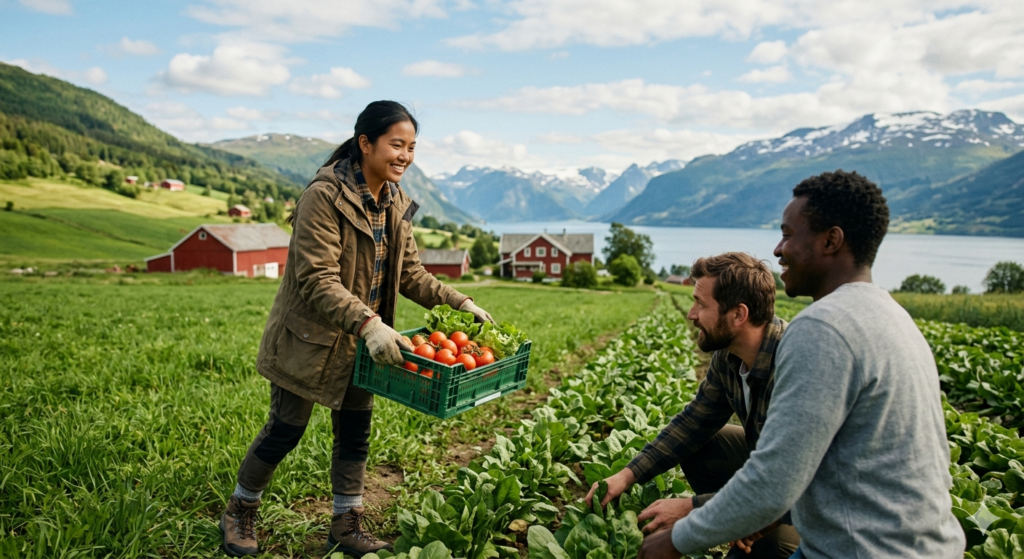

Farm jobs in Norway have become one of the most accessible entry points into the European labour market for international job seekers — and in 2026, demand for foreign agricultural workers has never been stronger.
Why Norway Needs Foreign Farm Workers in 2026

A few other factors are driving demand in 2026 specifically:
- Post-pandemic labour gaps: haven’t fully recovered, and many farms that shifted operations are now scaling back up.
- A short but intense growing season: means farms need to hit peak capacity fast — and they can’t afford empty slots.
- Greenhouse and controlled-environment agriculture is expanding: creating year-round roles that didn’t exist a decade ago.
- Government-backed seasonal worker programmes: make it legally straightforward to bring in foreign workers under regulated conditions.
The bottom line is that Norwegian farmers need you as much as you need them. That’s a good starting position for any job seeker.
Types of Farm Work Jobs in Norway
See also: Italy Farm Work Visa Sponsorship Jobs 2026: Agricultural Jobs for Foreign Workers
New Zealand Farm Jobs for Foreigners in 2026: Visa Sponsorship, Pay & How to Apply
Not all farm work is the same, and understanding the range of roles available will help you target the right opportunities for your skills and physical condition.
Fruit and Berry Picking
This is by far the most common entry point for foreign workers. Strawberries, raspberries, blueberries, and cherries are harvested across central and eastern Norway from June through August. The work is physically demanding — you will spend long hours crouching or kneeling in fields — but it’s straightforward, no experience is required, and many farms pay a productivity bonus on top of the base wage if you pick above a daily target.
Vegetable Farming and Planting
Roles in vegetable production include planting, weeding, and manual harvesting of crops like cauliflower, kale, lettuce, carrots, and onions. These positions often start earlier in the season (April/May) and run later than fruit picking, sometimes into October.
Greenhouse Work
Norway has a growing controlled-environment agriculture industry, particularly for tomatoes, cucumbers, and herbs. Greenhouse work is arguably more comfortable than field work — you’re out of the rain — and some of these roles extend into winter months. Duties include transplanting seedlings, pruning plants, and general maintenance. Attention to detail is valued here.
Dairy and Livestock Farming
Dairy farms need workers for feeding, milking, mucking out, and general animal husbandry. These are less seasonal and more year-round in nature. Some farms specifically recruit for holiday stand-in roles when permanent staff take leave. Experience with animals is a strong advantage, and you may be expected to work early morning shifts.
Grain and Arable Farming
The harvest season for grain crops like wheat, barley, and oats typically runs July to September in southern Norway. Roles often involve operating machinery (if licensed) or doing manual tasks like clearing and sorting.
Fish Farming (Aquaculture)
While technically separate from land-based agriculture, Norway’s salmon farming industry is enormous and frequently hires seasonal workers for feeding, net maintenance, and harvest operations. Many of the same visa rules apply, and the salary rates are often higher due to the physical nature and remote locations of the work.
Seasonal Farm Jobs in Norway
The Norwegian agricultural calendar is tightly defined by the country’s northern climate. Understanding the seasonal windows is critical to timing your application correctly — miss the recruitment window and you may have to wait another full year.
| Season / Period | Typical Roles | Key Regions |
|---|---|---|
| Spring (April–May) | Planting, greenhouse preparation, early vegetable sowing | Rogaland, Vestfold |
| Early Summer (June) | Strawberry picking begins, lettuce/herb harvest | Telemark, Innlandet, Hedmark |
| Peak Summer (July–August) | All berry picking, grain harvest, vegetable harvest | Nationwide, especially east Norway |
| Autumn (Sept–Oct) | Root vegetable harvest, greenhouse wind-down, apple picking | Hardanger (apples), Trøndelag |
| Winter (Nov–Mar) | Greenhouse work, dairy/livestock, fish farming | Year-round greenhouse regions |
| Peak recruitment for summer roles typically happens February–April. Apply early. | ||
Timing tip
The summer harvest season (June–August) accounts for roughly 70% of all seasonal farm job postings in Norway. If you want a role for this window, start your application in February or March at the latest. Many farms fill their quotas by April.
Salary Expectations for Farm Workers in Norway
This is the section most people come here for — and the good news is that Norway’s wages are among the highest for agricultural work anywhere in Europe.
Norway does not have a single national minimum wage. Instead, legally binding minimum rates are set sector by sector through collective agreements — a system called allmenngjøring. Agriculture and horticulture is one of the nine regulated sectors, which means the rates below are legal minimums enforced by the Norwegian Labour Inspection Authority (Arbeidstilsynet).
The current rates, effective from 15 June 2025 and still in force throughout 2026, are as follows:
| Worker Category | Min. Hourly Rate (NOK) | Approx. Monthly (Full-Time) |
|---|---|---|
| Under 18 years old | NOK 142.90 | ~NOK 23,200 |
| Adult beginner (0–12 weeks seniority) | NOK 162.90 | ~NOK 26,500 |
| Adult with 12 weeks–6 months seniority | NOK 168.40 | ~NOK 27,400 |
| Typical market rate (experienced workers) | NOK 170–185 | ~NOK 27,600–30,100 |
| Source: Arbeidstilsynet (Norwegian Labour Inspection Authority), effective 15.06.2025. Monthly estimate based on 162.5 hours/month full-time. | ||
It’s worth noting that all documented and relevant prior experience in agriculture or horticulture — including work done in other countries — counts toward your wage seniority calculation. Bring documentation of any previous farm work.
What Can You Actually Take Home?
A full-time adult beginner working an entire summer season (say, 14 weeks) at NOK 162.90 per hour would earn approximately NOK 96,000 gross before tax. Norway’s income tax for this bracket sits around 25%, leaving you with roughly NOK 72,000 net — about €6,200 or $6,700 USD.
That is strong money for seasonal work, especially if your accommodation is provided by the farm (more on that shortly).
Bonus tip
Norwegian law also entitles you to feriepenger (holiday pay) equivalent to 10.2% of your gross earnings, paid out after the season. This is not optional — it’s a legal right, even for seasonal workers.
Work Visa Requirements for Foreigners
Who Needs a Visa?
EU/EEA/Swiss citizens do not need a work permit to take up farm work in Norway. You can enter, register with the local authorities, and start working freely.
Non-EU/EEA citizens — including nationals of countries like the Philippines, India, Nepal, Thailand, Pakistan, South Africa, Nigeria, and many others — need a Seasonal Worker Permit (Sesongarbeider) issued by UDI (the Norwegian Directorate of Immigration).
The Seasonal Worker Permit — Step by Step
Key requirement
You must have a confirmed, full-time job offer before you can apply. Since February 2026, Norwegian employers must submit a digital job confirmation through UDI’s system prior to your application.
- Secure a job offer from a Norwegian farm.The work must be seasonal in nature (harvest, holiday cover, etc.) and full-time for the duration of your stay. Eligible sectors include agriculture, horticulture, forestry, fish processing, restaurants, and tourism.
- Employer submits digital job confirmation via UDI.This is a new requirement as of February 2026. Your employer logs into UDI’s online portal and officially confirms your offer. You cannot proceed until this is done.
- Submit your online application at udi.no. Complete the Seasonal Worker Permit form. You will need your passport, the employer’s confirmation reference, and details of your planned stay. Pay the application fee — budget approximatelyNOK 3,800–5,900for a seasonal permit (fees vary by permit type and are updated periodically; always verify the current amount on the UDI website).
- Submit biometrics and documents in person. Visit a Norwegian embassy, consulate, or VFS Global centre in your home country to provide fingerprints and photos, and to submit supporting documents.
- Wait for UDI to process your application. Standard processing for seasonal work permits typically takes4 to 8 weeks, though this can vary during peak summer recruitment periods. Plan accordingly — submit in early spring for a June start.
- Receive your permit and travel to Norway. Once approved, you’ll receive confirmation from UDI. Collect your residence permit card from a local police station upon arrival in Norway.
Key Rules to Know
- You can stay a maximum of 6 months in any 12-month period on a Seasonal Worker Permit.
- If you’ve held the permit for 6 months, you must leave Norway for 6 months before applying again.
- You cannot use a Seasonal Worker Permit as a pathway to permanent residence.
- If you stay fewer than 3 months, check with UDI whether a permit is even required for your nationality.
Warning
Working without the correct permit is a serious immigration offence in Norway. It can result in deportation and a ban from re-entering the Schengen Area. Never accept a cash-in-hand arrangement that bypasses the official system.
How to Apply for Farm Jobs in Norway
Applying for farm work in Norway is more straightforward than it might seem, but timing and preparation make all the difference.
Start with a Direct Approach
Many Norwegian farms — especially large berry producers — recruit directly and have established international worker programmes. A cold email or message via a farm’s website in February or March, expressing clear availability and enthusiasm for summer work, often yields results.
Use Recruitment Agencies
Several agencies specialise in placing foreign workers on Norwegian farms. They handle the paperwork, coordinate with employers, and often arrange transport and accommodation as a package. This is the safest route for first-time applicants. Companies like SeasonWorkers connect candidates with verified seasonal farm roles.
Use Online Job Portals
Norway’s job market is well-served by several public and private platforms (detailed in the next section). Set up job alerts on multiple platforms simultaneously to maximise your chances.
Prepare Your Application
Even for manual farm work, a clear and professional application matters. Include:
- A brief cover letter confirming your availability dates and stating that you are physically fit and ready to work
- Any previous farm or manual labour experience (even from your home country)
- Confirmation that you are eligible to work in Norway or that you are prepared to apply for the correct permit
- Contact details and any references from previous employers
Best Websites to Find Farm Jobs in Norway
If you’re hunting for seasonal or farm work in Norway, these are the platforms that actually move the needle in 2026. Think less “random internet haystack,” more “tractor with GPS.”
Verified Platforms for Norway Farm Jobs
- Finn.no – Job Section
Norway’s largest classifieds and recruitment platform. Search using keywords like:- “landbruk” (agriculture)
- “gårdsarbeid” (farm work)
- “sesongarbeid” (seasonal work)
Listings are updated daily and often include berry farms, greenhouses, and livestock roles.
- NAV – Norwegian Labour and Welfare Administration
Norway’s official government employment portal. Free to use and highly reliable for verified agricultural vacancies. - Work in Norway (EURES)
Norway’s EURES-linked portal built for international applicants seeking legal employment opportunities. - Jobbnorge
Major Norwegian recruitment site with listings in horticulture, greenhouse operations, and agricultural services. - Season Workers
International seasonal work platform that regularly features Norwegian fruit-picking and farm jobs with accommodation packages.
Smart Search Strategy for Farm Jobs in Norway
Set up email alerts on both:
That way, new vacancies land in your inbox before the application stampede begins. In seasonal hiring, speed matters almost as much as experience.
Quick Norway Reality Check
Before applying:
- Most seasonal jobs peak between May and September
- Accommodation is sometimes included, but not always
- Employers should provide written contracts
- Norway’s cost of living is high, so calculate net earnings carefully
- If a recruiter asks for large upfront fees, that’s a frost warning in July
Accommodation and Living Costs for Farm Jobs in Norway
Let’s be honest: Norway is one of the most expensive countries in Europe. Before you accept any job offer, you need a clear picture of what life will actually cost you there.
Farm-Provided Accommodation
The majority of seasonal farm jobs in Norway come with accommodation included on-site or nearby. Norwegian labour law regulates this: if your employer provides a single room, they are allowed to deduct NOK 675.67 per month from your wages. For a shared double room, the deductible rate is NOK 439.46 per month. These are legal maximums set by the authorities — not arbitrary charges.
Always confirm in writing before accepting a job: Is accommodation provided? What is the monthly deduction? What are the shared facilities like?
Renting Independently
If you arrange your own housing — common if you’re working near a city like Oslo or Bergen — expect to pay significantly more. A room in a shared house in a smaller Norwegian town typically runs NOK 4,000–7,000 per month. In Oslo, a single room rarely costs less than NOK 8,000–10,000.
Day-to-Day Costs for Farm Jobs in Norway
| Item | Estimated Cost (NOK) |
|---|---|
| Grocery shop (weekly, budget) | NOK 600–900 |
| Local bus/transport (monthly pass) | NOK 850–1,100 |
| SIM card + data (monthly) | NOK 150–250 |
| Restaurant meal (budget) | NOK 160–220 |
| Coffee (café) | NOK 40–70 |
| Costs are approximate 2026 estimates. Rural areas are generally cheaper than Oslo or Bergen. | |
The realistic monthly living cost for a single person outside of major cities — when accommodation is provided by the farm — is around NOK 4,000–6,000 covering food, transport, and phone. That leaves you a meaningful savings margin on a farm wage, which is one of the key reasons this path appeals to international workers.
Benefits and Challenges of Farm Work in Norway
Farm work in Norway is genuinely rewarding — but it’s not a holiday. Here’s an honest look at both sides:
Benefits for Farm Jobs in Norway
- One of the highest farm wages in Europe
- Legal, regulated employment with full labour rights
- Holiday pay (feriepenger) paid as a legal entitlement
- Accommodation often included at a regulated rate
- Breathtaking natural environment to live and work in
- Strong worker protections enforced by Arbeidstilsynet
- Opportunity to save significantly given low rural living costs
- Can count toward future skilled worker visa seniority
Challenges for Farm Jobs in Norway
- Physically demanding work — long hours on your feet or kneeling
- Short, intense seasons mean income is time-limited
- Norway is one of Europe’s most expensive countries
- Language barrier (Norwegian) in some rural areas
- Seasonal permits don’t lead to permanent residency
- Weather can be unpredictable — wet, cold summers do happen
- Remote farm locations can feel isolating
Tips to Get Hired Faster For Farm Jobs in Norway
Apply in February
Peak summer roles fill up fast. Applications submitted in February or early March have a significantly higher success rate than those sent in May.
Confirm your visa eligibility early
Check the UDI website for your specific nationality before applying to any job. Some permit processes take 6–8 weeks, so don’t leave it until the last minute.
Highlight any agricultural experience
Even informal experience — helping on a family farm, market gardening, fruit picking elsewhere — is worth mentioning. It affects your starting wage seniority.
Use recruitment agencies
First-timers should strongly consider going through a specialist agency. They simplify the paperwork enormously and often have pre-negotiated accommodation deals.
Set job alerts on multiple platforms
Use Finn.no, NAV, and SeasonWorkers simultaneously. The best roles go quickly. Set keyword alerts for “sesongarbeid”, “plukking”, and “landbruk”.
Learn basic Norwegian phrases
You don’t need to be fluent. But knowing a dozen phrases — greetings, asking for clarification, basic numbers — immediately distinguishes you from other candidates.
Final Thoughts On Farm Jobs in Norway
Farm work in Norway isn’t glamorous in the traditional sense. You will wake up early. Your back will ache. There will be rainy days when the fields are muddy and the harvest quotas still need to be met.
But here’s what makes it genuinely worthwhile: Norway pays its farm workers honestly, treats them with legal protections that most countries can only aspire to, and offers a level of natural beauty that few workplaces on earth can match.
For international job seekers willing to put in the physical effort, a summer season on a Norwegian farm is one of the best-paid, most well-regulated agricultural experiences in the world. You’ll come home with meaningful savings, documented international work experience, and a story worth telling.
The key is preparation — and that means starting now. Update your CV, check your visa eligibility on the UDI website, set your job alerts, and make your applications before the spring recruitment window closes.
Ready to Start Your Norwegian Farm Journey?
Browse live opportunities on Norway’s top job platforms right now. Most summer roles open up between February and April — don’t miss the window.