
Electrician Jobs in Germany 2026 for African Skilled Workers
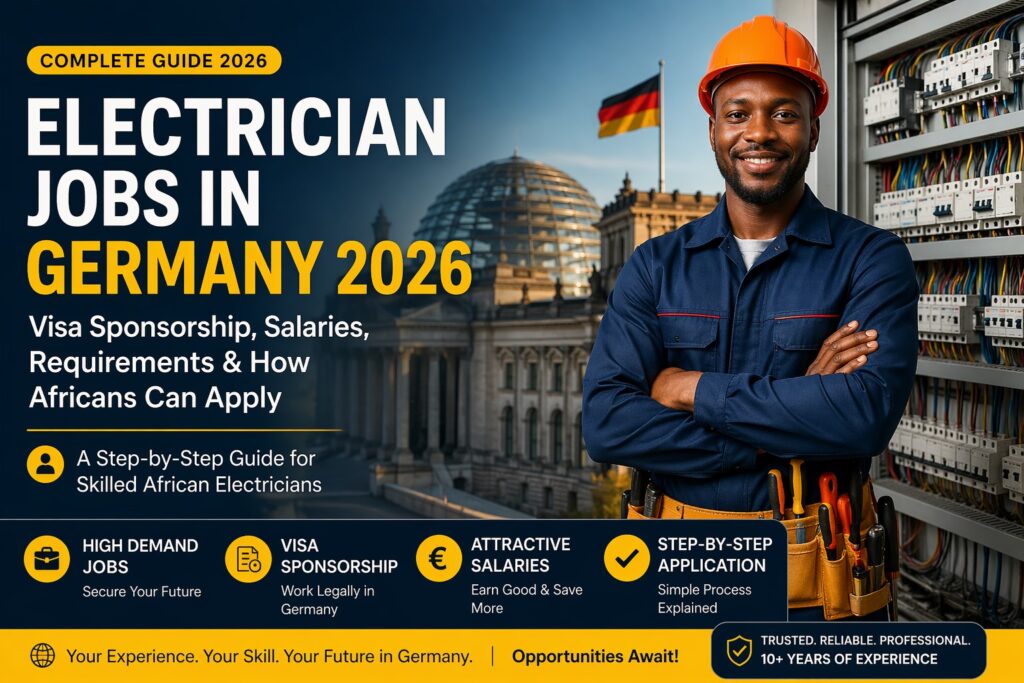
Electrician jobs in Germany 2026 are among the most in-demand opportunities for skilled African workers, driven by a severe shortage of trained electrical professionals across the country’s expanding industrial and energy sectors.
Germany is facing a critical shortage of electricians in 2026, creating real opportunities for skilled African and non-EU workers. This guide breaks down salaries, visa sponsorship, and exactly how to apply successfully.
A complete, research-backed guide for skilled Nigerian and African trade workers seeking legitimate, employer-sponsored careers in Germany’s fastest-growing sector.
Why Electrician Jobs in Germany Are in High Demand
Currently, there is a major shift quietly reshaping the global labor market. As a result, as populations age in the world’s most industrialized nations, the skilled workers who kept those economies running are retiring — and there simply are not enough young, trained replacements to fill the gap. For the right candidate with the right preparation, this is not a crisis. It is a career-defining window.
Global Labor Shortage Explained
Electrician jobs in Germany 2026 are at the center of this global labor shift, creating real opportunities for skilled African workers who are ready to take advantage of structured migration pathways. Electrician jobs in Germany 2026 are at the center of this global labor shift, creating real opportunities for skilled African workers who are ready to take advantage of structured migration pathways.
Germany sits at the Centre of this shift. Europe’s largest economy is experiencing one of the most significant skilled workforce shortages in its modern history. The Federal Employment Agency (http://www.arbeitsagentur.de/int/en/working-in-germany) has identified skills shortages across 163 occupational fields — and at the very top of that list, consistently and urgently, is one profession that rarely makes headlines but keeps the lights on, powers industry, and enables the energy transition: the electrician.
If you are a trained electrician in Nigeria, Ghana, Kenya, South Africa, or anywhere else across Africa — or a skilled trade professional from outside the European Union — this article is written specifically for you. Not to promise easy money or overnight miracles, but to give you an honest, well-researched, and actionable guide to one of the most legitimate and promising labor migration routes available in 2026.
“The opportunity for African electricians in Germany is real, structural, and growing. But it rewards those who prepare — not those who simply wish.”
Senior Career Consultant Perspective · International Migration Series 2026
The German government has deliberately legislated to welcome skilled non-EU workers. But it requires preparation, documentation, persistence, and — above all — accurate information. This guide provides all of that. The opportunity is genuine. The legal pathway exists.
This guide breaks down everything you need to know about electrician jobs in Germany 2026, from visa sponsorship to salary expectations and how to apply successfully
Germany’s Skilled Labor Shortage and the Demand for Electricians
Germany’s labor gap is not caused by poor economic planning. It is the predictable consequence of three converging forces that have been building for decades and which no domestic policy measure alone can fully reverse.
-
Aging Workforce Crisis
To begin with, a rapidly ageing workforce. Germany has one of the oldest working populations in the world. Between 600,000 and 1.1 million skilled workers in critical trades are currently aged between 55 and 64. As they retire over the next decade, they take decades of institutional knowledge with them and there are not enough trained young Germans to replace them.
2. Declining Trend
In addition, falling population: Germany’s birth rate has been below population replacement level for over 50 years. This means the domestic pipeline of young workers entering skilled trades has been shrinking for a generation. The reality is simple.
3. Energy and Industrial Expansion
Furthermore, industrial and green energy expansion: Germany has simultaneously committed to one of the most ambitious energy transitions in the world — the Energiewende — while continuing to expand manufacturing and construction. Demand for skilled trades is not just holding steady; it is actively growing at the same time the workforce is contracting.
Key figure to understand: Germany requires approximately 300,000 to 400,000 foreign skilled workers every year just to maintain current economic output. Without immigration of skilled workers, Germany could face a shortage of approximately 16 million workers by 2060 — a projection cited by the Federal Ministry for Economic Affairs.
In response, the government fundamentally reformed its immigration framework under the Fachkräfteeinwanderungsgesetz (Skilled Immigration Act), making it easier than at any point in modern history for qualified non-EU nationals to enter, work, and build a life in Germany.
Germany is not reluctantly accepting foreign workers. It is actively competing for them. That is the context you must carry into every step of your application process.
This is exactly why electrician jobs in Germany 2026 are not just available, but actively being filled through international recruitment.
Why Electricians Are in Critical Demand Across Germany

More importantly, within Germany’s broader skills shortage, electricians occupy a uniquely critical position. The Federal Employment Agency’s annual bottleneck analysis consistently classifies electrical and construction trades among the most severely understaffed categories in the country.
Electrician jobs in Germany 2026 continue to rank among the top shortage occupations identified by the federal employment agency due to rapid energy transition demands and workforce retirement. The surge in electrician jobs in Germany 2026 is directly tied to infrastructure expansion, renewable energy goals, and workforce retirement gaps.
A 2024 report by the German Economic Institute’s Competence Centre for Securing a Skilled Workforce (KOFA) found that in electrical engineering and construction alone, there were more than 18,300 unfilled vacancies related to Germany’s energy transition — a 2.9% increase from the prior year. The shortage of skilled workers in electrical engineering specifically stood at approximately 14,200 people on average, representing a 10% increase year-on-year. The European Labor Authority’s EURES report identified electricians as among the most critical shortage professions across the entire EU.
In practical terms, the reasons are structural and ongoing. Germany is:
Expanding solar and wind infrastructure at national scale, requiring certified electrical installers for every installation, grid connection, and maintenance cycle.
Building out EV charging networks across its motorway system, cities, and commercial properties.
Renovating residential buildings to meet new energy efficiency standards — all of which require certified electrical work.
Modernizing industrial plants as part of its manufacturing competitiveness agenda.
Replacing an entire generation of electricians who entered the trade 30–40 years ago and are now reaching retirement.
For African skilled workers who have trained in electrical installation, industrial electrical systems, or renewable energy technology, this sustained, structural demand translates directly into long-term employment — not short-term contracts or seasonal work.
Types of Electrician Jobs Available in Germany 2026
Electrical technician opportunities in Germany 2026 offers multiple entry pathways depending on skill level, certification and specialization.
Before applying, match your existing training and experience to the right job category. This significantly strengthens your application and helps employers assess your fit quickly.
Residential Electrician
Handles wiring, installation, and maintenance of electrical systems in homes and apartment buildings. High demand driven by Germany’s building renovation programmed for climate targets -Most Accessible Entry Point
Industrial Electrician
Works in manufacturing plants and industrial facilities. Handles complex machinery wiring, automation systems, PLC controllers, and high-voltage equipment. Requires advanced technical background; commands higher salaries -Higher Salary Range
Renewable Energy Technician
Installs and maintains solar PV systems, wind turbine electrical components, battery storage, and EV charging infrastructure. Fastest-growing segment — Germany’s Energiewende makes this critically important -Fastest Growing Segment
Maintenance Electrician
Ensures existing electrical infrastructure in commercial buildings, factories, transport networks, and public facilities remains operational. Stable, consistent employment base across Germany’s established industries -Stable, Consistent Work
Electrical Engineer
For those with university-level training in electrical engineering. Strong demand in product development, infrastructure planning, and industrial automation. Requires degree-level qualifications -Degree Required
Electricians Jobs in Germany 2026 Salaries
From a financial perspective, electrician jobs in Germany 2026 provide competitive salaries and long-term financial stability compared to many African labor markets. Understanding electrician jobs in Germany 2026 also means understanding realistic salary expectations and long-term earning potential.
Average Electrician Salary in Germany
Here is an honest, data-based answer to what you will actually earn. Figures are drawn from Germany’s Federal Statistical Office, and employer salary surveys conducted in 2025–2026.
| Experience Level | Gross / Month | Net Take-Home | Annual Gross |
| Entry Level (0–2 years in Germany) | €2,200 – €2,800 | €1,500 – €2,100 | €26,400 – €33,600 |
| Mid-Level (3–7 years) | €2,800 – €3,800 | €2,000 – €2,800 | €33,600 – €45,600 |
| Experienced / Specialist (8+ years) | €4,000 – €5,500 | €2,800 – €3,800 | €48,000 – €66,000 |
| Electrical Engineer (degree-level) | €5,000 – €7,000+ | €3,400 – €4,800 | €60,000 – €90,000+ |
| Sector Average (Mechatronics/Electrical) | €4,629 | €3,000 – €3,700 | €55,548 |
However, it is important to consider cost-of-living context: Monthly rent for a shared apartment in smaller German cities typically ranges from €400 to €700. In major cities like Munich or Hamburg, costs are higher — but wages in those cities also trend higher. Many employers in the trades also offer accommodation support or relocation assistance as part of their hiring package for international workers.
Germany’s progressive tax system means 20–35% is deducted from gross salary in taxes and social security contributions, depending on your tax class, marital status, and whether you have dependents.
Employment benefits beyond the base salary — this is where Germany’s system truly stands apart from most African employment contexts:
Statutory health insurance, covering you and often your dependents
Pension contributions paid jointly by employer and employee into a nationally managed system
Minimum 20 paid vacation days per year (most trade collective agreements provide 25–30 days)
Unemployment insurance providing an income safety net
Regulated overtime compensation, typically at 125–150% of your hourly rate
Sick pay at full salary for up to six weeks, covered by your employer
Electrical work in Germany is a formal, regulated profession with strong worker protections. This is not a gig arrangement. It is a structured career with a clear progression pathway and genuine financial security.
Visa Sponsorship and Legal Work Pathways for Germany
Also see: Truck Driver Jobs in Canada (2026): Demand, Requirements & Salary Insights
CONSTRUCTION JOBS IN SPAIN FOR NIGERIANS & AFRICANS — 2026 COMPLETE GUIDE
At this stage, understanding the legal routes available to you — and choosing the right one for your situation — can be the difference between a successful migration and a costly failure. Germany has three primary pathways relevant to electricians from non-EU countries.
To access electrician jobs in Germany 2026, you must understand the correct visa pathway that fits your qualifications and experience.
Most Common Route – Skilled Worker Visa
Fachkräftevisa — Requires Job Offer First
- Recognized vocational qualification in an electrical trade
- Confirmed employment contract from a German employer
- Salary meeting minimum threshold for your occupation
- Basic German language skills (A1–B1 level)
- Valid passport and complete documentation
- Employer effectively “sponsors” your visa via the contract
- Processing: approximately 6–12 weeks after application
Alternatively, the Opportunity Card allows;
Chancenkarte — No Job Offer Needed
- Live in Germany up to 12 months to job search
- Work part-time up to 20 hours/week while searching
- Two-week trial work periods permitted (unlimited)
- Recognized qualification (Route A) OR 6+ points system (Route B)
- Proof of funds: ~€13,092/year via blocked account
- German A1 or English B2 language proficiency
- Processing: typically 3–5 months
On the other hand, the EU Blue Card applies;
For Degree-Level Professionals
- University-level qualification required
- Confirmed job offer with minimum annual salary
- In 2026: threshold for shortage occupations = €45,934/year
- Faster pathway to permanent residence (21 months with B1 German)
- Family reunification rights included
- Most relevant for electrical engineers
- Vocational electricians use Skilled Worker Visa instead
Understanding the Opportunity Card Points System
If your qualification is not yet fully recognized in Germany, you may still qualify for the Opportunity Card via Route B — the points system. You need a minimum of 6 points across the following categories:
| Partial qualification recognition | Up to 4 pts |
| Work experience 5+ years in relevant field | 3 pts |
| Work experience 2–4 years in relevant field | 2 pts |
| German language proficiency B2+ | Up to 3 pts |
| German language proficiency A2–B1 | 1–2 pts |
| English proficiency at C1 level | 1 pt |
| Applicant under age 35 | 2 pts |
| Applicant aged 35–40 | 1 pt |
| Prior stay in Germany of 6+ months | 1 pt |
| Shortage occupation alignment | 1 pt |
Use the official self-check tool at chancenkarte.com to verify your eligibility before beginning your application.
Where to Find Legitimate Electrical Job Opportunities in Germany
Finding genuine, employer-listed vacancies is one of the most important practical steps in this process. There are many fraudulent “visa sponsorship” offers circulating on social media. The platforms below are verified, legitimate sources used by German employers.
Finding legitimate electrician jobs in Germany 2026 requires using verified job platforms and avoiding common recruitment scams.
Indeed Germany de.indeed.com
General · High Volume crafthunt.work
Specifically designed for skilled trades and actively facilitates international recruitment in Germany’s construction and electrical sectors stepstone.de
Germany’s largest professional job board. Strong for mid-level trade and engineer positions. Often includes salary information in listings energyjobline.com
Focused on the energy sector, including renewable energy electrical roles — solar, wind, and grid infrastructure. Strong for energy transition positions. careerstructure.com
Strong for construction and infrastructure-related electrical positions. Covers large commercial and infrastructure projects across Germany make-it-in-germany.com
Official German government portal for international job seekers. Contains verified job listings, visa guidance, and employer contacts. Always start here eures.europa.eu
European Employment Services portal with verified cross-border vacancies across Germany. Run by the European Labor Authority Official EU Portal
LinkedIn linkedin.com
Apply German location filters. Increasingly used by larger electrical contracting firms and industrial employers. Also useful for direct recruiter outreach.
Professional Network: Search in German for better results. When searching on German job boards, use German-language job titles rather than English translations. The most effective search terms include: Elektriker (electrician), Elektroinstallateur (electrical installer), Elektrofachkraft (qualified electrical specialist), Mechatroniker (mechatronics technician), and Solarteur or Photovoltaik-Monteur (solar PV installer).
Step-by-Step Guide to Apply for Electrician Jobs in Germany
This is the most practically valuable section of this guide. Each step builds on the previous one. Skipping steps is the primary reason applications fail. Follow the sequence.
This step-by-step breakdown is designed specifically for candidates targeting electrician jobs in Germany 2026. To move forward effectively, follow this structured process:
-
Get Your Qualifications Assessed for German Recognition
This is the foundation of everything else. Without credential recognition, neither the Skilled Worker Visa nor the Opportunity Card (Route A) is available to you. Begin this process immediately — before you have a job offer.
Visit anerkennung-in-deutschland.de — the official government recognition portal. Enter your trade (electrician/electrical installer) and your country of origin. It will direct you to the competent authority for your specific qualification. For electrical trades, this is typically the Handwerkskammer (Chamber of Crafts) or Industrie– und Handelskammer (Chamber of Industry and Commerce).
Submit certified copies and certified translations of your training certificates, apprenticeship records, and practical assessments. Full recognition means your qualification is deemed equivalent to German standards. Partial recognition may require a supplementary assessment — but still qualifies you for the Opportunity Card points route.
Timeline: Allow 3 to 6 months for the recognition process. Do not wait for a job offer before starting.
2. Equally important, learn German Seriously and Consistently
German language skills are not optional if you want to build a sustainable career in Germany. They are the single most important non-technical factor in your long-term success. For an initial visa application, A1 to B1 German is typically sufficient. But to work effectively on a job site — to understand safety instructions, communicate with supervisors, and integrate into German workplace culture — you will need to reach at minimum B2 level.
The Goethe-Institut operates offices in Lagos, Accra, Nairobi, and other African cities. Their language courses carry the certification recognized by German immigration authorities. Telc and ÖSD certificates are also accepted. For free online study, Deutsche Welle’s “Deutsch Lernen” portal and “Nicos Weg” video series are specifically designed for migrants and are highly effective supplements.
Realistic timeline: 6–12 months of consistent study to reach B1; an additional 6–12 months for B2. Treat language study as a professional investment and begin immediately — not when you have a job offer.
3. Next, Prepare a European-Standard CV
Your Nigerian or Ghanaian CV format will not serve you well in Germany. German employers expect a specific document structure called the Lebenslauf.
A German-standard CV includes: personal information at the top (name, contact details, date of birth, nationality); a professional photo — standard and expected in Germany, unlike in the UK or US where photos are avoided; work experience in reverse chronological order with employer names, locations, dates, and role descriptions; education and qualifications in reverse chronological order; language skills with your CEFR level (A1, B2, etc.); and technical skills listing specific competencies — wiring systems, PLC programming, solar PV installation, safety standards, tools and equipment.
4. Format guidance
Two pages maximum. Attach certified copies of your recognized qualification and language certificates. German employers value precision over volume.
5. Apply Strategically, Not at Volume
Sending 200 generic applications is far less effective than sending 20 targeted, well-researched ones. Focus on employers who are actively hiring internationally: medium and large electrical contracting firms (Elektroinstallationsbetriebe), renewable energy project developers, industrial facility management companies, and construction conglomerates with electrical divisions.
Write a personalized cover letter (Anschreiben) for each application — in German if possible, professional English if not yet fluent. Reference the specific role, explain why your international experience is relevant, and address your qualification recognition status directly. Employers appreciate candidates who have already begun the recognition process; it signals seriousness. Also use LinkedIn to connect directly with recruiters at German electrical firms.
Key insight: A brief, professional LinkedIn message introducing yourself to the right person can open doors that passive applications cannot. Target HR managers and technical directors at mid-sized firms.
6. Prepare for the Technical Interview
If selected, the interview will typically be conducted via video call. German employers assess competence, reliability, and cultural fit — in that order. Expect questions on your technical training, the types of electrical systems you have worked with, safety procedures and standards you are familiar with, and your understanding of DIN VDE standards (Germany’s electrical engineering standards — research these before your interview).
Also be prepared to explain clearly why you want to work in Germany, your current German language level and improvement plan, and your timeline for relocation. Research the company thoroughly before the interview — know their projects, sector, and size.
Cultural note: German workplace culture values precision, directness, and punctuality. Be specific in your answers. Avoid vague generalities. Demonstrate practical knowledge over enthusiasm.
7. Apply for Your Visa
For the Skilled Worker Visa: Gather all required documents (recognized qualification certificate, signed employment contract, passport, biometric photos, language proof, completed forms). Book your appointment at the German embassy or consulate in your country. Pay the application fee (approximately €75). Processing typically takes 6 to 12 weeks after submission.
For the Opportunity Card: Confirm your eligibility using the official self-check at chancenkarte.com. Open a blocked bank account (Sperrkonto) — services like Fintiba or Coracle specialize in this for visa applicants. Gather documentation and submit at the German consulate. Processing typically takes 3 to 5 months — book your embassy appointment as early as possible, as slots fill quickly in many African countries.
Critical: Book your embassy appointment immediately upon beginning this process. In Nigeria and several other African nations, appointment waiting times can run several months.
8. Arrive, Register, and Begin Your Career
Once in Germany, register your address at the local registration office (Einwohnermeldeamt or Bürgeramt) within two weeks of arrival. This is a legal requirement and unlocks your ability to open a bank account, register for health insurance, and access the tax system.
If you arrived on the Opportunity Card, begin your job search systematically. Attend industry trade fairs, visit local electrical contractors in person, and use the Federal Employment Agency’s job placement services (Arbeitsagentur). Once you secure full-time employment, your employer will support the transition of your residence status from Opportunity Card to Skilled Worker Visa — at which point you are building a long-term career and life in Germany.
Long-term pathway: Skilled worker visa holders may qualify for permanent residence (Niederlassungserlaubnis) after 4 years of employment, or after 21–27 months as an EU Blue Card holder. German citizenship becomes possible after 5–8 years, depending on integration milestones.
Challenges in Working as an Electrician in Germany
That said, no credible guide would omit the difficulties. These challenges are real — but each one is manageable with the right preparation and mindset.
Challenge 1: Qualification Recognition Delays
Getting a Nigerian or Kenyan trade certificate recognized by a German authority takes time — typically 3 to 6 months — and may result in partial recognition rather than full equivalence, requiring an adaptation period or supplementary assessment.
Solution
Start the recognition process as early as possible — ideally months before you plan to apply for a visa. Partial recognition still qualifies you for the points-based Opportunity Card route. Many German employers are also willing to conduct an in-house qualification analysis (Qualifikationsanalyse) to assess your practical skills directly — a process that can lead to full recognition without formal re-examination.
Challenge 2: The Language Barrier
German is a complex language, and B2 proficiency requires sustained effort over an extended period. This is probably the most common reason qualified African workers fail to secure German employment — not their technical skills, but their language preparation.
Solution
Begin language study immediately and treat it as a professional investment, not an optional extra. Enroll in a structured course at the Goethe-Institut or a reputable language school. Use Deutsche Welle’s free resources daily. Consider the 12 to 24 months before your planned move as your language preparation window. Many Nigerian and Ghanaian professionals have successfully achieved B2 German — it requires consistency, not extraordinary talent.
Challenge 3: Job Scams and Fake Sponsorship Offers
This is one of the most serious risks facing African professionals seeking international employment. Fraudulent “visa sponsorship” offers are rampant on Facebook, WhatsApp groups, and Telegram channels. They typically involve requests for upfront payments framed as “processing fees,” “embassy fees,” or “documentation costs,” along with promises of guaranteed placement with no qualification assessment.
Solution
Apply only through the verified platforms listed in Section 7. Legitimate German employers never charge applicants for job placement. Use only official government portals (make-it-in-germany.com, anerkennung-in-deutschland.de, arbeitsagentur.de) for immigration and recognition guidance. A verifiable company name, German business registration, and a contact at a named individual with a corporate email address are minimum standards. If an offer requires payment or sounds too frictionless, it is almost certainly fraudulent.
Challenge 4: Adapting to German Workplace Culture
German workplace culture is more formal, more process-oriented, and far more punctuality-focused than what most Africans are accustomed to. Hierarchy is communicated differently, feedback is often very direct, and casual relationship-building takes longer.
Solution
Research German professional culture before arrival. Understand that precision, reliability, and procedural correctness are highly valued — showing up exactly on time, following safety protocols, and documenting your work properly will earn genuine respect. Strong language skills accelerate integration considerably. Many larger German firms also have formal onboarding programmed for international hires that ease the cultural transition.
Scam Alert — Share This Widely: Legitimate German employers never ask you to pay a “visa processing fee,” “accommodation deposit,” or any upfront cost before you are hired and have signed a verifiable employment contract.
Never share your passport details, bank account information, or send money to any individual or agency promising German employment via WhatsApp, Facebook, or unverified email. If an offer sounds effortless, it is designed to exploit you. Report suspicious offers to the German embassy in your country.
Action Plan for Securing Electrical Jobs in Germany 2026
In summary, electrician jobs in Germany 2026 offers a structural migration pathway, but success depends on preparation, certification and strategic application. The window for electrician jobs in Germany 2026 is open, but only those who prepare properly will secure these opportunities.
Germany’s demand for electricians is documented, structural, and growing. The government has invested in legal pathways specifically to attract professionals like you. The salary, benefits, and long-term pathway to permanent residency are real and achievable. But none of this happens through passive hope, payment to fraudsters, or under-prepared applications. The Africans building careers in Germany right now started preparing years before they arrived.
Final Action Plan for 2026 Applicants
- Begin Qualification Recognition Today Visit anerkennung-in-deutschland.de and start the assessment process. Do not wait for a job offer.
- Enroll in German Language Classes Contact the Goethe-Institut in your city this week. Target B1 within 12 months, B2 within 24.
- Check Your Opportunity Card Eligibility Use the official self-check tool at chancenkarte.com to understand your points and your best pathway.
- Start Applying on Verified Platforms Search on Indeed.de, Crafthunt, and Step Stone using German job title terms. Apply strategically, not at volume.
- Build Your European-Standard CV Reformat your CV to German standards. Include a professional photo. Attach recognized certificates.
- Book Your Embassy Appointment Early Appointment waiting times are long. Book at your German embassy or consulate now — even before your documents are ready.
The Window Is Open for Skilled Electricians