
Introduction: Software Developer Jobs in Germany 2026
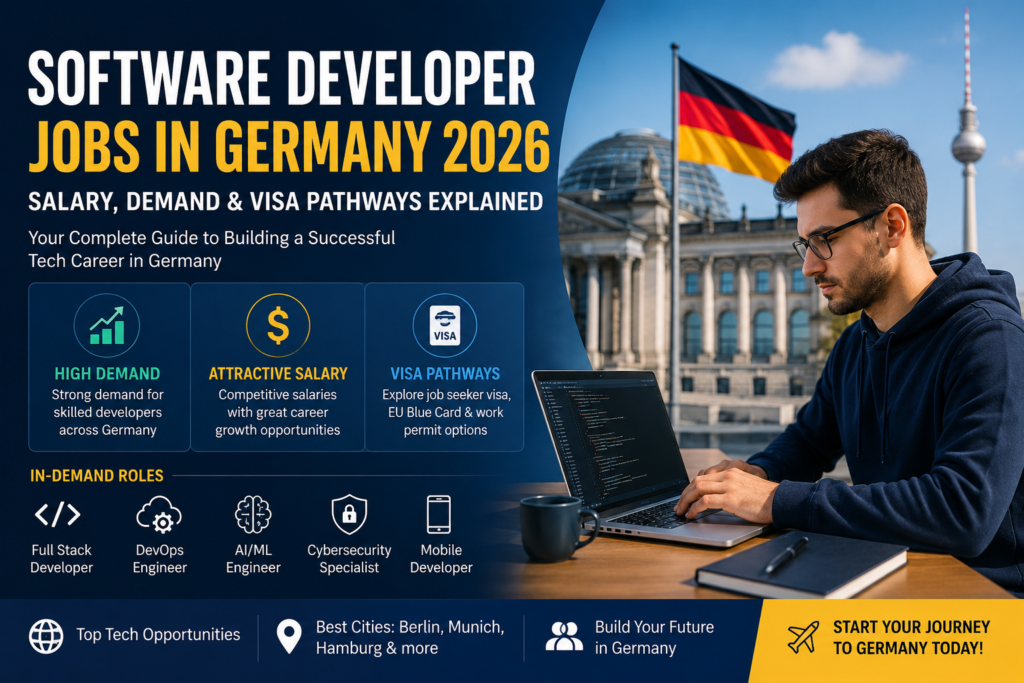
Germany remains one of the world’s strongest economies, but its booming tech industry is facing a major challenge: a growing shortage of skilled software developers. By 2026, the country is expected to face a deficit of more than 150,000 IT professionals, according to Bitkom. This rising demand is creating massive opportunities for international talent seeking Software Developer Jobs in Germany with competitive salaries, relocation support, and visa sponsorship pathways
For skilled international developers, this is a rare opportunity. Germany is actively opening its doors to foreign tech talent through streamlined visas, competitive salaries, and government-backed programs. Whether you are in Lagos, Nairobi, Bangalore, or Manila, software developer jobs in Germany in 2026 are more accessible than ever before.
This guide covers everything you need: which roles are in demand, what salaries to expect, how to apply for a work visa, and practical steps to land your first German tech job.
Why Software Developer Jobs in Germany 2026 are in High Demand
 Several powerful forces are driving demand for software developers across Germany right now.
Rapid Digital Transformation
German industries — from automotive giants like BMW and Volkswagen to healthcare, logistics, and banking — are aggressively modernizing. Legacy systems are being replaced. New digital products are being built. Every sector needs developers to make it happen.
A Booming Startup Ecosystem
Berlin has cemented its place as one of Europe’s top startup cities. Hamburg, Munich, and Frankfurt are also growing fast. Hundreds of funded startups are hiring engineers at every level, often offering remote flexibility and equity packages.
Government Support for Skilled Migration
Germany’s Skilled Immigration Act (Fachkräfteeinwanderungsgesetz), updated in 2023 and further refined in 2025, makes it significantly easier for non-EU tech workers to obtain work permits. The government has also simplified the EU Blue Card salary thresholds specifically for IT roles.
Official Resource
The German government’s official immigration portal for skilled workers is make-it-in-germany.com — an excellent starting point for any foreign developer considering relocation.
High-Demand Software Developer Jobs in Germany 2026
Frontend Developer
Builds user interfaces and client-side experiences for web and mobile applications.
Backend Developer
Handles server logic, databases, APIs, and business rules powering digital products.
Full-Stack Developer
Works across both frontend and backend — one of the most sought-after profiles in German SMEs.
DevOps Engineer
Bridges development and operations — manages CI/CD pipelines, cloud infrastructure, and deployments.
AI / ML Engineer
Designs and deploys machine learning models — in explosive demand as German companies adopt AI tools.
Cybersecurity Specialist
Protects digital infrastructure — increasingly critical as data privacy regulations tighten in the EU.
Software Developer Jobs in Germany 2026 Salary
Germany offers highly competitive salaries — especially in cities like Munich, Berlin, and Frankfurt. Here is a realistic overview of what you can expect:
Experience Level |
Annual Gross Salary |
Monthly (approx.) |
|---|---|---|
| Entry-Level (0–2 years) | €40,000 – €55,000 | €3,333 – €4,583 |
| Mid-Level (3–5 years) | €55,000 – €75,000 | €4,583 – €6,250 |
| Senior Developer (6+ years) | €75,000 – €110,000 | €6,250 – €9,166 |
| AI / ML Engineer (Senior) | €85,000 – €130,000 | €7,083 – €10,833 |
| DevOps / Cloud (Senior) | €80,000 – €115,000 | €6,666 – €9,583 |
Factors That Affects the Salary for Software Developer Jobs in Germany 2026
- Location: Munich and Frankfurt pay more than Berlin, but have higher costs of living
- Company size: Large corporates like SAP, Siemens, and Deutsche Bank often pay more than startups
- Specialization: AI, cloud, and security roles command premiums in 2026
- Language skills: German fluency can add €5,000–€10,000 to your package at some firms
- Remote vs. on-site: Fully remote roles may have slightly adjusted pay scales
Requirements to Work as a Software Developer in Germany 2026
Educational Qualifications for Software Developer Jobs in Germany 2026
Most employers prefer a Bachelor’s degree in Computer Science, Software Engineering, or a related field. However, Germany increasingly accepts equivalent professional qualifications and recognizes self-taught or bootcamp-trained developers — especially when backed by a strong portfolio.
Non-EU applicants typically need to have their foreign qualifications recognized through the anabin database or via the Statement of Comparability issued by the German Zentralstelle für ausländisches Bildungswesen (ZAB).
Technical Skills for Software Developer Jobs in Germany 2026
- Strong command of at least one primary programming language (Python, Java, JavaScript, C++)
- Familiarity with version control systems — primarily Git
- Experience with cloud platforms (AWS, Azure, or GCP) is highly valued
- Understanding of agile/scrum methodologies
- Database knowledge (SQL and NoSQL)
Language Requirements for Software Developer Jobs in Germany 2026
Good news for English speakers: many German tech companies — especially startups and international firms — operate fully in English. You do not need German to start your job search.
That said, learning basic German (B1 level) significantly improves your chances of being hired and helps you integrate into daily life far more easily. Consider it a strategic investment.
Work Experience for Software Developer Jobs in Germany 2026
Entry-level roles typically require 0–2 years of experience or strong internship/project work. Senior positions expect 5+ years of demonstrable experience, ideally with real-world production code on your GitHub or portfolio.
Visa Pathways for Foreign Software Developers
1. EU Blue Card (Most Popular for Developers)
The EU Blue Card is the fastest and most straightforward route for qualified tech professionals. To qualify in 2026:
- You must have a recognized university degree (or equivalent qualification)
- You must have a job offer with a minimum annual gross salary of approximately €45,300 (or ~€41,041 for shortage occupations including IT)
- The employer does not need to prove no EU candidate is available for IT roles
The Blue Card gives you the right to live and work in Germany — and after 21 months (or 33 months without B1 German), you can apply for permanent residence.
2. General Skilled Worker Visa
For developers with recognized vocational qualifications (not just degrees), Germany’s Skilled Worker Visa is an excellent alternative. It covers IT professionals who have completed formal training in software development or related disciplines.
3. Job Seeker Visa
Already qualified but don’t have a job offer yet? Germany’s Job Seeker Visa allows you to enter Germany for up to 6 months to search for work on the ground. You must prove financial self-sufficiency during this period (typically €5,000–€8,000 in your bank account).
How to Apply for Software Developer Jobs in Germany 2026
1 Get Your Qualifications Recognized
Use the anabin database or apply to ZAB for a Statement of Comparability for your degree or certificates.
2 Secure a Job Offer
Apply to German companies. Once you receive a written job offer, you can proceed with your visa application.
3 Book an Appointment at the German Embassy
Apply at your local German consulate or embassy with your documents: passport, degree, job offer letter, CV, and proof of accommodation.
4 Arrive and Register
Once in Germany, register your address at the local Einwohnermeldeamt (registration office) within 14 days of arrival.
5 Apply for EU Blue Card at Local Foreigners’ Office
Visit the Ausländerbehörde in your city to convert your entry visa into a full EU Blue Card residence permit.
How to Find Software Developer Jobs in Germany 2026
Top Job Platforms
Company Career Pages
Many of Germany’s top employers — SAP, Siemens, Bosch, Deutsche Telekom, N26, Zalando, Celonis — post roles directly on their own career pages before listing them elsewhere. Bookmark and check regularly.
Networking
German tech events like TOA Berlin, Munich Startup Festival, and online communities like Dev.to Germany are great places to make connections. A warm referral can significantly improve your chances of getting an interview.
Optimizing Your CV for German Employers
Use a clean, one-to-two page format — German employers value brevity and clarity
- Include a professional photo (standard practice in Germany, unlike some other countries)
- Write a targeted cover letter (Anschreiben) for each application — generic cover letters are noticed and penalized
- List certifications (AWS, GCP, Azure, PMP) prominently
- Include your GitHub profile and portfolio link
Cost of Living vs. Salary: Best Cities for Software Developer Jobs in Germany 2026
Germany’s cities vary significantly in both job opportunities and cost of living. Here is a practical comparison for developers in 2026:
BerlinStartup capital. Huge tech scene. Most international atmosphere. Many English-speaking employers.
Rent: €1,200–€2,000/moAvg Dev Salary: €60,000–€90,000
MunichHighest salaries in Germany. Corporate headquarters. BMW, MAN, Allianz tech hubs. High cost of living.
Rent: €1,800–€3,000/moAvg Dev Salary: €70,000–€110,000
HamburgStrong fintech and logistics tech scene. More affordable than Munich. Excellent quality of life.
Rent: €1,200–€2,200/moAvg Dev Salary: €60,000–€95,000
FrankfurtFinancial technology powerhouse. Major banking IT departments. Well-connected European hub.
Rent: €1,300–€2,400/moAvg Dev Salary: €65,000–€100,000
Other Living Costs to Budget For
- Public transport: €30–€90/month (Deutschlandticket covers all regional trains and city transport)
- Groceries: €200–€400/month for one person
- Health insurance: Mandatory — typically €200–€400/month (often employer-subsidised)
- Internet + phone: €40–€70/month
- Eating out: €10–€20 per meal at a mid-range restaurant
A mid-level developer earning €65,000 gross in Berlin can expect a comfortable lifestyle with approximately €1,000–€1,500 in discretionary savings per month after rent, food, and essentials.
Tips to Increase Your Chances of Getting Hired
- Build a strong, public portfolio. Host your projects on GitHub. Make sure your README files are clear and your code is well-commented. A visible portfolio often matters more than your degree for junior roles.
- Learn basic German — even just A2 level. Even a few phrases show employers you are serious about integrating. Apps like Duolingo, Babbel, or a structured Goethe-Institut course are all good starting points.
- Get cloud or relevant certifications. AWS Certified Developer, Google Associate Cloud Engineer, and Microsoft Azure certifications are immediately recognisable to German recruiters and add tangible value to your CV.
- Tailor every application. Avoid spray-and-pray job applications. Read the job description carefully and tailor your cover letter and CV for each role. German employers notice — and appreciate — this attention.
- Be patient with the process. German hiring can be slower than you are used to — sometimes 4–8 weeks from application to offer. Follow up professionally after two weeks if you have not heard back.
- Prepare for technical interviews. Practice data structures, algorithms, and system design on platforms like LeetCode and HackerRank. Many German tech companies use structured coding assessments.
Frequently Asked Questions for Software Developer Jobs in Germany 2026
Here are answers to the most common questions from foreign developers considering IT jobs in Germany:
Can foreigners get software developer jobs in Germany?
What is the salary of a software developer in Germany in 2026?
Do I need German language skills for IT jobs in Germany?
How long does it take to get a work visa for Germany as a software developer?
Which German companies hire international developers?
Is Germany a good country for software developers in 2026?
Your Next Chapter Starts in Germany
Germany’s demand for software developers is not slowing down. The talent gap is real, the visa pathways are clear, and the salaries are competitive. Whether you are fresh out of university or a seasoned engineer, 2026 is an exceptional year to make your move.
Start by getting your qualifications assessed, building out your portfolio, and targeting roles on platforms like LinkedIn and StepStone. The journey may take some patience — but the destination is worth it.