
INTRODUCTION: Ausbildung Jobs in Germany 2026
Germany faces one of the most severe skilled-worker shortages in its modern history. By 2026, experts estimate over 1.7 million positions will remain unfilled across healthcare, IT, engineering, and the trades. For international job seekers, this is not just a statistic — it is an invitation.
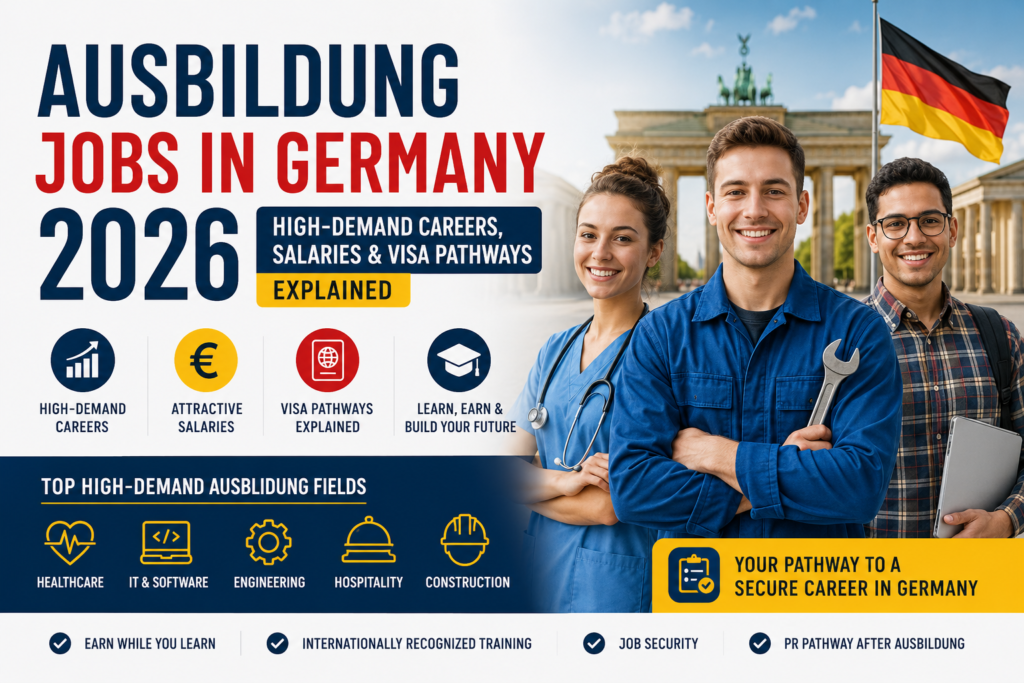
Enter the Ausbildung — Germany’s world-famous dual vocational training system. Recognized globally for producing highly skilled professionals, Ausbildung jobs in Germany 2026 represent one of the most accessible and rewarding pathways for foreigners to build a career, earn a stable income, and eventually call Germany home.
Whether you are from India, Nigeria, the Philippines, or anywhere outside the EU, this guide breaks down everything you need to know: the top in-demand fields, realistic Ausbildung salary Germany figures, the Ausbildung visa Germany process, and how to apply successfully.
“Germany doesn’t just need workers — it needs trained professionals who will stay. Ausbildung is designed to create exactly that.”
— Federal Institute for Vocational Education and Training (BIBB)
Ausbildung Jobs in Germany 2026: What you need to know
The word Ausbildung simply means “training” or “education” in German. But in the context of the German job market, it refers specifically to the dual vocational training system — a structured program where you split your time between a company (practical training) and a vocational school (Berufsschule) for theoretical learning.
How Does the Dual System Work?
Unlike a typical university degree, vocational training Germany style means you are an employee and a student at the same time. You spend roughly 3–4 days per week working at a company and 1–2 days per week at school.
- Duration: Typically 2 to 3.5 years, depending on the profession
- Structure: Alternates between workplace training and vocational school
- Outcome: A nationally recognized German qualification (IHK or HWK certificate)
- Status: You are hired as a trainee (Auszubildender / Azubi) from day one
- Pay: You receive a training allowance (Ausbildungsvergütung) throughout
This Germany work and study model is one of the few in the world where you earn money, gain real work experience, and receive a formal qualification — all at the same time. For foreigners, it also opens the door to long-term residency.
Top High-Demand Ausbildung Jobs in Germany 2026

Germany’s labor market shortage is concentrated in specific sectors. These are the fields where employers are actively recruiting international trainees through Ausbildung jobs in Germany 2026:
Healthcare & Nursing
Pflegefachmann/frau (Nurse), Medical Assistant, Elder Care Worker. Germany’s aging population drives explosive demand. Over 200,000 positions unfilled in 2025 alone.
CRITICAL SHORTAGE
IT & Digitalization
IT Specialist (Fachinformatiker), IT System Electronics Technician. Every industry is digitalizing — demand far outpaces supply, especially in cybersecurity and cloud.
HIGH GROWTH
Engineering & Mechatronics
Mechatronics Technician, Industrial Mechanic, Electronics Technician. Germany’s industrial backbone needs technically skilled workers at every level.
STABLE DEMAND
Construction & Trades
Electrician, Plumber, Carpenter, Painter. Infrastructure investment is booming. Trades workers are urgently needed across all 16 federal states.
URGENT NEED
Hospitality & Tourism
Hotel Specialist, Restaurant Professional, Event Manager. Post-pandemic recovery and strong domestic tourism continue to drive hiring in this sector.
GROWING
Automotive & Logistics
Automotive Mechatronics Technician, Warehouse Logistics Specialist. Germany’s auto industry and e-commerce boom create steady Ausbildung openings.
Salary Expectations for Ausbildung Jobs in Germany 2026
see also: IT Technician Jobs in Germany 2026: High Demand, Salaries & Visa Opportunities Explained
Nursing Jobs in Germany 2026: High Demand, Salaries & Visa Opportunities Explained
One of the biggest questions for international applicants is: Can I actually live on an Ausbildung salary in Germany? The short answer is yes — especially outside major cities like Munich or Frankfurt.
Since 2020, Germany has a minimum training allowance guaranteed by law (Mindestausbildungsvergütung). In 2026, this floor has increased significantly. Here is a realistic overview of Ausbildung salary Germany figures:
Sector |
Year 1 Allowance |
Year 2–3 Allowance |
Post-Ausbildung Salary |
|---|---|---|---|
| Healthcare / Nursing | €1,190 – €1,300 | €1,250 – €1,400 | €2,400 – €3,200/mo |
| IT / Fachinformatiker | €800 – €1,100 | €950 – €1,200 | €3,000 – €4,500/mo |
| Mechatronics / Engineering | €750 – €1,050 | €900 – €1,100 | €2,800 – €3,800/mo |
| Construction / Trades | €700 – €950 | €800 – €1,050 | €2,500 – €3,400/mo |
| Hospitality | €620 – €850 | €700 – €950 | €2,000 – €2,800/mo |
| Logistics / Automotive | €700 – €1,000 | €850 – €1,100 | €2,400 – €3,200/mo |
Note: Allowances vary by employer, region (West Germany typically pays more), and sector collective agreements (Tarifvertrag). Larger companies such as Siemens, BMW, or Charité Hospital often pay above the sector average.
Requirements for International Applicants
Germany welcomes international candidates for vocational training Germany programs, but you will need to meet specific requirements. Here is what employers and immigration authorities look for:
Educational Qualifications for Ausbildung Jobs in Germany 2026
- A completed secondary school certificate (equivalent to German Mittlere Reife or Abitur)
- Proof that your qualification is recognized in Germany (use the Anabin database to check)
- For healthcare roles: additional subject-specific prerequisites may apply
German Language Requirements
This is the most important factor. Most Ausbildung programs in Germany require at least B1 level German. However:
- A2–B1: Minimum for some hospitality or trade roles
- B1–B2: Required for IT, engineering, healthcare
- B2–C1: Strongly recommended for nursing (direct patient communication)
- Accepted certificates: Goethe-Institut, TestDaF, telc, ÖSD
Age & Other Considerations
- No official maximum age limit — adults successfully complete Ausbildung programs
- Most trainees are between 16 and 35 years old
- Soft skills valued highly: reliability, punctuality, team spirit, willingness to learn
- A valid passport and clean criminal record are required for the visa process
Ausbildung Jobs in Germany 2026: Step-by-Step Visa Pathway
Non-EU citizens need a specific Ausbildung visa Germany to begin their training. The good news: Germany has a dedicated visa category for this purpose under Section 16a of the German Residence Act (AufenthG).
Required Documents for Ausbildung Jobs in Germany 2026
- Valid passport (minimum 6 months validity beyond training end date)
- Signed Ausbildungsvertrag (training contract) from a German employer
- Proof of German language skills (Goethe-Institut or equivalent certificate)
- Recognized educational qualification / school leaving certificate
- Biometric passport photos (35×45mm)
- Completed visa application form (from German embassy website)
- Proof of accommodation in Germany
- Health insurance coverage confirmation
- Visa application fee: €75
Application Process for Ausbildung Jobs in Germany 2026
Secure Your Ausbildung Placement First
You cannot apply for the visa without a signed training contract (Ausbildungsvertrag). Find and apply for a position before approaching the embassy.
Book an Appointment at the German Embassy
Contact the German embassy or consulate in your home country. Appointment wait times vary — book as early as possible (sometimes 3–6 months in advance).
Submit Your Application
Attend your appointment with all required documents. The consular officer may ask questions about your training and language skills. Be prepared and confident.
Wait for Processing
Processing typically takes 4–12 weeks. Some embassies (especially in India and African countries) may take longer. Apply well in advance of your training start date.
Arrive and Register in Germany
Once in Germany, register at the local Einwohnermeldeamt (residents’ registration office) within 2 weeks. Then apply for your residence permit at the Ausländerbehörde.
How to Apply for Ausbildung Jobs in Germany 2026
Where to Find Openings
- Bundesagentur für Arbeit (JOBBÖRSE): arbeitsagentur.de — Germany’s official job agency, free to use
- Make it in Germany: make-it-in-germany.com — government portal specifically for international applicants
- Make it in Germany — Official Federal Government Portal for Skilled Workers
- BIBB (Federal Institute for Vocational Education and Training) — Ausbildung statistics and research
- Bundesagentur für Arbeit — Official German Job Agency (JOBBÖRSE)
- BAMF (Federal Office for Migration and Refugees) — Visa and residency regulations
- Aufenthaltsgesetz §16a — Legal basis for Ausbildung visa
- Federal Employment Agency Germany (Bundesagentur für Arbeit)
https://www.arbeitsagentur.de/en/jobboard/training-placements - Make it in Germany (Official German Government Portal)
https://www.make-it-in-germany.com/en/study-training/training-in-germany - Germany Apprenticeship Information Portal
https://www.arbeitsagentur.de/int/en/training-in-germany - Official German Job Search Portal Germany Job Search Portal
- DeinAzubi International Platform DeinAzubi
- Ausbildung in Germany Free Application Platform Ausbildung in Germany
- IHK Apprenticeship Portal Germany https://www.meine-ausbildung-in-deutschland.de/
- Ausbildung.de Germany Ausbildung.de
- Azubiyo Apprenticeship Portal Azubiyo
- StepStone Germany Ausbildung Jobs StepStone Germany
Application Tips for Ausbildung Jobs in Germany 2026
- Write your CV (Lebenslauf) in German, in the European Europass format
- Include a professional photo on your CV — this is standard in Germany
- Your cover letter (Anschreiben) should be tailored to each employer and explain your motivation clearly
- Mention your language certificates and any relevant work or school experience
- Apply 6–12 months before the intended start date (most Ausbildung programs begin in September)
- Prepare for a practical aptitude test (Eignungstest) and an interview — often conducted in German
Benefits vs. Challenges for Ausbildung Jobs in Germany 2026
Benefits
- Earn a salary from day one of training
- Nationally recognized, portable qualification
- Strong job security and career progression
- Pathway to permanent residency (Niederlassungserlaubnis)
- Access to Germany’s world-class social benefits
- Learn German professionally — a lifelong asset
- Employers often convert Azubis into full employees
Challenges
- German language requirement is a real barrier
- Cultural adjustment takes time and effort
- Training allowance may feel low in expensive cities
- Recognition of foreign qualifications can be slow
- Embassy appointment wait times can be frustrating
- Vocational school coursework is conducted in German
Your Ausbildung Jobs in Germany 2026 Next Step Starts Today
Germany’s Ausbildung jobs in 2026 represent one of the most genuine and structured pathways for international job seekers to build a European career from the ground up. Unlike speculative job hunting, vocational training Germany gives you an employer, a salary, a qualification, and a legal residency pathway — all bundled into one program.
The competition is real, and the language requirement is non-negotiable. However, for those willing to invest in their German language skills and start their applications early, the reward is a stable, respected career in one of the world’s strongest economies.
The best time to start was yesterday. The second-best time is right now.
Ready to Begin Your Ausbildung Jobs in Germany 2026 Journey?
Follow these practical first steps to get started on your path to jobs in Germany for foreigners through the Ausbildung system.
- Start B1 German Now
- Search on Make-it-in-Germany.com
- Get Your Qualifications Recognized
- Apply 6–9 Months Early
- Book Embassy Appointment