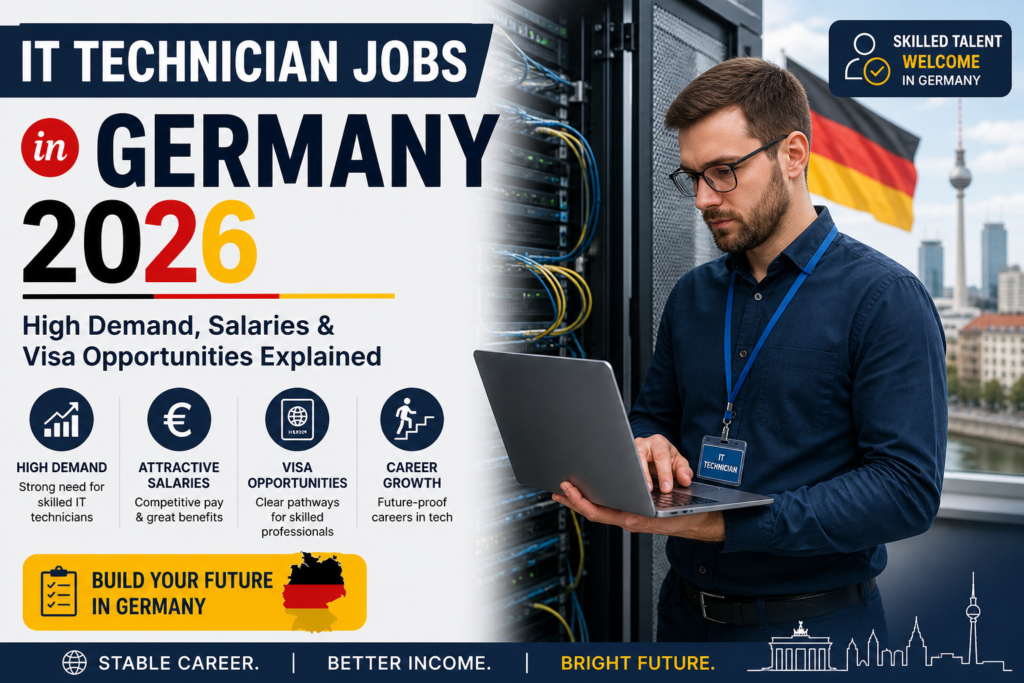

Introduction: IT Technician Jobs in Germany 2026
For international job seekers with IT skills, this is not just good news — it is a rare window of opportunity. Germany has also recently reformed its immigration laws, introducing the Opportunity Card (Chancenkarte) and lowering salary thresholds for the EU Blue Card in shortage occupations. In 2026, the doors to IT technician jobs in Germany are wider open than ever before.
This guide covers everything you need to know: job types, salary expectations, visa routes, job search tools, and practical tips to boost your chances of landing a role.
Why IT Technician Jobs in Germany 2026 Are in High Demand

Germany’s IT sector is booming — even as the wider economy grows modestly. Three powerful forces are driving demand for skilled IT workers right now.
1. Digital Transformation Across Every Industry
German companies — from global giants like Siemens and SAP to thousands of mid-sized firms (the Mittelstand) — are investing heavily in digital infrastructure. Cloud adoption, AI integration, and cybersecurity upgrades all require capable IT professionals on the ground.
2. Ageing Workforce and Demographic Pressure
Germany’s population is ageing fast. Fewer young workers are entering the labor market each year, which means more vacancies go unfilled. The government has responded by actively recruiting skilled workers from abroad, making immigration rules more flexible than ever.
3. Industry 4.0 and Smart Manufacturing
Germany’s manufacturing sector is undergoing a digital revolution. Factories, automotive plants, and logistics hubs are installing connected systems, automated processes, and smart sensors — all of which require IT support, systems administration, and network technicians to maintain them.
Together, these trends mean that IT jobs in Germany for foreigners are not just available — they are actively promoted. Government platforms like Make-it-in-Germany even help international candidates navigate the process step by step.
Types of Available IT Technician Jobs in Germany 2026
see also: Nursing in Australia: Demand, Opportunities & Migration Pathways in 2026
Caregiver Jobs in Germany 2026: High Demand, Salaries & Visa Opportunities
Germany recognizes a broad range of IT roles under its skilled immigration framework. Here are the most in-demand positions for IT technicians jobs in Germany 2026.
IT Support Specialist
Resolves technical issues for end-users, manages helpdesk tickets, and supports software/hardware problems. A great entry point for international candidates.
€32,000 – €50,000/yr
Network Technician
Installs, configures, and maintains network infrastructure including routers, switches, and firewalls across corporate environments.
€36,000 – €55,000/yr
System Administrator
Manages servers, user accounts, backups, and internal IT systems. High demand across SMEs and large enterprises alike.
€40,000 – €62,000/yr
Help Desk Technician
First line of IT support for employees or customers. Requires strong communication skills and solid technical troubleshooting ability.
€28,000 – €44,000/yr
Hardware / Field Service Technician
Installs, repairs, and services hardware on-site at client locations. Growing demand as Industry 4.0 equipment requires ongoing maintenance.
€30,000 – €48,000/yr
IT Security Technician
Monitors systems for threats, manages firewalls, and ensures data compliance. Cybersecurity roles are among the fastest-growing in Germany.
€42,000 – €65,000/yr
Salary Expectations for IT Technicians Jobs in Germany 2026
One of the biggest draws of IT technician jobs in Germany 2026 is the pay. Salaries are well above the European average, and they come with generous social benefits like health insurance, pension contributions, and paid leave.
| Experience Level | Monthly (Gross) | Annual (Gross) | Typical Role |
|---|---|---|---|
| Entry-Level (0–2 years) | €2,300 – €3,000 | €28,000 – €36,000 | Help Desk, IT Support |
| Mid-Level (2–5 years) | €3,200 – €4,500 | €38,000 – €54,000 | Network Tech, SysAdmin |
| Experienced (5+ years) | €4,500 – €6,000+ | €54,000 – €72,000 | Senior SysAdmin, IT Security |
Keep in mind that location plays a big role in salary. Munich, Frankfurt, and Hamburg typically offer higher pay, while cities like Leipzig or Dresden may offer lower salaries but significantly lower costs of living.
Key Insight IT Technician Jobs in Germany 2026
The EU Blue Card minimum threshold for IT shortage occupations in 2026 is €45,934.20 gross per year. If you earn above this amount, you qualify — a milestone many mid-level IT technicians can reach.
Skills and Qualifications Required for IT Technician Jobs in Germany 2026
To compete successfully for IT technician jobs in Germany for foreigners, you need a combination of technical skills, recognized certifications, and language ability.
Technical Skills
- Hardware installation, maintenance, and repair
- Networking fundamentals (TCP/IP, DNS, DHCP, VPN)
- Operating systems: Windows Server, Linux, macOS
- Troubleshooting and root cause analysis
- Basic cybersecurity knowledge and best practices
- Cloud platforms (Microsoft Azure, AWS basics)
Valued Certifications
- CompTIA A+ — widely recognized for IT support roles
- CompTIA Network+ — essential for network technicians
- Microsoft Certified: Azure Fundamentals
- Cisco CCNA — for networking-focused positions
- ITIL Foundation — valued by service-desk employers
Language Requirements
English is widely used in multinational tech companies. However, most IT technician roles — especially those involving on-site support, SME environments, or customer interaction — require at least German A2 to B1 level. The higher your German proficiency, the better your employment prospects and salary negotiation power.
Visa and Immigration Pathways for IT Technicians
Germany has built one of the most accessible immigration systems for skilled workers in Europe. Here are the main Germany work visa options for IT technicians in 2026:
EU Blue Card
For university graduates with a job offer. Minimum salary: €45,934/year for shortage occupations. Fastest route to permanent residency (21–33 months).
Skilled Worker Visa
For those with a recognized vocational qualification. Even without a degree, 3+ years of IT experience may qualify you. Valid up to 4 years, renewable.
Opportunity Card (Chancenkarte)
Points-based job-seeking visa. You can enter Germany and search for work in person. Ideal if you’re confident and have financial reserves for 6+ months.
Job Seeker Visa
Allows you to enter Germany for up to 6 months to find employment. Best for candidates with strong German skills and existing savings.
An important step for non-EU applicants is credential recognition (Anerkennung). Your foreign diploma or certificate must be verified as equivalent to a German qualification. This process is handled by bodies like IHK FOSA or ZAB, and typically takes 2–6 months. Start early.
How to Apply for IT Technician Jobs in Germany 2026
Where to Search for Jobs
- https://www.linkedin.com
- https://www.make-it-in-germany.com
- https://www.stepstone.de
- https://www.xing.com
- https://de.indeed.com
- https://www.arbeitsagentur.de
CV Tips for IT Technician Jobs in Germany 2026
German employers expect a specific CV format. Follow these guidelines closely:
- Include a professional headshot (standard in Germany)
- Keep the CV to 1–2 pages maximum
- List work experience in reverse chronological order
- Include date of birth and nationality (common practice in Germany)
- Attach certified copies of your qualifications
Cover Letter Matters
Unlike many countries, Germany takes cover letters seriously. Write a personalized Anschreiben (cover letter) for every application. Explain why you want to work for that specific company and how your skills address their needs. Keep it professional, specific, and no longer than one page.
Cost of Living vs. Salary: What You Actually Keep
Understanding your IT technician salary Germany in real terms means looking at take-home pay versus living costs. After taxes and social contributions, expect to take home roughly 55–65% of your gross salary.
| City | Avg. Monthly Rent (1-bed) | Monthly Living Cost | Cost Level |
|---|---|---|---|
| Munich | €1,500 – €2,000 | €2,200 – €2,800 | Very High |
| Frankfurt | €1,300 – €1,800 | €2,000 – €2,500 | High |
| Berlin | €1,100 – €1,600 | €1,800 – €2,300 | High |
| Hamburg | €1,200 – €1,700 | €1,900 – €2,400 | High |
| Leipzig / Dresden | €700 – €1,100 | €1,400 – €1,800 | Affordable |
| Nuremberg / Dortmund | €800 – €1,200 | €1,500 – €1,900 | Moderate |
Cities like Leipzig, Dortmund, and Nuremberg are worth considering. Salaries are slightly lower there, but so are expenses — meaning your real purchasing power can actually be higher than in Munich or Frankfurt.
Tips to Increase Your Chances of Getting Hired
- Learn German (A2–B1 minimum). Even basic German dramatically increases your job options and salary negotiation leverage. Apps like Duolingo, Babbel, or a language school are solid starting points.
- Get internationally recognized certifications. CompTIA A+, Network+, and Microsoft Azure certifications signal competence to German employers and set you apart from other applicants.
- Start the credential recognition process early. Apply for Anerkennung as soon as possible. It takes time, and you cannot get a work visa without it.
- Tailor every application. Generic CVs rarely work in Germany. Research the company, reference specific projects or needs, and match your skills to the job description precisely.
- Use the Germany Opportunity Card strategically. If you qualify, come in person. In-person networking and trial work dramatically increase your chances of being hired.
- Build an online presence. A complete LinkedIn profile with relevant skills and endorsements helps recruiters find you directly.
Ready to Start Your IT Career in Germany?
Don’t wait. Begin your credential recognition, polish your German, and start applying today. The 137,000 open IT positions won’t stay vacant forever.
Conclusion: Your Path Starts Now
Germany’s demand for IT technicians is real, urgent, and not going away anytime soon. Demographic shifts, digital transformation, and progressive immigration policies have aligned to create one of the best opportunities in years for skilled professionals from non-EU countries.
Whether you are an IT support specialist in Nigeria, a network technician in India, or a hardware engineer in the Philippines — IT technician jobs in Germany 2026 are genuinely within reach. The key is to prepare strategically: get certified, learn basic German, start your credential recognition early, and apply consistently on the right platforms.
Your next career move could take you to the heart of Europe. Start planning today.