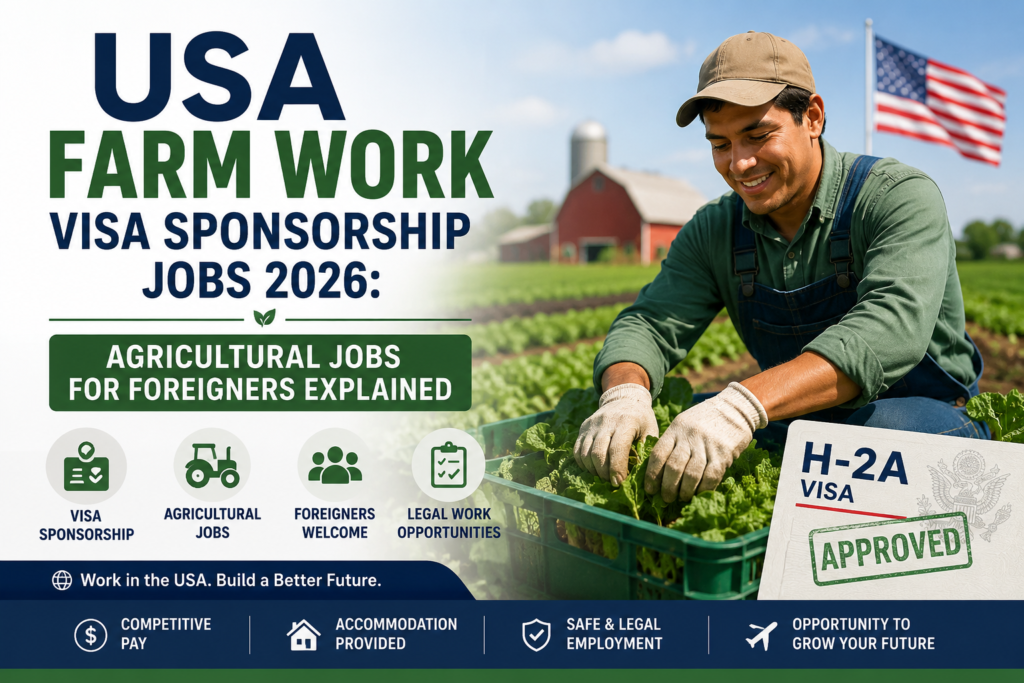

USA farm work is one of the most in-demand opportunities for foreign workers seeking legal agricultural jobs in the United States. In 2026, as American growers continue to face persistent labor shortages across dozens of states, the federal government’s H-2A visa program remains the primary and most reliable legal pathway for international workers to join the U.S. agricultural workforce.
If you are a foreign worker wondering how to access farm jobs in the USA with visa sponsorship, this guide breaks down everything you need to know: who qualifies, what the application process looks like, what you can expect to earn, and where to apply — using only official government resources.
Quick Context
The H-2A Temporary Agricultural Worker Program allows U.S. agricultural employers to bring foreign nationals to the United States to fill temporary or seasonal agricultural jobs. Importantly, the employer — not the worker — initiates the sponsorship process. Your job is to find a certified employer and respond to their offer.
USA Farm Work Overview for Foreign Workers

When people hear “USA farm work,” they sometimes imagine one narrow type of job: picking fruit in the summer heat. The reality is much broader. American agriculture is a vast industry, and the types of roles available under seasonal visa sponsorship span a wide range of physical tasks and crop types.
Here is what seasonal farm work in the USA typically includes for foreign workers entering on H-2A visas:
- Crop harvesting — fruits, vegetables, grains, and specialty crops by hand or with equipment
- Livestock handling — feeding, herding, milking operations, and animal care on ranches and dairy farms
- Packing and processing — sorting, grading, packaging produce for distribution
- Planting and irrigation — transplanting seedlings, operating irrigation systems, applying fertilizers
- Orchard and vineyard work — pruning, thinning, tying, and harvesting tree fruits and grapes
The program is open to workers from many nationalities. Historically, the largest sending countries have included Mexico, South Africa, Jamaica, Guatemala, and the Philippines — but workers from dozens of countries participate each year. There is no professional degree or specialized credential required. What employers look for is physical fitness, reliability, and a willingness to live and work in rural areas on a seasonal schedule.
This accessibility makes H-2A agricultural jobs genuinely entry-level in the best sense: the barrier to entry is work ethic, not academic background.
USA Farm Work Requirements and Eligibility
See also: South Korea Farm Jobs for Foreigners 2026: A Practical Guide for African Applicants
Morocco Farm Work Jobs in 2026: Agricultural Employment Opportunities for Foreigners
Basic Eligibility Criteria for USA Farm Work
The H-2A visa is designed for temporary agricultural labor, and the eligibility requirements reflect that. You do not need a college degree or professional certification to apply. What you do need is the ability to perform the physical demands of farm labor and meet basic immigration admissibility standards.
Core eligibility criteria include:
Eligibility Checklist
- You are a citizen of a country eligible to participate in the H-2A program (most countries qualify; Cuba, North Korea, and a handful of others are excluded)
- You have a valid job offer from a U.S. employer certified by the Department of Labor
- You are physically capable of performing the agricultural tasks described in the job order
- You intend to return home after the temporary work period ends
- You have no disqualifying criminal history or prior immigration violations
- You can demonstrate ties to your home country (property, family, community) as evidence of return intent
No advanced education is required. Many participants in the H-2A program have completed only secondary school. What matters most to U.S. agricultural employers is availability, physical capability, and the documentation to enter the country legally. Prior farm experience is a plus but rarely a strict requirement — most employers provide on-site training.
Visa Sponsorship and the H-2A Process for USA Farm Work
Understanding how visa sponsorship actually works is important before you begin. The H-2A program is employer-driven. That means a U.S. agricultural employer must first obtain government approval to hire foreign workers before any individual applicant can receive a visa.
Here is how the system works in practice:
- The employer applies to the Department of Labor (DOL) and must demonstrate that no qualified U.S. workers are available for the positions. This “labor market test” is a federal requirement.
- The DOL issues a certification, and the employer then files a petition (Form I-129) with U.S. Citizenship and Immigration Services (USCIS).
- Once USCIS approves the petition, the employer offers positions to foreign workers — often working through recruiting agents in the workers’ home countries.
- The worker applies for an H-2A visa at a U.S. Embassy or Consulate in their home country, attends an interview, and — if approved — travels to the United States for the work period.
H-2A visas are temporary. They are issued for the duration of the specific job contract, typically one agricultural season (a few months up to one year), and can be extended up to three consecutive years before requiring the worker to return home for an uninterrupted period.
USA Farm Work Application Process Explained
Step-by-Step Guide to Applying for USA Farm Work Visa Sponsorship
The most important thing to understand about applying for farm jobs in the USA with visa sponsorship is that your journey begins with finding the right employer — not with filling out a visa application. The visa follows the job offer, not the other way around.
Find a DOL-approved U.S. agricultural employer
Use the official Seasonal Jobs portal at seasonaljobs.dol.gov to browse active H-2A job listings. These are real, certified positions with verified employers. You can filter by crop type, state, and job start date.
Review the job order carefully
Each job listing includes the job order document, which outlines wages, housing arrangements, work location, duration, and duties. Read this thoroughly before accepting anything. The employer is legally bound to the terms stated in the job order.
Receive and accept the job offer
The employer — or their authorized recruiter — will contact selected candidates with a formal job offer. Be cautious of intermediaries who charge recruitment fees, as this is a known area for exploitation. Legitimate H-2A recruitment should not require upfront payment from workers.
Employer files the USCIS petition (Form I-129)
Once you have accepted the offer, the employer handles the government filing steps — submitting DOL certification and the I-129 petition to USCIS. You do not pay for or submit this petition yourself.
Apply for your H-2A visa at a U.S. Embassy or Consulate
After USCIS approves the petition, you will apply for the H-2A nonimmigrant visa at your nearest U.S. Embassy or Consulate using Form DS-160. You will attend a visa interview, present your job offer and supporting documents, and pay the visa application fee.
Travel to the United States and begin work
Upon visa approval, you will travel to the U.S. and report to the employer’s farm or operation by the agreed start date. The employer is required by law to provide or arrange housing, often at no cost or at a regulated rate.
Worker Protection Note
Beware of fraudulent recruiters who promise guaranteed U.S. farm jobs in exchange for large upfront fees. Legitimate H-2A sponsors are not permitted to charge workers recruitment costs that would reduce their wages below the legal minimum. If someone is asking for $1,000–$3,000 upfront to “guarantee” placement, treat that as a serious red flag.
USA Farm Work Salary, AEWR, and Earnings in 2026
One of the most practical questions any international worker will ask is: how much does USA farm work actually pay? The answer involves a federal wage standard called the Adverse Effect Wage Rate (AEWR) — and understanding it will help you know exactly what you are legally entitled to earn.
What Is AEWR and Why Does It Matter?
The AEWR is the minimum wage that employers must pay H-2A workers in each U.S. state. It is set annually by the U.S. Department of Labor based on the average hourly wages for field and livestock workers in each state, as reported by the USDA’s Farm Labor Survey. The purpose is twofold: to prevent employers from undercutting wages for U.S. farm workers by hiring cheaper foreign labor, and to ensure that H-2A workers themselves receive fair pay.
In practical terms, this means your wage is legally protected and varies depending on which state you work in. Higher-wage agricultural states in the Pacific Northwest and Northeast tend to have higher AEWRs than states in the South or Great Plains.
Region / State Group |
Approx. 2026 AEWR Range |
Common Crops / Roles |
|---|---|---|
| Pacific Northwest Washington, Oregon, Idaho |
$19.50–$21.00/hr | Apples, cherries, hops, wine grapes |
| Northeast Massachusetts, Vermont, New York |
$18.50–$20.50/hr | Dairy, apples, blueberries, vegetables |
| Midwest Michigan, Wisconsin, Minnesota |
$17.00–$18.50/hr | Cherries, blueberries, sugar beets |
| Southeast Georgia, Florida, North Carolina |
$14.50–$16.50/hr | Tobacco, sweet potatoes, peaches, citrus |
| Southwest California, Arizona, New Mexico |
$17.50–$19.00/hr | Lettuce, strawberries, peppers, citrus |
*AEWR figures are approximate ranges based on 2025 DOL data. Exact 2026 rates are published annually by the Department of Labor. Always verify current rates at dol.gov.
Seasonal Earning Potential Beyond the Base Wage
Beyond the base AEWR, seasonal farm work in the USA offers several additional earnings factors that can significantly increase your take-home pay over a contract period:
Earnings Boosters to Know
- Overtime pay: Hours beyond 40 per week are subject to overtime in most states — often 1.5× the base rate
- Employer-provided housing: Most H-2A employers are required to provide free or low-cost housing, which dramatically increases your effective take-home
- Travel reimbursement: Employers must reimburse travel costs from your home country once you complete 50% of the contract
Piece-rate bonuses: Some operations pay per-unit (e.g., per bin of apples) in addition to or instead of hourly rates — skilled, fast workers can out-earn the AEWR floor significantly
A worker on a 6–8 month seasonal contract in a medium-AEWR state, with housing provided and normal seasonal overtime, can realistically take home between $12,000 and $22,000 USD over the course of a single contract — numbers that carry significant purchasing power when converted to many home-country currencies.
Official Websites to Apply for USA Farm Work Jobs 2026
This is perhaps the most important section of this guide. When searching for H-2A agricultural jobs, the safest and most reliable route is always through official U.S. government portals. Fraudulent job listings and fake recruiters are real risks in international labor markets — going directly to government sources protects you.
Here are the four official resources you should bookmark:
Seasonal Jobs — U.S. Department of Labor
The primary federal job board for H-2A agricultural positions.
You can:
- Browse certified farm employers
- Filter by state, crop type, and season
- View full job orders (wages, housing, work conditions included)
H-2A Temporary Agricultural Workers — USCIS
USCIS H-2A Program Information
Official immigration authority page explaining:
- How H-2A petitions are filed
- Employer responsibilities
- Worker rights and protections
- Program rules (the legal backbone of everything)
Temporary Worker Visas — U.S. Department of State
U.S. Temporary Worker Visa Process
This is your embassy-side playbook, covering:
- DS-160 visa application form
- Interview scheduling
- Embassy/consular requirements
- Visa approval workflow
🇺🇸 USA Jobs Portal — USA.gov
A broader federal gateway into:
- Government-recognized employment pathways
- Labor and job assistance resources
- Related official U.S. work programs
Reality Check
The safest path into U.S. farm work sponsorship is simple: DOL certification → verified employer → USCIS process → State Department visa system.
Benefits and Challenges of USA Farm Work Opportunities
Before you apply, it is worth taking an honest look at both sides of this opportunity. USA farm work under the H-2A program offers real financial and legal benefits — but it is also physically demanding, geographically remote, and structurally temporary. Going in with clear expectations leads to better outcomes.
Benefits
- Legal U.S. employment status with full worker protections under federal law
- Employer-provided housing — often free or at minimal cost — dramatically reduces living expenses
- Legally protected wages under AEWR — you cannot be paid below the state minimum
- Travel cost reimbursement after completing 50% of the contract
- Real work experience on U.S. agricultural operations for your CV
- Renewable contracts — many workers return for multiple seasons with the same employer
Challenges
- Physically demanding work — long hours, outdoor conditions, and repetitive labor
- Rural and remote locations — often far from cities, entertainment, or community networks
- Visa is tied to the specific employer — changing jobs mid-contract requires legal steps
- Seasonal nature means income is not year-round; financial planning matters
- Language barrier can be isolating in areas without multilingual support
- Recruiting fraud risk — fake employers and fee-charging agents do exist
None of the challenges above are reasons to avoid the program — they are reasons to prepare well. Workers who research their employer, read the job order carefully, and understand their legal rights consistently report the H-2A experience as positive and financially worthwhile.
Final Thoughts: Is USA Farm Work Right for You?
The H-2A visa program is one of the most transparent and legally structured agricultural employment pathways available to international workers anywhere in the world. Every aspect — wages, housing, travel, and contract terms — is regulated and documented. That matters.
If you are physically capable, prepared for seasonal rural life, and willing to engage with the process through legitimate government channels, USA farm work with visa sponsorship can offer meaningful income, valuable experience, and a legal, dignified path to working in the United States.
Start with the official resources. Read every job order before signing. Use seasonaljobs.dol.gov as your primary search tool. And if a recruiter is asking for large upfront fees, walk away — they are not part of the legitimate system.
This article is for informational purposes only and does not constitute legal immigration advice. Always verify current visa requirements and wage rates through official U.S. government sources.