
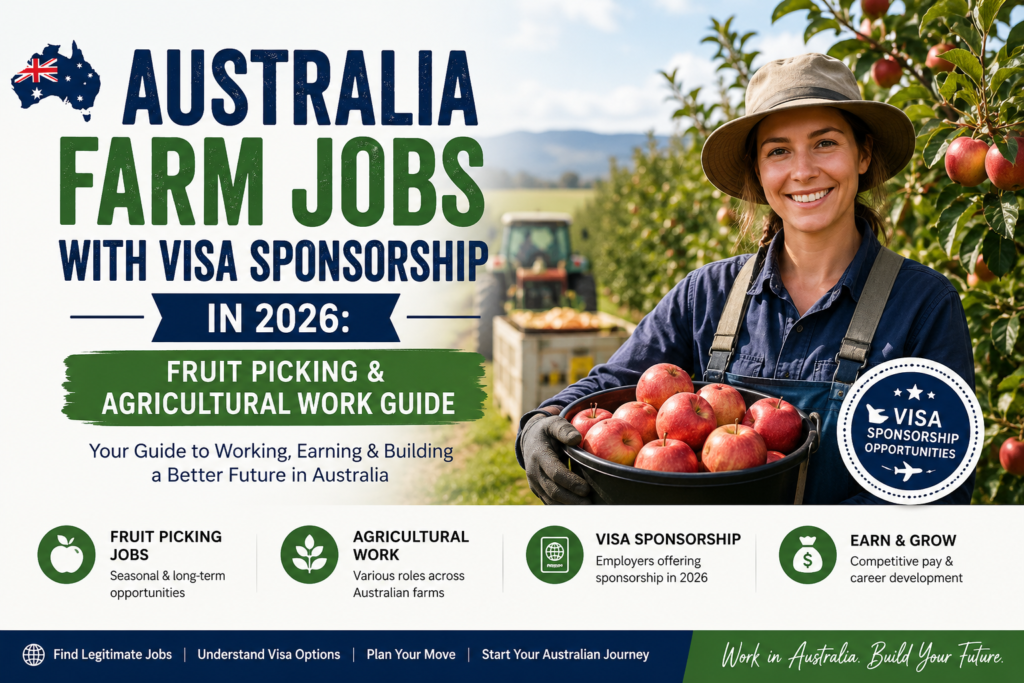

Whether you want to spend a season picking mangoes in Queensland, working a vineyard in Victoria, or getting your hands into dairy farming in Tasmania, the demand is real — and so are the wages. Casual farm workers under the Horticulture Award are earning AUD $24–$28+ per hour as a baseline, with experienced machinery operators and supervisors earning considerably more.
This guide covers everything you need: which visa to use, where to apply (safely), what each state offers, and exactly how to land a job without falling for scams. Let’s get into it.
Australia Farm Jobs With Visa Sponsorship in 2026

Australia’s agricultural sector produces over AUD $70 billion in output annually — but it consistently runs short of hands to do the work. The 2026 labor market across rural and regional Australia remains tight, driven by a combination of population drift toward cities, an ageing domestic workforce, and post-pandemic bottlenecks in migration pipelines that are only now beginning to ease.
The result: Australian employers in horticulture, viticulture, dairy, and livestock farming are more willing than ever to sponsor overseas workers. The government has actively expanded regional employer-sponsored pathways and extended the second and third Working Holiday Visa year eligibility — precisely to funnel international labor toward areas where domestic supply falls short.
For foreign workers, this creates a genuine window. You do not need to be a specialist or a skilled tradesperson to get started. Entry-level farm work in Australia is genuinely within reach for anyone physically fit, motivated, and holding the right visa.
Types of Australia Farm Jobs Available
See also: Farm Work Jobs in Germany 2026 With Visa Sponsorship
Top Farm Work Jobs in Canada for Foreigners in 2026: Visa Sponsorship & How to Apply
Farm work in Australia covers a wider range of roles than most people expect. Here is a breakdown of the most common positions available to foreign workers in 2026.
Fruit Picking & Packing
Harvest apples, mangoes, strawberries, grapes, and stone fruit by hand. Packing shed roles involve sorting, grading, and boxing produce for distribution.
Dairy Farming
Milking, feeding, herd monitoring, and shed maintenance. Tasmania and Victoria have particularly strong demand for dairy farmhands year-round.
Poultry Farming
Feeding, monitoring flock health, egg collection, and biosecurity duties. Work is typically indoor and physically demanding but consistent year-round.
Vegetable Harvesting
Hand-picking or machine-assisting in the harvest of onions, potatoes, leafy greens, and legumes. Queensland and WA have active vegetable operations.
Vineyard & Viticulture
Vine pruning, bunch thinning, harvest picking, and general vineyard maintenance. South Australia and Victoria are the key regions for wine-region work.
Livestock Farming
Mustering, feeding, drafting, and general care of cattle, sheep, and pigs. Remote station work often includes accommodation as part of the package.
A Note on Piece-Rate vs. Hourly Pay
Some fruit picking roles are advertised on a piece-rate basis — meaning you’re paid per bin, box, or kilogram picked rather than by the hour. Under the Fair Work Act, piece-rate arrangements must guarantee at least the applicable Award minimum hourly rate. Confirm this in writing before accepting any offer.
Visa Sponsorship Requirements for Australia Farm Jobs
Getting a visa is the single most critical step, and the pathway you use depends heavily on your nationality, skills, and how long you plan to stay. The three main routes into farm work in Australia are outlined below.
Working Holiday Visa — Subclass 417 & 462
This is the most popular entry point for international farm workers, particularly those aged 18–35 (up to 30 for some nationalities on the subclass 462). Citizens of eligible countries — including the UK, Germany, Canada, South Korea, Japan, France, and many others — can apply for a 12-month Working Holiday Visa, which allows unrestricted work with any employer.
Critically, completing 88 days of specified regional work (which includes farm and agricultural work) qualifies you for a second-year extension. A third year is available upon completing 179 days. This regional work incentive is specifically designed to funnel Working Holiday makers toward rural farm employers — and it works well for both parties.
Temporary Skill Shortage Visa — Subclass 482
For workers with demonstrated skills in agricultural machinery operation, farm management, or related technical roles, the TSS 482 visa offers a pathway to work up to four years with a sponsoring employer. Your occupation must appear on the relevant skilled occupations list, and the employer must be an approved sponsor. English proficiency at an IELTS band 5.0 or equivalent is typically required.
Temporary Work (Short Stay Specialist) — Subclass 400
This visa is less common in standard farm contexts but is used for highly specialized short-term agricultural roles — for example, a specialist aquaculture technician or advanced viticulture consultant engaged for a specific project. It is issued for up to three months and is employer-specific, not transferable.
General Eligibility Criteria
Across all pathways, expect to meet the following baseline requirements: a valid passport from an eligible country, a satisfactory health examination (chest X-ray for TB screening in many cases), a police clearance certificate, and proof of basic English capability where applicable. No prior farm experience is required for entry-level Working Holiday roles, but it strengthens your application significantly.
For the full list of eligible nationalities and official visa conditions, consult the Australian Department of Home Affairs directly.
Average Salary for Australia Farm Jobs in 2026
Wages in Australian agricultural jobs are regulated by two key instruments: the Horticulture Award (MA000028) and the Pastoral Award (MA000044), both of which set legally enforceable minimums. The following figures reflect current award rates and typical market ranges for 2026.
| Role / Level | Employment Type | Hourly Rate (AUD) | Est. Weekly (AUD) |
|---|---|---|---|
| Entry-level fruit picker / packer | Casual (seasonal) | $24.00–$26.50 | $960–$1,200 |
| General farm hand (livestock/dairy) | Casual / Permanent PT | $25.00–$28.00 | $1,000–$1,260 |
| Agricultural machinery operator | Casual / Full-time | $28.00–$34.00 | $1,120–$1,530 |
| Vineyard / viticulture worker | Seasonal / Casual | $26.00–$30.00 | $1,040–$1,350 |
| Farm supervisor / team leader | Full-time | $34.00–$45.00+ | $1,360–$1,800+ |
All casual workers in Australia receive a 25% casual loading on top of base rates to compensate for the absence of paid leave entitlements. Overtime (beyond 38 hours per week) attracts penalty rates of 150–200% depending on the award and day of the week. Public holiday work attracts a 250% rate under most awards.
A seasonal fruit picker completing a full 10-week harvest can realistically save AUD $8,000–$12,000 after covering basic regional living expenses — a figure that changes lives for workers from lower-income economies.
For verified, up-to-date award rates, check the Fair Work Commission’s Pay and Conditions Tool.
Best Australian States for Farm Work
Not all states have the same opportunities, and timing matters enormously. Here is a practical breakdown of what each major agricultural state offers international workers in 2026.
Queensland
The country’s largest fruit and vegetable producer. Key crops include mangoes, bananas, tomatoes, capsicums, and melons. Regions like the Atherton Tablelands, Bundaberg, and Bowen are perennial hotspots for farm workers.
Victoria
Stone fruit, apples, pears, and wine grapes dominate the Goulburn Valley and Mildura regions. Victoria also has significant dairy and livestock operations. The harvest rush runs through late summer into early autumn.
Western Australia
The South West and Carnarvon regions offer citrus, vegetables, and berry harvests. The distances involved are significant — plan logistics carefully. WA has some of the strongest demand for farm workers outside Queensland.
Tasmania
Known for apples, cherries, berries, and cool-climate wines. Tasmania also has a strong year-round dairy industry. Workers cite high savings potential due to lower living costs compared to mainland cities.
New South Wales
The Hunter Valley for viticulture, Orange for stone fruit, and the Murray–Darling basin for broad-acre crops. NSW offers a wide range of farm types, from small family orchards to large corporate agribusinesses.
Verified Websites to Apply for Australia Farm Jobs
Only use platforms you can independently verify. The following are legitimate, actively maintained job portals for agricultural work in Australia in 2026.
- Workforce Australia — workforceaustralia.gov.au
The official Australian Government employment services platform. Includes a dedicated regional and harvest job board, employer-verified listings, and information on visa-eligible positions. The most authoritative starting point for any serious applicant.
- SEEK — seek.com.au
Australia’s largest job board, with thousands of agricultural listings ranging from casual harvest work to full-time farm management. Filter by location, pay type, and “visa sponsorship” to narrow results.
- Indeed Australia — au.indeed.com
Indeed aggregates listings from employer websites and other boards, giving you broad coverage. Use keywords like “fruit picking visa sponsorship,” “farm hand casual,” or “agricultural worker regional.”
- Backpacker Job Board — backpackerjobboard.com.au
A niche platform specifically serving Working Holiday Visa holders seeking regional work. Strong for fruit picking, 88-day qualifying work, and farm stays. Community reviews help identify legitimate employers.
How to Apply for Australia Farm Jobs Successfully
The application process for farm work in Australia is relatively straightforward — but small details matter. Here is a step-by-step approach that actually works.
Format Your Resume for the Australian Market
Keep it to one or two pages. Include a brief personal statement at the top that specifically mentions your visa type and its validity. Australian employers want to know immediately whether you’re legally cleared to work. List physical fitness, any machinery licences (forklift, tractor), and previous outdoor or manual labor experience prominently.
Apply During the Off-Season
Seasonal employers begin shortlisting candidates weeks or even months before the harvest begins. Applying late in peak season often means the positions are already filled. Research the peak dates for your target region and submit applications at least six to eight weeks ahead.
Prepare for Remote or Video Interviews
Most farm employers will not fly candidates in for interviews. Expect a 15–30 minute video call. Emphasize reliability, your willingness to work in all weather, and any experience with physical, team-based roles. Have your passport and visa grant letter ready to share on screen.
Confirm the Visa Sponsorship Process With Your Employer
If you are applying for a Subclass 482 role, the employer must be a registered sponsor with the Department of Home Affairs before they can lodge a nomination on your behalf. Ask to see their sponsorship approval number if it is not already documented in the job listing.
Arrange Accommodation Before You Arrive
Regional towns near farm work areas often have very limited accommodation. Many larger farm employers offer on-site accommodation — sometimes subsidized, sometimes deducted from wages. Confirm the terms in writing. If accommodation is not provided, research caravan parks, farm worker hostels, and shared houses in the region before you commit.
Benefits of Australia Farm Jobs
The appeal of farm work in Australia goes well beyond just the pay. For international workers, this type of employment can genuinely reshape your financial and professional position.
Challenges of Farm Work in Australia
An honest guide has to address the hard parts too. Farm work in Australia is not for everyone, and going in with clear expectations makes the difference between a rewarding experience and a difficult one.
Final Thoughts on Australia Farm Jobs in 2026
The opportunity here is real, but timing and preparation are everything. Australia farm jobs remain one of the few genuine pathways where an international worker — regardless of formal qualifications — can enter a high-wage country, earn strong wages, accumulate substantial savings, and simultaneously extend their visa eligibility through verified regional work.
Apply early. The best farms fill their seasonal rosters well before harvest begins, and late applications often end up on waiting lists. Stick exclusively to the verified platforms listed in this guide, verify employer sponsorship credentials directly through the Department of Home Affairs, and never pay a fee to secure a placement.
If you approach Australian agricultural jobs with realistic expectations, the right visa in hand, and a willingness to put in the physical work, the return — financial and otherwise — can be genuinely transformative. The harvest is waiting. Start your application process now.
Frequently Asked Questions About Australia Farm Jobs
Can I get an Australia farm job with no prior experience?
Yes. Most entry-level fruit picking and vegetable harvesting roles require no formal experience. Employers value physical fitness, reliability, and a willingness to work outdoors in varying weather. A Working Holiday Visa (subclass 417 or 462) is the most accessible entry route for first-timers.
Does the employer pay for my flights to Australia?
Generally, no. Most farm employers do not cover international airfares. Some larger agribusinesses may offer relocation assistance within Australia — for example, transport from a major city to a regional farm — but workers are typically responsible for their own travel to the country.
What is the minimum wage for farm work in Australia in 2026?
Under the Horticulture and Pastoral Awards, casual entry-level workers earn approximately AUD $24–$28+ per hour, with penalty rates applying for overtime, weekends, and public holidays. Piece-rate arrangements must meet minimum hourly guarantees under Fair Work regulations.
Is it safe to apply for Australia farm jobs through third-party agents?
Use caution. Only apply through verified platforms such as Workforce Australia, SEEK, Indeed, or directly with registered employers. Never pay upfront fees to recruiters or agents. Legitimate employers do not charge workers for job placement. Report suspicious offers to Scamwatch Australia.