
Engineering Jobs in Germany 2026: A Golden Window for Foreign Talent
Engineering Jobs in Germany 2026 are experiencing massive growth as the country faces one of the most significant engineering talent shortages in its modern history. In 2026, over 130,000 engineering positions remain unfilled across the country, and that number is expected to rise sharply over the next decade. For skilled engineers from abroad, this creates a rare and powerful career opportunity.
Germany’s industrial backbone — from automotive giants like BMW and Volkswagen to renewable energy pioneers and cutting-edge AI startups — runs on engineering talent. Therefore, the demand for qualified engineers is not slowing down anytime soon.
Whether you are a mechanical engineer in Nigeria, an electrical engineer in India, or a software engineer in the Philippines, engineering jobs in Germany 2026 are genuinely within your reach. This guide breaks down everything you need to know — from the top roles in demand to visa pathways, salary expectations, and practical steps to land your first German engineering job.
Why Engineering Jobs in Germany 2026 Are So Sought-After
Germany is the largest economy in Europe and the fourth-largest in the world. Consequently, its appetite for technical expertise is enormous. However, three structural forces are making the engineering talent gap especially acute right now.
An Ageing Workforce
Germany’s population is ageing rapidly. Thousands of experienced engineers retire every year, and there are simply not enough domestic graduates to replace them. As a result, employers are actively looking overseas for qualified talent.
Industrial Transformation
Germany is in the middle of a major industrial transformation known as Industrie 4.0. Factories are becoming smarter, cars are going electric, and cities are being redesigned around sustainable energy. Each of these shifts demands fresh waves of engineering expertise.
Government Support for Foreign Workers
Germany’s government has significantly liberalised its immigration laws since the Skilled Immigration Act (Fachkräfteeinwanderungsgesetz) was expanded in 2023 and 2024. Today, it is easier than ever for non-EU engineers to obtain a German work visa. Additionally, the government actively promotes immigration through the official Make it in Germany portal.
“Germany does not just need engineers — it urgently needs engineers. The gap between talent supply and industrial demand is growing wider every year, and international applicants stand to benefit enormously.”
Top In-Demand Engineering Jobs in Germany 2026

Not all engineering disciplines are equal in Germany’s job market. Below are the fields hiring most aggressively in 2026, along with a snapshot of what each role involves and why demand is so high.
Mechanical Engineers Engineering Jobs in Germany 2026
Very High Demand
Mechanical engineers are the backbone of German manufacturing. They design machinery, production systems, and industrial components. Automotive, aerospace, and heavy industry sectors are all hiring aggressively. Experience with CAD software (e.g., CATIA, SolidWorks) is a major advantage.
Electrical Engineers Engineering Jobs in Germany 2026
Very High Demand
Germany’s push toward renewable energy — particularly wind, solar, and hydrogen — is fuelling enormous demand for electrical engineers. Power systems, embedded systems, and smart grid expertise are especially sought after in 2026.
Civil Engineers Engineering Jobs in Germany 2026
High Demand
Germany’s ageing infrastructure requires continuous renewal. Civil engineers are needed for road, rail, and bridge projects, as well as large-scale urban development. Knowledge of German building codes (DIN standards) is a bonus but not always mandatory for entry-level roles.
Software & IT Engineers Engineering Jobs in Germany 2026
Very High Demand
Software engineers remain among the most in-demand professionals in Germany. Embedded software, cloud architecture, cybersecurity, and AI/ML engineers are particularly sought. Many tech roles are fully English-speaking, making them ideal for international applicants.
Automotive Engineers Engineering Jobs in Germany 2026
Very High Demand
Germany is home to the world’s most iconic car brands. In 2026, the entire automotive sector is racing to master electric vehicle (EV) technology and autonomous driving systems. Engineers with experience in battery management, power electronics, or ADAS software are in extremely high demand.
Environmental Engineers Engineering Jobs in Germany 2026
High Demand
Germany’s Green Deal commitments and aggressive climate targets are creating growing demand for environmental and energy engineers. Roles in sustainability consulting, waste management, and green building design are expanding rapidly across both the public and private sectors.
Salary Expectations for Engineering Jobs in Germany 2026
see also: Caregiver Jobs in Germany 2026: High Demand, Salaries & Visa Opportunities
Ausbildung Jobs in Germany 2026: High-Demand Careers, Salaries & Visa Pathways Explained
Germany offers highly competitive salaries for engineers. Furthermore, the country’s social benefits — including public healthcare, generous pension contributions, and paid parental leave — add significant value on top of the base pay.
Engineering Field |
Entry-Level (0–3 yrs) |
Mid-Level (3–8 yrs) |
Senior (8+ yrs) |
|---|---|---|---|
| Mechanical Engineering | €50,000–€58,000 | €62,000–€78,000 | €82,000–€105,000 |
| Electrical Engineering | €52,000–€60,000 | €65,000–€82,000 | €85,000–€110,000 |
| Software / IT Engineering | €55,000–€70,000 | €75,000–€95,000 | €100,000–€130,000 |
| Civil Engineering | €46,000–€56,000 | €58,000–€72,000 | €75,000–€95,000 |
| Automotive Engineering | €55,000–€65,000 | €68,000–€88,000 | €90,000–€120,000 |
| Environmental Engineering | €44,000–€54,000 | €56,000–€70,000 | €72,000–€90,000 |
Key salary factors: Location plays a big role. Munich, Frankfurt, and Stuttgart consistently pay 15–25% above the national average. Conversely, cities in the former East Germany, such as Leipzig and Dresden, may offer lower salaries but with a significantly lower cost of living. Specialization in high-demand areas (e.g., EV battery systems, AI engineering) can also push salaries well above these ranges.
Engineering Jobs in Germany 2026: What You Need
Degree Recognition
Germany does not automatically recognise foreign engineering degrees. You will typically need to have your qualifications assessed and recognised by the relevant German authority. The process is handled through Anerkennung in Deutschland, and processing times vary by country and discipline.
Importantly, for many engineering roles in the private sector, employers may accept your foreign degree without formal recognition — especially in software and IT engineering. However, for regulated professions such as civil engineering, official recognition is usually mandatory.
Certifications and Skills
- Relevant engineering degree (Bachelor’s minimum; Master’s preferred for senior roles)
- Professional certifications (e.g., PMP, Six Sigma, AWS/Azure for software engineers)
- Proficiency with industry-standard software (CATIA, AutoCAD, MATLAB, SAP)
- Knowledge of German or international standards (DIN, ISO, VDE)
Language Requirements
This is where many applicants get confused. In reality, language requirements depend heavily on the role and employer. Software and IT engineering jobs at international tech companies are often fully in English. However, roles at mid-sized German manufacturers (Mittelstand companies) typically require at least conversational German (B1–B2 level).
Investing in German language learning — even to a basic conversational level — dramatically increases your job prospects and is strongly recommended regardless of your target role.
Engineering Jobs in Germany 2026: Your Complete Pathway Guide
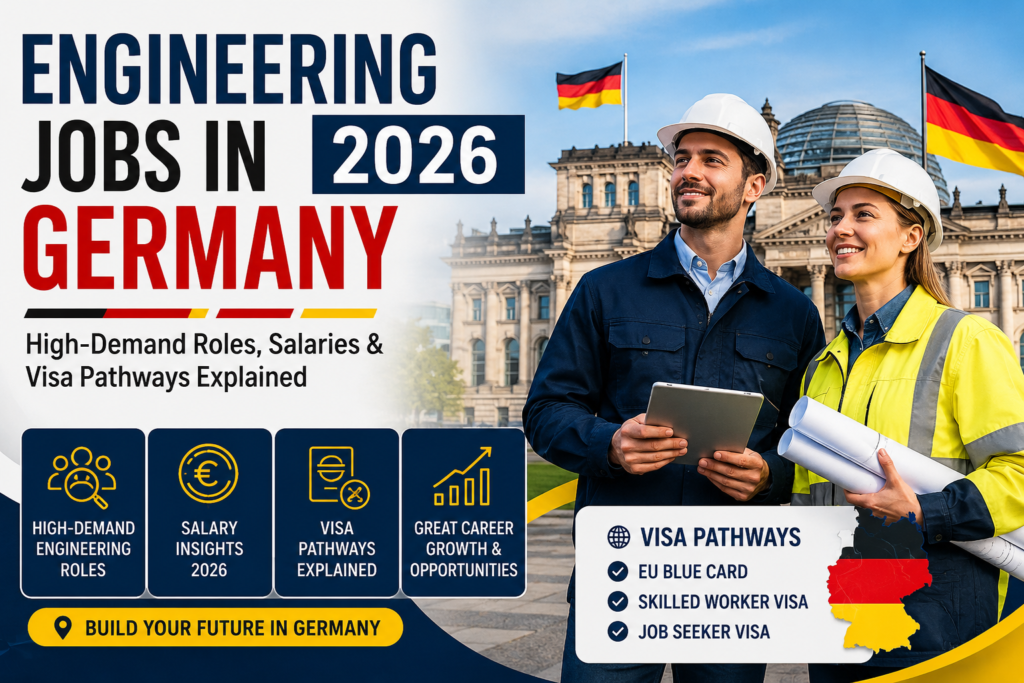
Germany offers several visa pathways for skilled engineers from outside the EU. Choosing the right one depends on your qualifications, salary level, and whether you already have a job offer. Here is a clear breakdown of the three most relevant options.
EU Blue Card
- For non-EU university graduates
- Requires a recognised degree + job offer
- Minimum salary threshold: ~€45,300/year (STEM fields often lower)
- Leads to permanent residence in 21–33 months
- Allows family reunification
- Best for: mid-to-senior engineers with a concrete offer
Skilled Worker Visa
- Requires recognised vocational or university qualification
- No minimum salary threshold (unlike Blue Card)
- Valid for the duration of employment
- Can be converted to EU Blue Card after starting work
- Applicable to all engineering fields
- Best for: engineers with solid qualifications and a job offer
Job Seeker Visa
- Allows you to travel to Germany to look for work
- Valid for up to 6 months
- Requires proof of qualifications + financial means (~€5,000+)
- No work permitted during job search period
- Can be converted to a work visa once you secure a job
- Best for: engineers who want to interview in person
Since the 2024 expansion of Germany’s Skilled Immigration Act, qualification recognition requirements have been relaxed for many STEM fields — making it easier than ever to qualify for a German work visa as a foreign engineer.
How to Get Engineering Jobs in Germany 2026 from Abroad
Securing a job from outside Germany requires a strategic, step-by-step approach. Fortunately, the process is far more straightforward today than it was five years ago, particularly with the growth of remote-first hiring at German tech companies.
- Start on the Right Job Portals: Use Make it in Germany (official government portal), LinkedIn, StepStone, XING (very popular in Germany), and Indeed Germany. Set up job alerts for your exact engineering specialisation.
- Format Your CV the German Way: A German CV (Lebenslauf) is structured differently from a British or American résumé. It includes a professional photo, date of birth, nationality, a detailed chronological work history, and copies of certificates. Keep it to 2 pages maximum. Use clean, professional formatting — no graphics or infographics.
- Write a Targeted Motivationsschreiben: A cover letter (Motivationsschreiben) is essential in Germany. Unlike a generic letter, it should specifically explain why you want to work for that particular company and how your skills match the role. Keep it to one page.
- Get Your Qualifications Assessed Early: Begin the degree recognition process as early as possible, since it can take 3–6 months. Use the anabin database to check if your institution and degree are already listed.
- Network Actively on LinkedIn and XING: Many German engineering jobs are filled through networks before they are even advertised. Connect with German recruiters, join engineering groups, and engage with content from target companies. A polite, direct connection request with a short message works well in Germany’s professional culture.
- Apply Consistently and Tailor Every Application: Quality beats quantity in the German job market. Rather than sending 100 generic applications, send 20 highly tailored ones. German HR managers are known for their attention to detail and will notice when an application feels copy-pasted.
Engineering Jobs in Germany 2026: Challenges Foreign Engineers May Face
While the opportunities are real, it is equally important to be honest about the hurdles. Understanding these challenges in advance helps you prepare effectively and avoid common pitfalls.
Language Barrier
Even for English-friendly roles, day-to-day workplace communication, bureaucracy, and social integration are much easier with at least basic German. Start learning early — apps like Duolingo, Babbel, or structured Goethe Institut courses are all good starting points. Aim for B1 level before you arrive.
Qualification Recognition Delays
The recognition process can be slow and complex, especially for engineers from countries with less-documented education systems. Apply well in advance (ideally 6–12 months before your target start date), and use the official Anerkennung in Deutschland helpline to get guidance specific to your country and field.
Cultural Workplace Adaptation
German workplace culture values punctuality, directness, precision, and a clear separation between professional and personal relationships. Be prepared for a more formal and structured work environment than you may be used to. Investing time in understanding German professional etiquette will set you apart from other international candidates.
Tips to Increase Your Chances of Landing Engineering Jobs in Germany 22026
Practical Tips for Success
- Learn German to at least A2–B1 level before applying — it signals genuine commitment
- Tailor every CV and cover letter to the specific company and job description
- Include a professional headshot on your German CV (this is standard practice)
- Get your degree pre-assessed before applying to save time in later stages
- Apply for roles in cities with lower competition: Nuremberg, Dresden, and Hamburg are often overlooked
- Target German Mittelstand companies (mid-sized exporters) — they hire globally and are often less competitive than DAX giants
- Follow up after applications — a polite email 1–2 weeks after submission is normal and appreciated
- Be patient: German hiring processes are thorough and often take 6–12 weeks from application to offer
Engineering Jobs in Germany 2026: Your Moment to Act Is Now
Germany’s engineering talent shortage is not going away anytime soon — and that is excellent news for qualified engineers worldwide. In 2026, the combination of Germany’s modernised immigration laws, aggressive industrial transformation, and strong salary packages makes this one of the best countries in the world for an international engineering career.
The path from application to employment is clearer than ever before. Therefore, whether you apply for the EU Blue Card, the Skilled Worker Visa, or use the Job Seeker Visa to explore opportunities in person, Germany genuinely wants you. The door is open. You simply need to walk through it with the right preparation.
Start by assessing your qualifications, polishing your German-style CV, practising your language skills, and targeting the right job portals. Above all, be consistent and patient. Thousands of international engineers have successfully built rewarding careers in Germany — and there is no reason you cannot be next.
Engineering jobs in Germany 2026 represent one of the most compelling career opportunities on the global stage. The country needs you, the system supports you, and the rewards are well worth the effort.
Frequently Asked Questions for Engineering Jobs in Germany 2026
Can I get an engineering job in Germany without speaking German?
Yes — especially in software engineering and IT, where many companies operate entirely in English. However, learning basic German (A2–B1) significantly improves your chances across all engineering fields and is essential for daily life and workplace integration outside major tech hubs.
How long does it take to get a Germany work visa for engineers?
Processing times vary by country and visa type. Generally, the EU Blue Card and Skilled Worker Visa take 4–12 weeks after submitting a complete application at a German consulate. Degree recognition (handled separately) can take an additional 3–6 months, so start this process early.
Is it hard to find in-demand engineering jobs in Germany as a foreigner?
It is genuinely becoming easier. Germany is actively recruiting foreign engineers and has simplified its immigration laws for this purpose. The main challenges are degree recognition and language. With a recognised degree, a tailored application, and some German language skills, your chances are strong — particularly in mechanical, electrical, and software engineering.
Do I need a job offer before moving to Germany as an engineer?
Not necessarily. The Job Seeker Visa lets you enter Germany for up to 6 months to search for work without an offer. However, if you already have an offer, the EU Blue Card or Skilled Worker Visa is the faster, more stable route.
What is the best city in Germany for engineering jobs in 2026?
Munich leads for automotive and aerospace engineering. Stuttgart and Wolfsburg are also automotive powerhouses. Berlin and Hamburg dominate software and tech. Frankfurt is strong for engineering consultancy and fintech infrastructure roles. Each city has distinct strengths, so target the city that aligns with your engineering specialisation.
Ready to Start Your German Engineering Career?
Thousands of engineering positions are waiting to be filled right now. Begin your journey today — assess your qualifications, build your German CV, and apply with confidence.